Department of Molecular Pharmacology, University of Groningen, Groningen, Netherlands.
Respir Res. 2010 Dec 3;11(1):170. doi: 10.1186/1465-9921-11-170.
Fibroproliferative airway remodelling, including increased airway smooth muscle (ASM) mass and contractility, contributes to airway hyperresponsiveness in asthma. In vitro studies have shown that maturation of ASM cells to a (hyper)contractile phenotype is dependent on laminin, which can be inhibited by the laminin-competing peptide Tyr-Ile-Gly-Ser-Arg (YIGSR). The role of laminins in ASM remodelling in chronic asthma in vivo, however, has not yet been established.
Using an established guinea pig model of allergic asthma, we investigated the effects of topical treatment of the airways with YIGSR on features of airway remodelling induced by repeated allergen challenge, including ASM hyperplasia and hypercontractility, inflammation and fibrosis. Human ASM cells were used to investigate the direct effects of YIGSR on ASM proliferation in vitro.
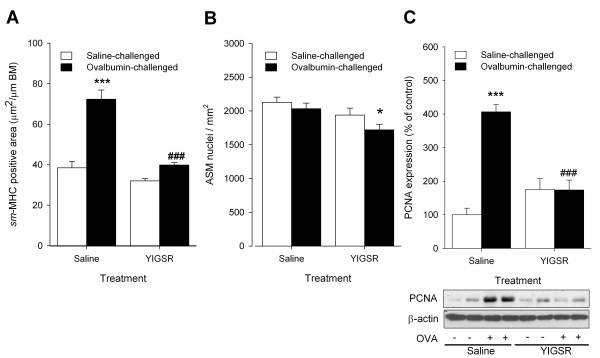
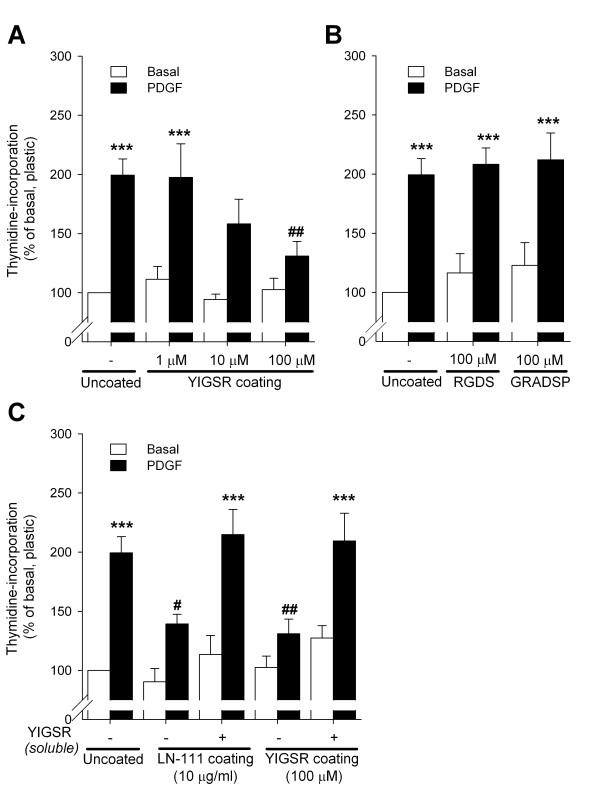
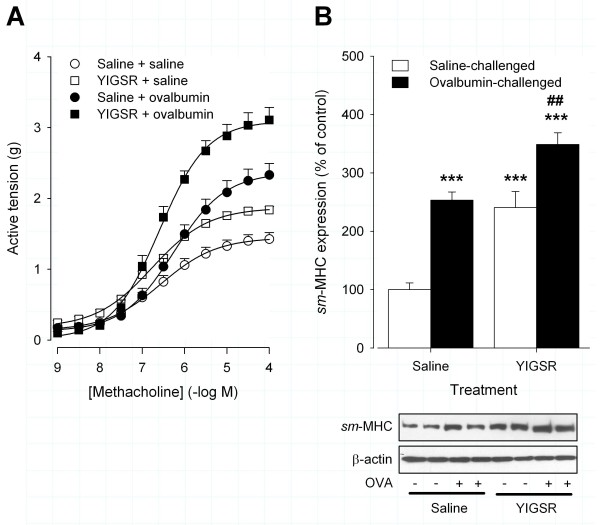
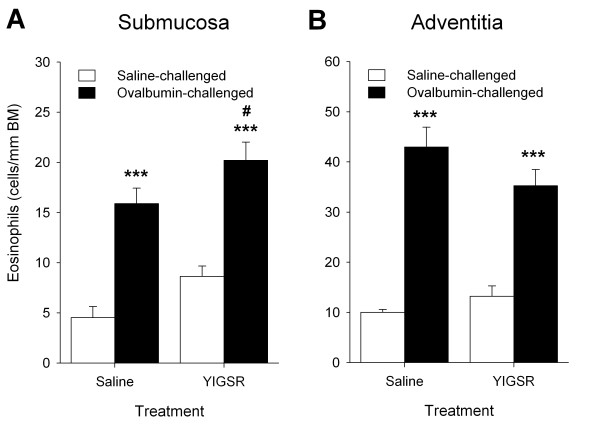
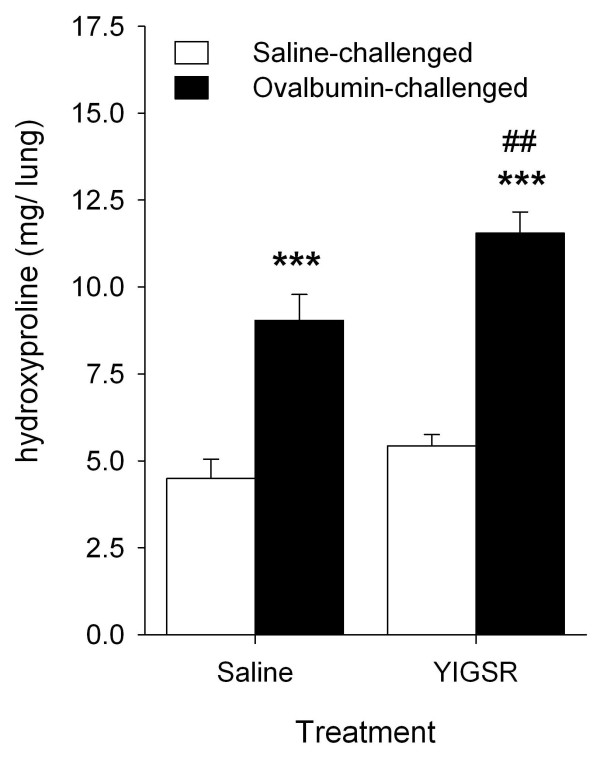
Topical administration of YIGSR attenuated allergen-induced ASM hyperplasia and pulmonary expression of the proliferative marker proliferating cell nuclear antigen (PCNA). Treatment with YIGSR also increased both the expression of sm-MHC and ASM contractility in saline- and allergen-challenged animals; this suggests that treatment with the laminin-competing peptide YIGSR mimics rather than inhibits laminin function in vivo. In addition, treatment with YIGSR increased allergen-induced fibrosis and submucosal eosinophilia. Immobilized YIGSR concentration-dependently reduced PDGF-induced proliferation of cultured ASM to a similar extent as laminin-coated culture plates. Notably, the effects of both immobilized YIGSR and laminin were antagonized by soluble YIGSR.
These results indicate that the laminin-competing peptide YIGSR promotes a contractile, hypoproliferative ASM phenotype in vivo, an effect that appears to be linked to the microenvironment in which the cells are exposed to the peptide.
纤维增生性气道重塑,包括气道平滑肌(ASM)质量和收缩性增加,导致哮喘的气道高反应性。体外研究表明,ASM 细胞向(高)收缩表型的成熟依赖于层粘连蛋白,层粘连蛋白可被层粘连蛋白竞争肽 Tyr-Ile-Gly-Ser-Arg(YIGSR)抑制。然而,层粘连蛋白在慢性哮喘中对 ASM 重塑的作用尚未确定。
我们使用已建立的豚鼠变应性哮喘模型,研究了气道局部应用 YIGSR 对反复变应原刺激引起的气道重塑特征的影响,包括 ASM 增生和高收缩性、炎症和纤维化。我们使用人 ASM 细胞研究了 YIGSR 对体外 ASM 增殖的直接作用。
YIGSR 局部给药可减弱变应原诱导的 ASM 增生和肺增殖核抗原(PCNA)的表达。YIGSR 治疗还增加了盐水和变应原刺激动物的 sm-MHC 和 ASM 收缩性的表达;这表明,在体内,用层粘连蛋白竞争肽 YIGSR 处理模拟而非抑制层粘连蛋白的功能。此外,YIGSR 治疗增加了变应原诱导的纤维化和粘膜下嗜酸性粒细胞增多。固定化 YIGSR 浓度依赖性地降低了培养的 ASM 对 PDGF 诱导的增殖,其程度与包被层粘连蛋白的培养板相似。值得注意的是,固定化 YIGSR 和层粘连蛋白的作用都被可溶性 YIGSR 拮抗。
这些结果表明,层粘连蛋白竞争肽 YIGSR 促进了体内收缩性、低增殖性 ASM 表型,这一效应似乎与细胞暴露于肽的微环境有关。