Manchester Interdisciplinary Biocentre, Faculty of Life Sciences, University of Manchester, 131 Princess Street, Manchester M1 7DN, UK.
Malar J. 2010 Dec 3;9:351. doi: 10.1186/1475-2875-9-351.
The folate pathway enzyme serine hydroxymethyltransferase (SHMT) converts serine to glycine and 5,10-methylenetetrahydrofolate and is essential for the acquisition of one-carbon units for subsequent transfer reactions. 5,10-methylenetetrahydrofolate is used by thymidylate synthase to convert dUMP to dTMP for DNA synthesis. In Plasmodium falciparum an enzymatically functional SHMT (PfSHMTc) and a related, apparently inactive isoform (PfSHMTm) are found, encoded by different genes. Here, patterns of localization of the two isoforms during the parasite erythrocytic cycle are investigated.
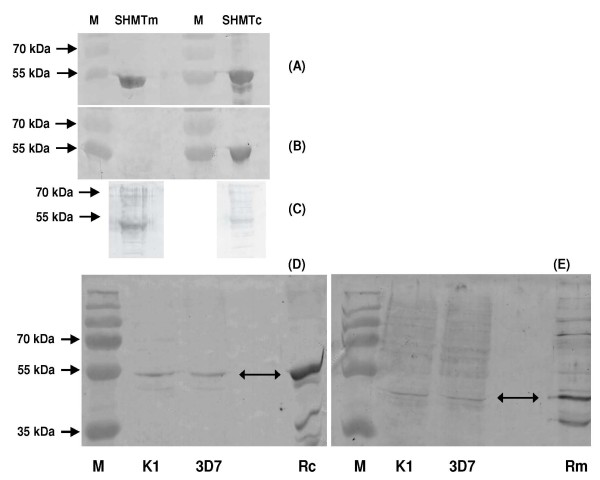
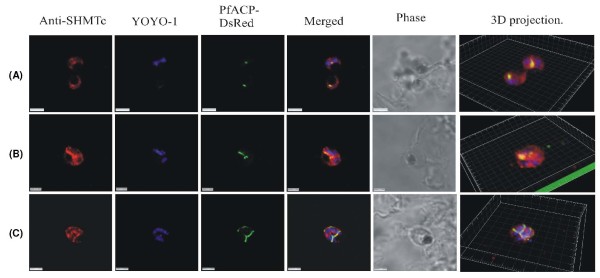
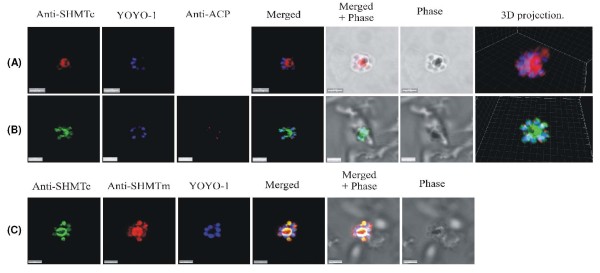
Polyclonal antibodies were raised to PfSHMTc and PfSHMTm, and, together with specific markers for the mitochondrion and apicoplast, were employed in quantitative confocal fluorescence microscopy of blood-stage parasites.
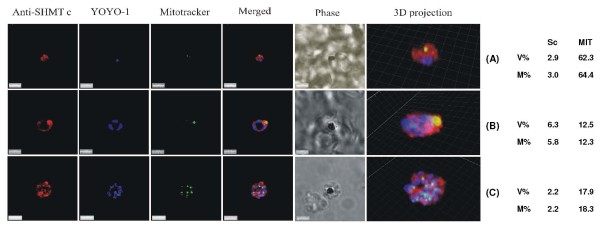
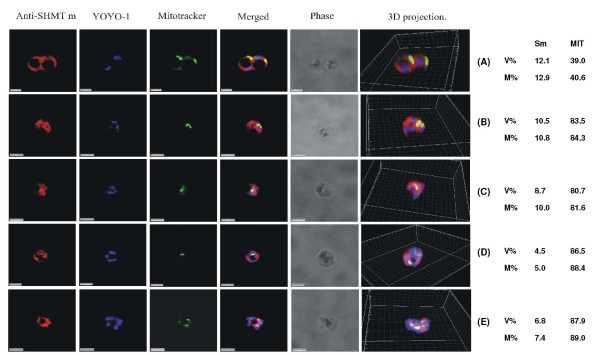
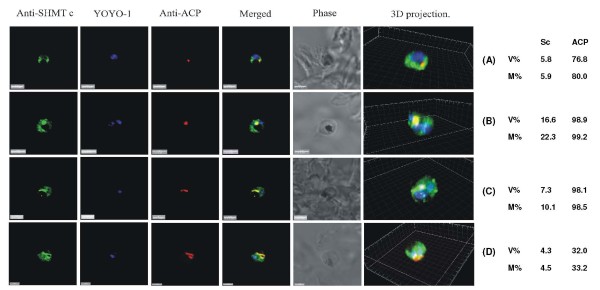
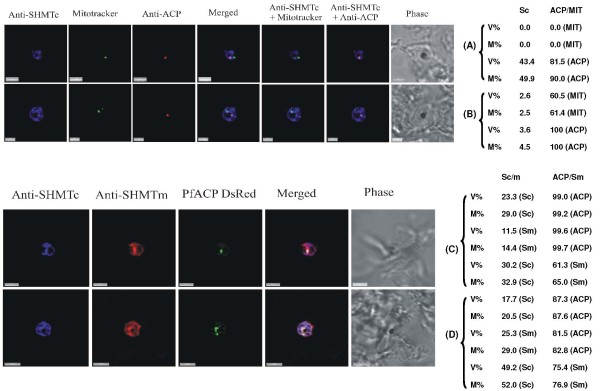
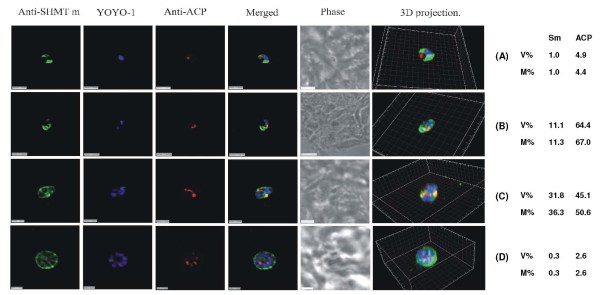
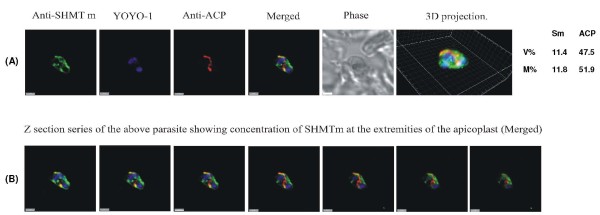
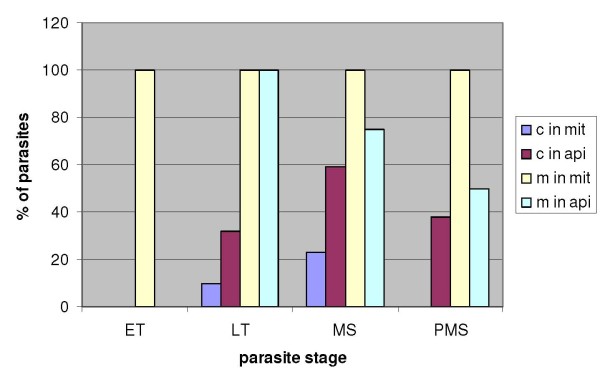
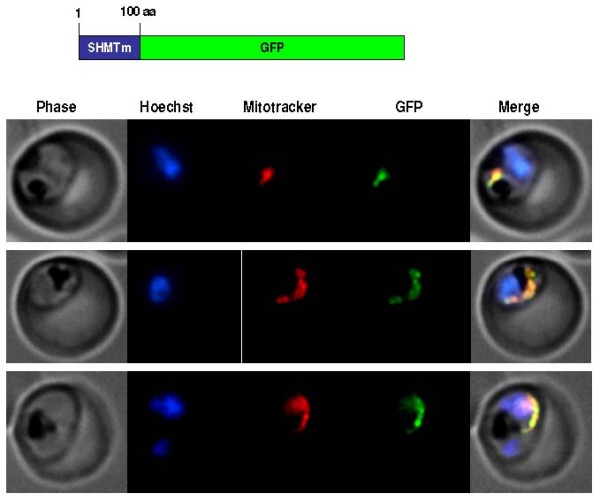
As well as the expected cytoplasmic occupancy of PfSHMTc during all stages, localization into the mitochondrion and apicoplast occurred in a stage-specific manner. Although early trophozoites lacked visible organellar PfSHMTc, a significant percentage of parasites showed such fluorescence during the mid-to-late trophozoite and schizont stages. In the case of the mitochondrion, the majority of parasites in these stages at any given time showed no marked PfSHMTc fluorescence, suggesting that its occupancy of this organelle is of limited duration. PfSHMTm showed a distinctly more pronounced mitochondrial location through most of the erythrocytic cycle and GFP-tagging of its N-terminal region confirmed the predicted presence of a mitochondrial signal sequence. Within the apicoplast, a majority of mitotic schizonts showed a marked concentration of PfSHMTc, whose localization in this organelle was less restricted than for the mitochondrion and persisted from the late trophozoite to the post-mitotic stages. PfSHMTm showed a broadly similar distribution across the cycle, but with a distinctive punctate accumulation towards the ends of elongating apicoplasts. In very late post-mitotic schizonts, both PfSHMTc and PfSHMTm were concentrated in the central region of the parasite that becomes the residual body on erythrocyte lysis and merozoite release.
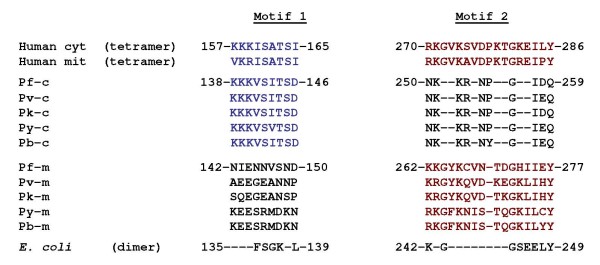
Both PfSHMTc and PfSHMTm show dynamic, stage-dependent localization among the different compartments of the parasite and sequence analysis suggests they may also reversibly associate with each other, a factor that may be critical to folate cofactor function, given the apparent lack of enzymic activity of PfSHMTm.
叶酸途径酶丝氨酸羟甲基转移酶(SHMT)将丝氨酸转化为甘氨酸和 5,10-亚甲基四氢叶酸,并为随后的转移反应获得一碳单位所必需。5,10-亚甲基四氢叶酸被胸苷酸合酶用于将 dUMP 转化为 dTMP 以合成 DNA。在恶性疟原虫中,发现了一种具有酶活性的 SHMT(PfSHMTc)和一种相关的、显然无活性的同工酶(PfSHMTm),它们由不同的基因编码。在这里,研究了两种同工酶在寄生虫红细胞周期中的定位模式。
用 PfSHMTc 和 PfSHMTm 制备多克隆抗体,并与线粒体和质体的特异性标记物一起,用于血液期寄生虫的定量共聚焦荧光显微镜检查。
除了在所有阶段都预期有 PfSHMTc 的细胞质占据外,还以阶段特异性的方式定位于线粒体和质体。虽然早期滋养体没有可见的细胞器 PfSHMTc,但在中晚期滋养体和裂殖体阶段,相当一部分寄生虫显示出这种荧光。对于线粒体,在任何给定时间的这些阶段的大多数寄生虫都没有明显的 PfSHMTc 荧光,这表明其对该细胞器的占据是有限的。PfSHMTm 在整个红细胞周期中明显更明显地定位于线粒体,并且 GFP 标记其 N 端区域证实了存在线粒体信号序列。在质体中,大多数有丝分裂裂殖体显示出 PfSHMTc 的明显聚集,其在这个细胞器中的定位不如线粒体严格,并从晚期滋养体持续到有丝分裂后阶段。PfSHMTm 在整个周期中表现出相似的分布,但在伸长的质体末端有明显的点状聚集。在非常晚期的有丝分裂裂殖体中,PfSHMTc 和 PfSHMTm 都集中在寄生虫的中央区域,该区域在红细胞裂解和裂殖体释放时成为残余体。
PfSHMTc 和 PfSHMTm 都显示出在寄生虫的不同隔室之间动态的、与阶段相关的定位,序列分析表明它们也可能可逆地相互关联,这一因素对于叶酸辅因子功能可能至关重要,因为 PfSHMTm 显然缺乏酶活性。