Department of Critical Care Medicine, Sunnybrook Health Sciences Centre, 2075 Bayview Av, Toronto, Ontario, Canada.
Trials. 2010 Dec 3;11:117. doi: 10.1186/1745-6215-11-117.
Hospital acquired infections are a major cause of morbidity and mortality and markedly increased health care costs. Critically ill patients who require management in an Intensive Care Unit are particularly susceptible to these infections which are associated with a very high mortality. Selective decontamination of the digestive tract (SDD) may reduce these infections and improve mortality but it has not been widely adopted into practice. We aim to 1. Clarify reasons why clinicians have avoided implementing SDD into clinical practice despite the current best-evidence 2. Describe barriers to SDD implementation and 3. Identify what further evidence is required before full scale clinical implementation would be considered appropriate and feasible.
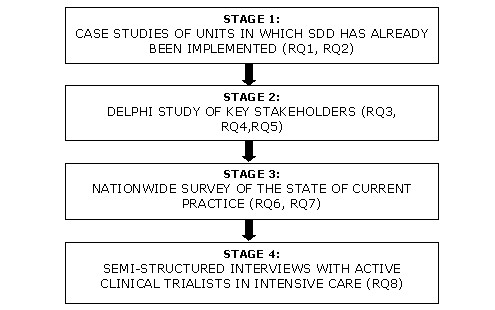
We have developed an international 'multi-lens' approach to investigate SDD from several perspectives. In case studies we will identify accounts of implementation of SDD in practice, in terms of the behaviours performed by the full range of individual clinicians, accounts of how SDD was first introduced into the Unit and specific content that may be used to populate the content of behaviour change techniques to be used in an implementation intervention and procedures to consider in order to deliver an implementation trial. In a 4 round Delphi study we will identify the range of stakeholders' beliefs, views and perceived barriers relating to the use of SDD. We will generate hypotheses about key beliefs about SDD and will inform the feasibility of any future randomised controlled trial. In large-scale nationwide postal questionnaire surveys of the state of current practice we will identify the factors predicting acceptability of an effectiveness or implementation trial using, and informed by, the theoretical domains structure. In semi-structured interviews with active international clinical trialists we will assess the feasibility of a randomised controlled trial and identify challenges and barriers to undertaking research in the field of SDD research.
We believe these methods will allow us to determine whether clinical implementation trials or further large effectiveness trials are required before full scale implementation into clinical practice.
医院获得性感染是发病率和死亡率的主要原因,显著增加了医疗保健成本。需要在重症监护病房进行治疗的重症患者特别容易受到这些感染的影响,这些感染与极高的死亡率有关。选择性消化道去污染(SDD)可能会减少这些感染并提高死亡率,但尚未广泛应用于实践。我们的目的是:1. 澄清为什么尽管目前有最佳证据,但临床医生仍避免将 SDD 应用于临床实践;2. 描述 SDD 实施的障碍;3. 确定在全面临床实施之前需要哪些进一步的证据,才能认为是合适和可行的。
我们采用了一种国际“多视角”方法,从多个角度研究 SDD。在案例研究中,我们将根据所有临床医生的行为,确定 SDD 在实践中的实施情况,以及 SDD 首次引入单位的情况,以及可能用于填充行为变化技术内容的特定内容,这些技术将用于实施干预措施,并考虑为实施试验提供服务。在四轮 Delphi 研究中,我们将确定与 SDD 使用相关的利益相关者的信念、观点和感知障碍的范围。我们将生成有关 SDD 的关键信念的假设,并为任何未来的随机对照试验的可行性提供信息。在全国范围内大规模的邮政问卷调查中,我们将根据理论领域结构,确定预测有效性或实施试验可接受性的因素,并告知其实施。在与积极的国际临床试验人员的半结构化访谈中,我们将评估随机对照试验的可行性,并确定在 SDD 研究领域进行研究的挑战和障碍。
我们相信这些方法将使我们能够确定在全面实施于临床实践之前是否需要进行临床实施试验或进一步的大型有效性试验。