Concha-Marambio Luis, Wang Fei, Armijo Enrique, Gorski Damian, Ramirez Frank, Scowcroft Andrew, Pritzkow Sandra, Soto Claudio
Department of Neurology, Mitchell Center for Alzheimer's Disease and Related Brain Disorders, University of Texas Health Science Center at Houston McGovern Medical School, Houston, TX, United States.
Amprion Inc., San Diego, CA, United States.
Front Mol Biosci. 2023 Aug 10;10:1184029. doi: 10.3389/fmolb.2023.1184029. eCollection 2023.
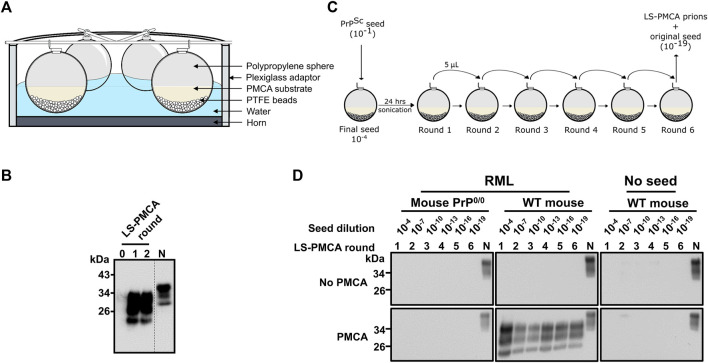
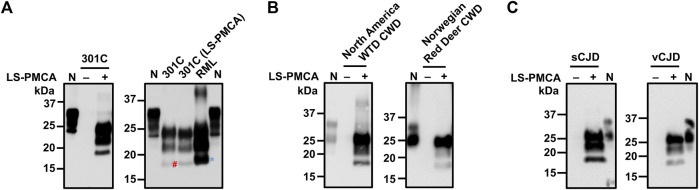
Prion diseases are a group of infectious neurodegenerative diseases produced by the conversion of the normal prion protein (PrP) into the disease-associated form (PrP). Extensive evidence indicate that the main or sole component of the infectious agent is PrP, which can replicate in affected individuals in the absence of nucleic acids. However, the mechanism of PrP-to-PrP conversion remains elusive, which has been attributed to the lack of sufficient structural information of infectious PrP and a reliable system to study prion replication . In this article we adapted the Protein Misfolding Cyclic Amplification (PMCA) technology for rapid and efficient generation of highly infectious prions in large-scale. Murine prions of the RML strain were efficiently propagated in volumes up to 1,000-fold larger than conventional PMCA. The large-scale PMCA (LS-PMCA) procedure enabled to produce highly infectious prions, which maintain the strain properties of the seed used to begin the reaction. LS-PMCA was shown to work with various species and strains of prions, including mouse RML and 301C strains, hamster Hyper prion, cervid CWD prions, including a rare Norwegian CWD prion, and human CJD prions. We further improved the LS-PMCA into a bioreactor format that can operate under industry-mimicking conditions for continuous and unlimited production of PrP without the need to keep adding brain-derived prions. In our estimation, this bioreactor can produce in 1d an amount of prions equivalent to that present in 25 infected animals at the terminal stage of the disease. Our LS-PMCA technology may provide a valuable tool to produce large quantities of well-defined and homogeneous infectious prions for biological and structural studies.
朊病毒疾病是一组传染性神经退行性疾病,由正常朊病毒蛋白(PrP)转变为疾病相关形式(PrP)所致。大量证据表明,感染因子的主要成分或唯一成分是PrP,它能在受感染个体中在无核酸的情况下复制。然而,PrP到PrP的转变机制仍然难以捉摸,这归因于缺乏感染性PrP的足够结构信息以及研究朊病毒复制的可靠系统。在本文中,我们采用了蛋白质错误折叠循环扩增(PMCA)技术,以快速高效地大规模产生高传染性朊病毒。RML株小鼠朊病毒能在比传统PMCA大1000倍的体积中有效增殖。大规模PMCA(LS-PMCA)程序能够产生高传染性朊病毒,其保持了用于启动反应的种子的毒株特性。LS-PMCA已被证明可用于各种物种和毒株的朊病毒,包括小鼠RML和301C株、仓鼠传染性海绵状脑病朊病毒、鹿慢性消耗病朊病毒,包括一种罕见的挪威慢性消耗病朊病毒,以及人类克雅氏病朊病毒。我们进一步将LS-PMCA改进为一种生物反应器形式,它可以在模拟工业的条件下运行,以连续无限量地生产PrP,而无需不断添加脑源性朊病毒。据我们估计,这种生物反应器在1天内产生的朊病毒量相当于25只处于疾病末期的感染动物体内的朊病毒量。我们的LS-PMCA技术可能为生物和结构研究提供一种有价值的工具,用于大量生产定义明确且均匀的传染性朊病毒。