HIV Netherlands Australia Thailand Research Collaboration, Thai Red Cross AIDS Research Center, Bangkok, Thailand.
J Allergy Clin Immunol. 2010 Dec;126(6):1294-301.e10. doi: 10.1016/j.jaci.2010.09.038.
There are limited data on the immune profiles of HIV-positive children compared with healthy controls, and no such data for Asian children.
To immunophenotype HIV-positive Asian children, including long-term nonprogressors (LTNPs), compared with age-matched healthy controls.
We used flow cytometry to analyze 13 lymphocyte and monocyte subsets from 222 untreated, HIV-positive children with 15% to 24% CD4(+) T cells and no AIDS-related illnesses and 142 healthy children (controls). Data were compared among age categories. Profiles from LTNPs (n = 50), defined as children ≥8 years old with CD4(+) T-cell counts ≥350 cells/mm(3), were compared with data from age-matched non-LTNPs (n = 17) and controls (n = 53).
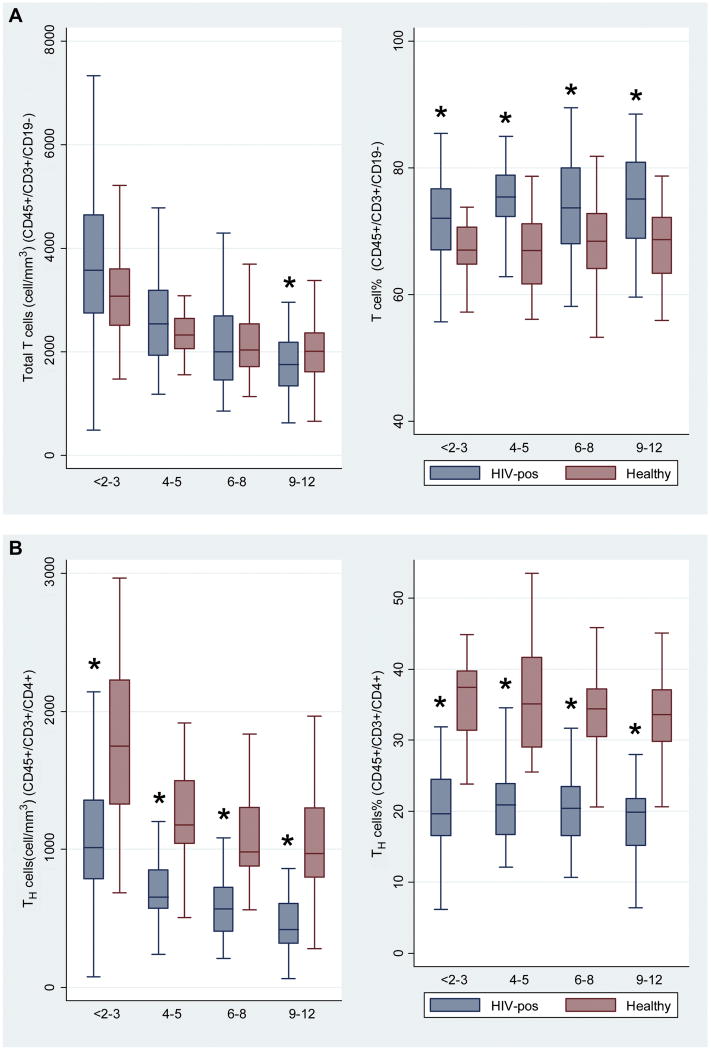
Compared with controls, HIV-positive children had lower values (cell count per mm(3) and percent distribution) for T(H) cells and higher values for cytotoxic T cells, with reductions in populations of naive T(H) and cytotoxic T cells, B cells, and natural killer (NK) cells. HIV-positive children had high values for activated T(H) and cytotoxic T cells. Compared with non-LTNPs, LTNPs had higher values of T(H) and cytotoxic T cells, naive and memory T-cell subsets, and B and NK cells. Surprisingly, counts of activated T(H) and cytotoxic T cells were also higher among LTNPs. LNTPs were more frequently male.
Untreated, HIV-infected Asian children have immune profiles that differ from those of controls, characterized by low values for T(H) cells, naive T cells, B cells, and NK cells but high values for cytotoxic, activated T(H), and cytotoxic T cells. The higher values for activated T cells observed in LTNPs require confirmation in longitudinal studies.
与健康对照者相比,针对 HIV 阳性儿童的免疫特征(包括长期非进展者[LTNP])的相关数据有限,且尚无针对亚洲儿童的此类数据。
对未经治疗的 HIV 阳性亚洲儿童(包括长期非进展者[LTNP])进行免疫表型分析,并与年龄匹配的健康对照者进行比较。
我们使用流式细胞术分析了 222 例未接受治疗、HIV 阳性且 CD4+T 细胞为 15%~24%、无艾滋病相关疾病的儿童(病例组)和 142 例健康儿童(对照组)的 13 种淋巴细胞和单核细胞亚群。我们比较了不同年龄组之间的数据。将 LTNP(n=50)定义为 CD4+T 细胞计数≥350 个细胞/mm3、年龄≥8 岁的儿童,与年龄匹配的非 LTNP(n=17)和对照组(n=53)的数据进行比较。
与对照组相比,HIV 阳性儿童的 T(H)细胞的细胞计数(每 mm3 的细胞数)和分布百分比较低,而细胞毒性 T 细胞的细胞计数(每 mm3 的细胞数)和分布百分比较高,幼稚 T(H)和细胞毒性 T 细胞、B 细胞和自然杀伤(NK)细胞的细胞数量减少。HIV 阳性儿童的活化 T(H)和细胞毒性 T 细胞数量较高。与非 LTNP 相比,LTNP 的 T(H)和细胞毒性 T 细胞、幼稚和记忆 T 细胞亚群、B 细胞和 NK 细胞数量较高。令人惊讶的是,LTNP 的活化 T(H)和细胞毒性 T 细胞的细胞计数也较高。LTNP 中男性比例较高。
未经治疗的 HIV 感染亚洲儿童的免疫特征与对照组不同,其特征为 T(H)细胞、幼稚 T 细胞、B 细胞和 NK 细胞数量较低,但细胞毒性、活化 T(H)和细胞毒性 T 细胞数量较高。LTNP 中观察到的活化 T 细胞较高值需要在纵向研究中进一步证实。