• 文献检索
  • 文档翻译
  • 深度研究
  • 学术资讯
  • Suppr Zotero 插件Zotero 插件
  • 邀请有礼
  • 套餐&价格
  • 历史记录
应用&插件
Suppr Zotero 插件Zotero 插件浏览器插件Mac 客户端Windows 客户端微信小程序
定价
高级版会员购买积分包购买API积分包
服务
文献检索文档翻译深度研究API 文档MCP 服务
关于我们
关于 Suppr公司介绍联系我们用户协议隐私条款
关注我们

Suppr 超能文献

核心技术专利:CN118964589B侵权必究
粤ICP备2023148730 号-1Suppr @ 2026

文献检索

告别复杂PubMed语法,用中文像聊天一样搜索,搜遍4000万医学文献。AI智能推荐,让科研检索更轻松。

立即免费搜索

文件翻译

保留排版,准确专业,支持PDF/Word/PPT等文件格式,支持 12+语言互译。

免费翻译文档

深度研究

AI帮你快速写综述,25分钟生成高质量综述,智能提取关键信息,辅助科研写作。

立即免费体验

阿根廷、尼加拉瓜和秘鲁发热性呼吸道症状患儿中人博卡病毒(HBoV)感染的频率。

Frequency of human bocavirus (HBoV) infection among children with febrile respiratory symptoms in Argentina, Nicaragua and Peru.

机构信息

Naval Medical Research Center Detachment, Callao, Peru.

出版信息

Influenza Other Respir Viruses. 2011 Jan;5(1):1-5. doi: 10.1111/j.1750-2659.2010.00160.x. Epub 2010 Sep 16.

DOI:10.1111/j.1750-2659.2010.00160.x
PMID:21138534
原文链接:https://pmc.ncbi.nlm.nih.gov/articles/PMC4066840/
Abstract

BACKGROUND

Globally, respiratory infections are the primary cause of illness in developing countries, specifically among children; however, an etiological agent for many of these illnesses is rarely identified.

OBJECTIVES

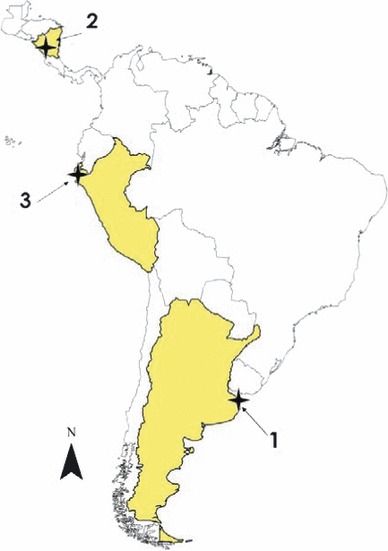
Our study aimed to estimate the frequency of human bocavirus (HBoV) infection among pediatric populations in Argentina, Nicaragua and Peru.

METHODS

We conducted a cross-sectional study using stored samples of an influenza-like illness surveillance program. Irrespective of previous diagnosis, nasopharyngeal or nasal swab specimens were randomly selected and tested using real-time PCR from three sites during 2007 from patients younger than 6 years old.

RESULTS

A total of 568 specimens from Argentina (185), Nicaragua (192) and Peru (191) were tested. The prevalence of HBoV was 10·8% (95% CI: 6·3; 15·3) in Argentina, 33·3% in Nicaragua (95% CI: 26·6; 40·1) and 25·1% in Peru (95% CI: 18·9; 31·3).

CONCLUSIONS

These findings demonstrate circulation of HBoV in Argentina, Nicaragua and Peru among children with influenza-like symptoms enrolled in a sentinel surveillance program.

摘要

背景

在发展中国家,呼吸道感染是导致疾病的主要原因,尤其是在儿童中;然而,这些疾病的许多病原体很少被确定。

目的

我们的研究旨在估计人类博卡病毒(HBoV)在阿根廷、尼加拉瓜和秘鲁儿科人群中的感染频率。

方法

我们进行了一项横断面研究,使用流感样疾病监测计划中储存的样本。在 2007 年期间,从三个地点随机选择了鼻咽或鼻拭子标本,并使用实时 PCR 对来自阿根廷(185 例)、尼加拉瓜(192 例)和秘鲁(191 例)的小于 6 岁的患者进行了检测。

结果

共检测了来自阿根廷(185 例)、尼加拉瓜(192 例)和秘鲁(191 例)的 568 个标本。在阿根廷,HBoV 的患病率为 10.8%(95%CI:6.3;15.3);在尼加拉瓜为 33.3%(95%CI:26.6;40.1);在秘鲁为 25.1%(95%CI:18.9;31.3)。

结论

这些发现表明,在流感样症状的哨点监测计划中,HBoV 在阿根廷、尼加拉瓜和秘鲁的儿童中传播。
https://cdn.ncbi.nlm.nih.gov/pmc/blobs/cbce/4940931/243b12c2a3e6/IRV-5-1-g001.jpg

相似文献

1
Frequency of human bocavirus (HBoV) infection among children with febrile respiratory symptoms in Argentina, Nicaragua and Peru.阿根廷、尼加拉瓜和秘鲁发热性呼吸道症状患儿中人博卡病毒(HBoV)感染的频率。
Influenza Other Respir Viruses. 2011 Jan;5(1):1-5. doi: 10.1111/j.1750-2659.2010.00160.x. Epub 2010 Sep 16.
2
Prevalence and molecular characterization of human bocavirus-1 in children and adults with influenza-like illness from Kunming, Southwest China.中国西南部昆明市流感样疾病儿童和成人中人类博卡病毒1型的流行情况及分子特征
Microbiol Spectr. 2025 Jan 7;13(1):e0156424. doi: 10.1128/spectrum.01564-24. Epub 2024 Dec 11.
3
Investigation of human bocavirus in pediatric patients with respiratory tract infection.人博卡病毒在儿童呼吸道感染患者中的调查。
J Infect Dev Ctries. 2020 Oct 31;14(10):1191-1196. doi: 10.3855/jidc.12553.
4
Detection of human bocavirus type 1 infection in Panamanian children with respiratory illness.检测巴拿马儿童呼吸道疾病中的人类博卡病毒 1 型感染。
J Med Virol. 2016 Mar;88(3):389-94. doi: 10.1002/jmv.24346. Epub 2015 Oct 19.
5
Detection and phylogenetic analysis of in children diagnosed with acute respiratory tract infection.检测并分析急性呼吸道感染患儿中的 。
J Med Microbiol. 2020 Sep;69(9):1197-1202. doi: 10.1099/jmm.0.001243. Epub 2020 Aug 19.
6
Human bocavirus as an important cause of respiratory tract infection in Taiwanese children.人博卡病毒是台湾地区儿童呼吸道感染的重要病因。
J Microbiol Immunol Infect. 2011 Oct;44(5):323-7. doi: 10.1016/j.jmii.2011.01.036. Epub 2011 Jan 20.
7
[Detection of human bocavirus in children from Tucuman and Santa Fe, Argentina].[阿根廷图库曼省和圣菲省儿童人博卡病毒的检测]
Rev Chilena Infectol. 2016 Apr;33(2):135-40. doi: 10.4067/S0716-10182016000200002.
8
Human bocavirus isolated from children with acute respiratory tract infections in Korea, 2010-2011.2010 - 2011年从韩国急性呼吸道感染儿童中分离出的人博卡病毒。
J Med Virol. 2014 Dec;86(12):2011-8. doi: 10.1002/jmv.23880. Epub 2014 Jan 4.
9
Human bocavirus infection in young children with acute respiratory tract infection in Lanzhou, China.中国兰州婴幼儿急性呼吸道感染中人博卡病毒感染。
J Med Virol. 2010 Feb;82(2):282-8. doi: 10.1002/jmv.21689.
10
Novel human bocavirus in children with acute respiratory tract infection.儿童急性呼吸道感染新型人博卡病毒。
Emerg Infect Dis. 2010 Feb;16(2):324-7. doi: 10.3201/eid1602.090553.

引用本文的文献

1
Human Bocavirus in Childhood: A True Respiratory Pathogen or a "Passenger" Virus? A Comprehensive Review.儿童人博卡病毒:真正的呼吸道病原体还是“过客”病毒?全面综述。
Microorganisms. 2023 May 9;11(5):1243. doi: 10.3390/microorganisms11051243.
2
Human Bocavirus infection among children with respiratory tract infection in Ibadan, Nigeria.尼日利亚伊巴丹呼吸道感染儿童中的人博卡病毒感染
Access Microbiol. 2022 May 23;4(5):acmi000356. doi: 10.1099/acmi.0.000356. eCollection 2022 Aug.
3
Prevalence of Human Bocavirus in Africa and Other Developing Countries between 2005 and 2016: A Potential Emerging Viral Pathogen for Diarrhea.

本文引用的文献

1
Prolonged detection of human bocavirus DNA in nasopharyngeal aspirates of children with respiratory tract disease.呼吸道疾病患儿鼻咽抽吸物中人博卡病毒 DNA 的长时间检测。
Pediatr Infect Dis J. 2009 Nov;28(11):1018-9. doi: 10.1097/INF.0b013e3181a854ae.
2
Influenza-like illness sentinel surveillance in Peru.秘鲁的流感样疾病哨点监测。
PLoS One. 2009 Jul 1;4(7):e6118. doi: 10.1371/journal.pone.0006118.
3
Novel respiratory virus infections in children, Brazil.巴西儿童中的新型呼吸道病毒感染
2005年至2016年期间非洲及其他发展中国家人类博卡病毒的流行情况:一种潜在的新兴腹泻病毒病原体
J Trop Med. 2018 Sep 12;2018:7875482. doi: 10.1155/2018/7875482. eCollection 2018.
4
Incidence of respiratory viruses in Peruvian children with acute respiratory infections.秘鲁患急性呼吸道感染儿童中呼吸道病毒的发病率。
J Med Virol. 2015 Jun;87(6):917-24. doi: 10.1002/jmv.24159. Epub 2015 Mar 17.
5
Human bocavirus: lessons learned to date.人博卡病毒:迄今为止的经验教训。
Pathogens. 2013 Jan 11;2(1):1-12. doi: 10.3390/pathogens2010001.
6
Spontaneous pneumomediastinum as a complication in human bocavirus infection.人博卡病毒感染的并发症——自发性纵隔气肿
Pediatr Int. 2014 Oct;56(5):793-5. doi: 10.1111/ped.12475.
7
Sentinel surveillance of influenza-like illness in two hospitals in Maracay, Venezuela: 2006-2010.委内瑞拉马拉凯市两家医院流感样疾病的哨点监测:2006-2010 年。
PLoS One. 2012;7(9):e44511. doi: 10.1371/journal.pone.0044511. Epub 2012 Sep 11.
8
Human metapneumovirus and human bocavirus associated with respiratory infection in Apulian population.人偏肺病毒和人博卡病毒与普利亚人群呼吸道感染相关。
Virology. 2011 Aug 15;417(1):64-70. doi: 10.1016/j.virol.2011.04.016. Epub 2011 Jun 1.
Emerg Infect Dis. 2009 May;15(5):806-8. doi: 10.3201/eid1505.081603.
4
Human bocavirus in very young infants hospitalized with acute respiratory infection in northeast Brazil.巴西东北部急性呼吸道感染住院的非常年幼婴儿中的人类博卡病毒。
J Trop Pediatr. 2010 Apr;56(2):125-7. doi: 10.1093/tropej/fmp026. Epub 2009 Apr 28.
5
Viral etiology of common cold in children, Finland.芬兰儿童普通感冒的病毒病因
Emerg Infect Dis. 2009 Feb;15(2):344-6. doi: 10.3201/eid1502.081468.
6
Epidemiology and etiology of childhood pneumonia.儿童肺炎的流行病学与病因学
Bull World Health Organ. 2008 May;86(5):408-16. doi: 10.2471/blt.07.048769.
7
Serial viral infections in infants with recurrent respiratory illnesses.反复呼吸道疾病患儿的系列病毒感染
Eur Respir J. 2008 Aug;32(2):314-20. doi: 10.1183/09031936.00161907. Epub 2008 Apr 30.
8
Emerging respiratory agents: new viruses for old diseases?新出现的呼吸道病原体:旧病遇上新病毒?
J Clin Virol. 2008 Jul;42(3):233-43. doi: 10.1016/j.jcv.2008.03.002. Epub 2008 Apr 14.
9
Pneumonia research to reduce childhood mortality in the developing world.旨在降低发展中国家儿童死亡率的肺炎研究。
J Clin Invest. 2008 Apr;118(4):1291-300. doi: 10.1172/JCI33947.
10
Human bocavirus detection in nasopharyngeal aspirates of children without clinical symptoms of respiratory infection.在无呼吸道感染临床症状儿童的鼻咽抽吸物中检测人博卡病毒
Pediatr Infect Dis J. 2008 Apr;27(4):358-60. doi: 10.1097/INF.0b013e3181626d2a.