Vlastos Anne-Therese, Charvet Igor, Dellacasa Ilaria, Capanna Federica, Pelte Marie-Françoise, Thueler Philippe, Saint-Ghislain Michel, Depeursinge Christian, Meda Paolo
Department of Gynecology and Obstetrics.
Rare Tumors. 2009 Jul 22;1(1):e8. doi: 10.4081/rt.2009.e8.
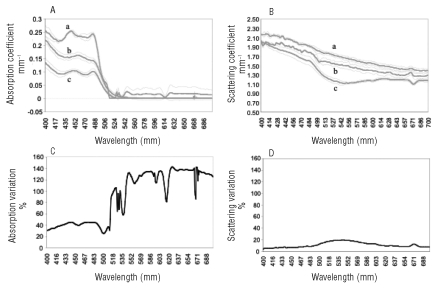
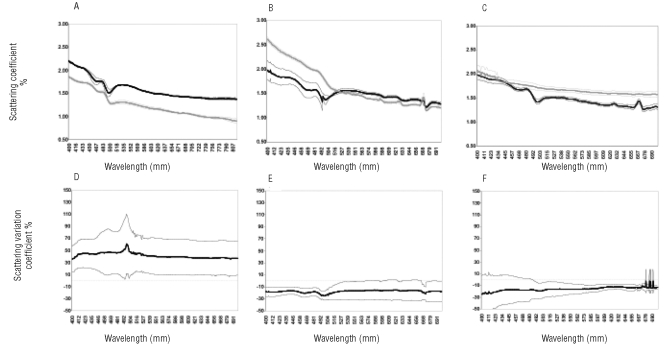
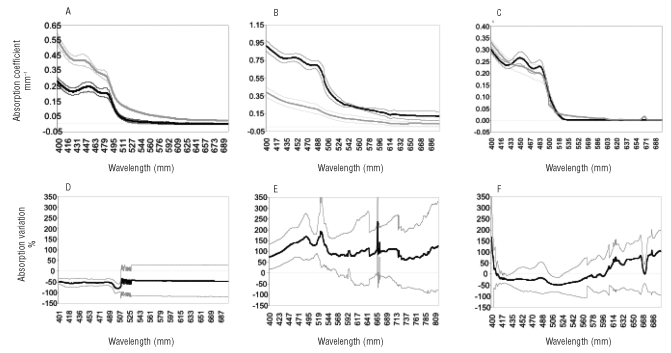
A procedure that could allow an early in vivo and non-invasive detection of vulvar lesions would be extremely useful. We tested an innovative optical method (Optiprobe), which uses a harmless, visible light source for the in vivo, on-line detection of minimal alterations in the structure of vulvar epithelium. A group of 3 female volunteers without gynecological symptoms were first screened to evaluate optical properties of normal vulvar tissue. Next, a group of 16 patients undergoing gynecological examination for vulvar lesions was evaluated by the Optiprobe at suspected sites before these sites were biopsied for histological analysis. Adjacent, non-involved sites were also measured to provide internal controls. Histological analysis of the biopsies identified one case that did not show obvious alterations, 4 cases of high-grade vulvar intraepithelial neoplasia (VIN), 5 cases of vulvitis, and 6 cases of lichen sclerosis (LS).The optical properties of the VIN cases were significantly different from those of controls, due to a decrease in the absorption spectra and an increase in the scattering spectra. In contrast, a significant increase in the absorption spectra and a decrease in the scattering spectra were observed in the cases of vulvitis. In the LS cases, the absorption spectra were as in controls, whereas the scattering spectra were significantly decreased. We conclude that the Optiprobe provides a useful tool for a rapid and non-invasive detection of vulvar alterations. The method should contribute to reduce the number of biopsies and to facilitate the long-term follow-up of vulvar lesions.
一种能够实现早期体内无创检测外阴病变的方法将非常有用。我们测试了一种创新的光学方法(Optiprobe),该方法使用无害的可见光源对体外的外阴上皮结构微小变化进行在线检测。首先对一组3名无妇科症状的女性志愿者进行筛查,以评估正常外阴组织的光学特性。接下来,对一组16名因外阴病变接受妇科检查的患者在疑似部位进行活检以进行组织学分析之前,先用Optiprobe进行评估。还对相邻的未受累部位进行测量以提供内部对照。活检的组织学分析发现1例未显示明显改变,4例高级别外阴上皮内瘤变(VIN),5例外阴炎和6例扁平苔藓(LS)。由于吸收光谱降低和散射光谱增加,VIN病例的光学特性与对照有显著差异。相比之下,外阴炎病例中观察到吸收光谱显著增加和散射光谱降低。在LS病例中,吸收光谱与对照相同,而散射光谱显著降低。我们得出结论,Optiprobe为快速无创检测外阴改变提供了一种有用的工具。该方法应有助于减少活检数量并便于对外阴病变进行长期随访。