Biochemistry Department, University of Pennsylvania School of Dental Medicine, 240 South 40th Street, Philadelphia, PA 19104, USA.
Semin Immunopathol. 2011 Sep;33(5):409-17. doi: 10.1007/s00281-010-0230-z. Epub 2010 Dec 8.
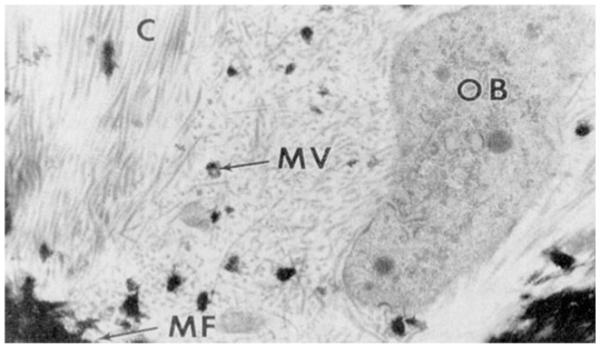
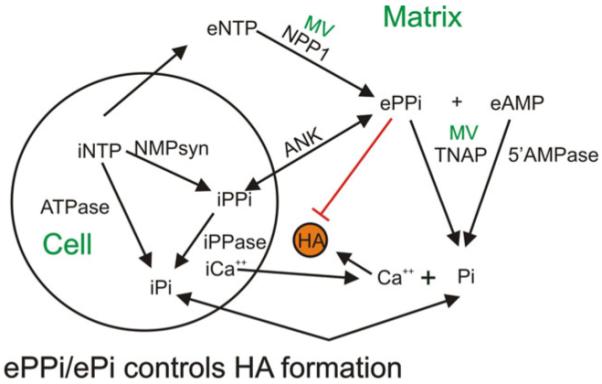
In normal healthy individuals, mineral formation is restricted to specialized tissues which form the skeleton and the dentition. Within these tissues, mineral formation is tightly controlled both in growth and development and in normal adult life. The mechanism of calcification in skeletal and dental tissues has been under investigation for a considerable period. One feature common to almost all of these normal mineralization mechanisms is the elaboration of matrix vesicles, small (20-200 nm) membrane particles, which bud off from the plasma membrane of mineralizing cells and are released into the pre-mineralized organic matrix. The first crystals which form on this organic matrix are seen in and around matrix vesicles. Pathologic ectopic mineralization is seen in a number of human genetic and acquired diseases, including calcification of joint cartilage resulting in osteoarthritis and mineralization of the cardiovasculature resulting in exacerbation of atherosclerosis and blockage of blood vessels. Surprisingly, increasing evidence supports the contention that the mechanisms of soft tissue calcification are similar to those seen in normal skeletal development. In particular, matrix vesicle-like membranes are observed in a number of ectopic calcifications. The purpose of this review is to describe how matrix vesicles function in normal mineral formation and review the evidence for their participation in pathologic calcification.
在正常健康个体中,矿物质的形成仅限于形成骨骼和牙齿的专门组织。在这些组织中,矿物质的形成无论是在生长发育过程中还是在正常成年期都受到严格控制。骨骼和牙齿组织中钙化的机制已经研究了相当长的一段时间。几乎所有这些正常矿化机制的一个共同特征是基质小泡的形成,基质小泡是一种小型(20-200nm)的膜颗粒,从小泡细胞的质膜上脱落并释放到预矿化的有机基质中。在这个有机基质上形成的第一批晶体可以在基质小泡内和周围看到。在许多人类遗传和获得性疾病中都可以看到病理性异位矿化,包括关节软骨的钙化导致骨关节炎,以及心血管系统的钙化导致动脉粥样硬化的恶化和血管阻塞。令人惊讶的是,越来越多的证据支持这样一种观点,即软组织钙化的机制与正常骨骼发育中所见的机制相似。特别是,在许多异位钙化中观察到基质小泡样膜。本综述的目的是描述基质小泡在正常矿物质形成中的作用,并回顾它们参与病理性钙化的证据。