Division of Clinical Pharmacology, Cincinnati Childrens Hospital Medical Center, Cincinnati, Ohio 45229-3039, USA.
Clin Pharmacokinet. 2011 Jan;50(1):1-24. doi: 10.2165/11536640-000000000-00000.
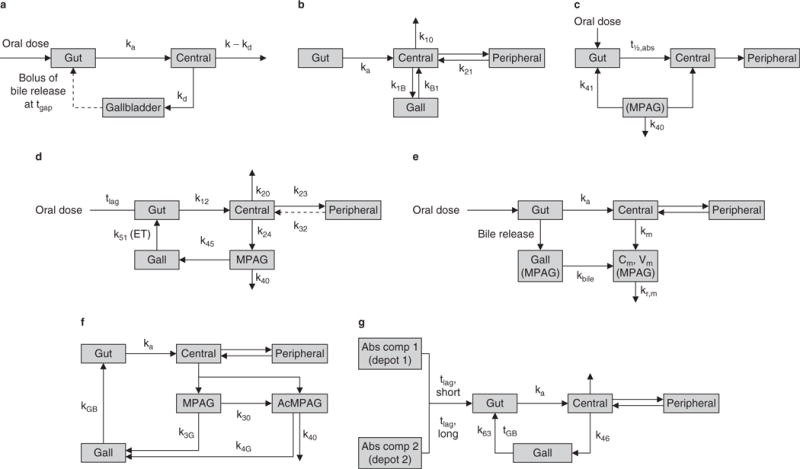
With the increasing use of mycophenolic acid (MPA) as an immunosuppressant in solid organ transplantation and in treating autoimmune diseases such as systemic lupus erythematosus, the need for strategies to optimize therapy with this agent has become increasingly apparent. This need is largely based on MPA's significant between-subject and between-occasion (within-subject) pharmacokinetic variability. While there is a strong relationship between MPA exposure and effect, the relationship between drug dose, plasma concentration and exposure (area under the concentration-time curve [AUC]) is very complex and remains to be completely defined. Population pharmacokinetic models using various approaches have been proposed over the past 10 years to further evaluate the pharmacokinetic and pharmacodynamic behaviour of MPA. These models have evolved from simple one-compartment linear iterations to complex multi-compartment versions that try to include various factors, which may influence MPA's pharmacokinetic variability, such as enterohepatic recycling and pharmacogenetic polymorphisms. There have been major advances in the understanding of the roles transport mechanisms, metabolizing and other enzymes, drug-drug interactions and pharmacogenetic polymorphisms play in MPA's pharmacokinetic variability. Given these advances, the usefulness of empirical-based models and the limitations of nonlinear mixed-effects modelling in developing mechanism-based models need to be considered and discussed. If the goal is to individualize MPA dosing, it needs to be determined whether factors which may contribute significantly to variability can be utilized in the population pharmacokinetic models. Some pharmacokinetic models developed to date show promise in being able to describe the impact of physiological processes such as enterohepatic recycling. Most studies have historically been based on retrospective data or poorly designed studies which do not take these factors into consideration. Modelling typically has been undertaken using non-controlled therapeutic drug monitoring data, which do not have the information content to support the development of complex mechanistic models. Only a few recent modelling approaches have moved away from empiricism and have included mechanisms considered important, such as enterohepatic recycling. It is recognized that well thought-out sampling schedules allow for better evaluation of the pharmacokinetic data. It is not possible to undertake complex absorption modelling with very few samples being obtained during the absorption phase (which has often been the case). It is important to utilize robust AUC monitoring which is now being propagated in the latest consensus guideline on MPA therapeutic drug monitoring. This review aims to explore the biological factors that contribute to the clinical pharmacokinetics of MPA and how these have been introduced in the development of population pharmacokinetic models. An overview of the processes involved in the enterohepatic recycling of MPA will be provided. This will summarize the components that complicate absorption and recycling to influence MPA exposure such as biotransformation, transport, bile physiology and gut flora. Already published population pharmacokinetic models will be examined, and the evolution of these models away from empirical approaches to more mechanism-based models will be discussed.
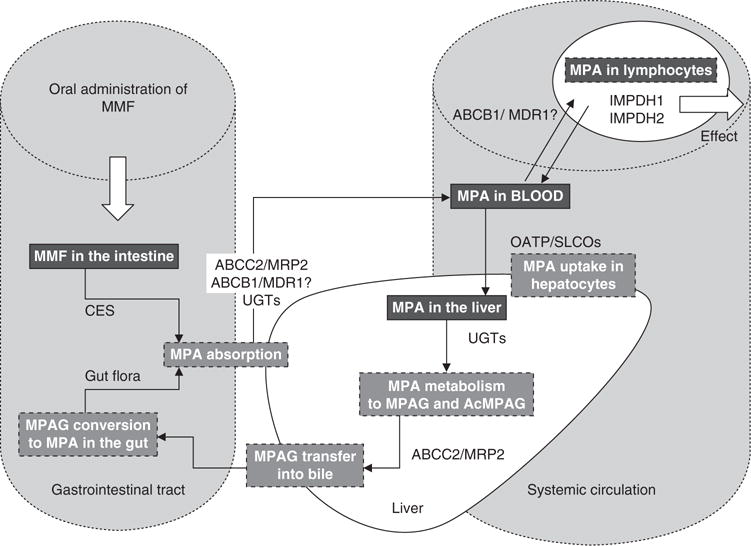
随着霉酚酸(MPA)作为免疫抑制剂在实体器官移植和治疗系统性红斑狼疮等自身免疫性疾病中的应用越来越多,优化这种药物治疗的策略的需求变得越来越明显。这种需求主要基于 MPA 在个体间和个体内(within-subject)药代动力学的显著变异性。虽然 MPA 暴露与疗效之间存在很强的相关性,但药物剂量、血浆浓度和暴露(浓度-时间曲线下面积 [AUC])之间的关系非常复杂,仍有待完全确定。过去 10 年来,使用各种方法提出了群体药代动力学模型,以进一步评估 MPA 的药代动力学和药效学行为。这些模型已经从简单的单室线性迭代发展到复杂的多室版本,试图包括可能影响 MPA 药代动力学变异性的各种因素,如肠肝循环和药物遗传多态性。在理解转运机制、代谢和其他酶、药物相互作用和药物遗传多态性在 MPA 药代动力学变异性中的作用方面取得了重大进展。鉴于这些进展,需要考虑和讨论基于经验的模型的有用性和非线性混合效应建模在开发基于机制的模型中的局限性。如果目标是个体化 MPA 剂量,就需要确定是否可以在群体药代动力学模型中利用可能对变异性有重大贡献的因素。迄今为止开发的一些药代动力学模型在描述肠肝循环等生理过程的影响方面显示出了希望。大多数研究历史上都是基于回顾性数据或设计不佳的研究,没有考虑到这些因素。模型通常是使用非控制治疗药物监测数据进行的,这些数据没有支持复杂机制模型开发的信息含量。只有少数最近的建模方法摆脱了经验主义,纳入了被认为重要的机制,如肠肝循环。人们认识到,精心设计的采样方案可以更好地评估药代动力学数据。在吸收阶段(通常是这种情况)获得很少的样本,就不可能进行复杂的吸收建模。利用现在在 MPA 治疗药物监测的最新共识指南中推广的稳健 AUC 监测非常重要。本综述旨在探讨导致 MPA 临床药代动力学的生物学因素,以及这些因素如何在群体药代动力学模型的开发中得到体现。将概述 MPA 肠肝循环中涉及的过程。这将总结使吸收和再循环复杂化以影响 MPA 暴露的成分,如生物转化、转运、胆汁生理学和肠道菌群。已经发表的群体药代动力学模型将被检查,并将讨论这些模型从经验方法向更基于机制的模型的演变。