Scientific Institute for Quality of Healthcare, Radboud University Nijmegen Medical Centre, the Netherlands.
BMC Health Serv Res. 2010 Dec 10;10:335. doi: 10.1186/1472-6963-10-335.
Most patients receive healthcare in primary care settings, but relatively little is known about patient safety. Out-of-hours contacts are of particular importance to patient safety. Our aim was to examine the incidence, types, causes, and consequences of patient safety incidents at general practice cooperatives for out-of-hours primary care and to examine which factors were associated with the occurrence of patient safety incidents.
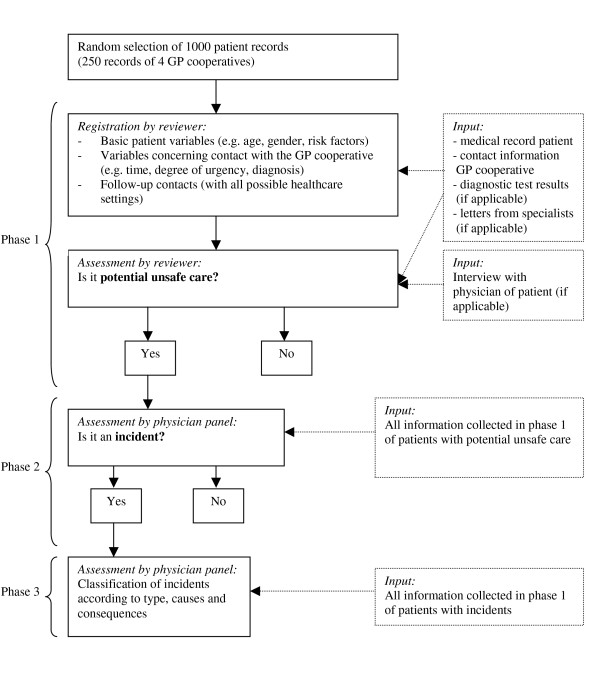
A retrospective study of 1,145 medical records concerning patient contacts with four general practice cooperatives. Reviewers identified records with evidence of a potential patient safety incident; a physician panel determined whether a patient safety incident had indeed occurred. In addition, the panel determined the type, causes, and consequences of the incidents. Factors associated with incidents were examined in a random coefficient logistic regression analysis.
In 1,145 patient records, 27 patient safety incidents were identified, an incident rate of 2.4% (95% CI: 1.5% to 3.2%). The most frequent incident type was treatment (56%). All incidents had at least partly been caused by failures in clinical reasoning. The majority of incidents did not result in patient harm (70%). Eight incidents had consequences for the patient, such as additional interventions or hospitalisation. The panel assessed that most incidents were unlikely to result in patient harm in the long term (89%). Logistic regression analysis showed that age was significantly related to incident occurrence: the likelihood of an incident increased with 1.03 for each year increase in age (95% CI: 1.01 to 1.04).
Patient safety incidents occur in out-of-hours primary care, but most do not result in harm to patients. As clinical reasoning played an important part in these incidents, a better understanding of clinical reasoning and guideline adherence at GP cooperatives could contribute to patient safety.
大多数患者在初级保健环境中接受医疗保健,但相对较少了解患者安全。非工作时间的接触对患者安全尤为重要。我们的目的是调查在初级保健非工作时间的全科医生合作社中发生的患者安全事件的发生率、类型、原因和后果,并研究哪些因素与患者安全事件的发生有关。
对四个全科医生合作社的 1145 份患者接触医疗记录进行回顾性研究。审核员确定记录中是否有潜在的患者安全事件证据;医生小组确定是否确实发生了患者安全事件。此外,小组还确定了事件的类型、原因和后果。使用随机系数逻辑回归分析检查与事件相关的因素。
在 1145 份患者记录中,确定了 27 起患者安全事件,发生率为 2.4%(95%CI:1.5%至 3.2%)。最常见的事件类型是治疗(56%)。所有事件至少部分是由于临床推理失败引起的。大多数事件并未导致患者伤害(70%)。有 8 起事件对患者产生了后果,如额外的干预或住院治疗。小组评估认为,大多数事件在长期内不太可能对患者造成伤害(89%)。逻辑回归分析显示,年龄与事件发生显著相关:年龄每增加 1 岁,事件发生的可能性就会增加 1.03(95%CI:1.01 至 1.04)。
患者安全事件发生在初级保健非工作时间,但大多数不会导致患者受伤。由于临床推理在这些事件中起着重要作用,因此更好地了解全科医生合作社的临床推理和指南遵循情况可能有助于提高患者安全性。