Service of Geriatric Medicine & Geriatric Rehabilitation, University of Lausanne Medical Center (CHUV), Lausanne, Switzerland.
BMC Geriatr. 2010 Dec 13;10:88. doi: 10.1186/1471-2318-10-88.
Although spirituality is usually considered a positive resource for coping with illness, spiritual distress may have a negative influence on health outcomes. Tools are needed to identify spiritual distress in clinical practice and subsequently address identified needs. This study describes the first steps in the development of a clinically acceptable instrument to assess spiritual distress in hospitalized elderly patients.
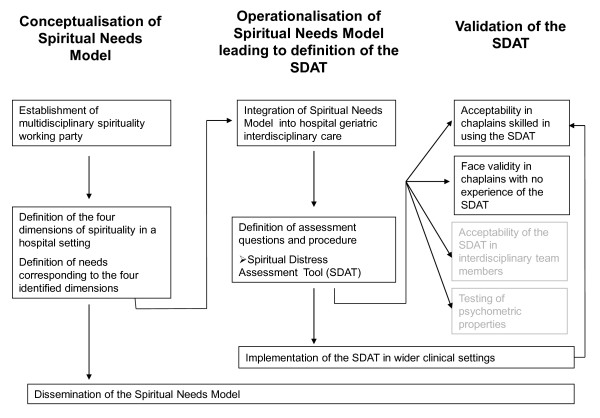
A three-step process was used to develop the Spiritual Distress Assessment Tool (SDAT): 1) Conceptualisation by a multidisciplinary group of a model (Spiritual Needs Model) to define the different dimensions characterizing a patient's spirituality and their corresponding needs; 2) Operationalisation of the Spiritual Needs Model within geriatric hospital care leading to a set of questions (SDAT) investigating needs related to each of the defined dimensions; 3) Qualitative assessment of the instrument's acceptability and face validity in hospital chaplains.
Four dimensions of spirituality (Meaning, Transcendence, Values, and Psychosocial Identity) and their corresponding needs were defined. A formalised assessment procedure to both identify and subsequently score unmet spiritual needs and spiritual distress was developed. Face validity and acceptability in clinical practice were confirmed by chaplains involved in the focus groups.
The SDAT appears to be a clinically acceptable instrument to assess spiritual distress in elderly hospitalised persons. Studies are ongoing to investigate the psychometric properties of the instrument and to assess its potential to serve as a basis for integrating the spiritual dimension in the patient's plan of care.
尽管灵性通常被认为是应对疾病的积极资源,但精神困扰可能对健康结果产生负面影响。在临床实践中需要工具来识别精神困扰,然后解决已确定的需求。本研究描述了开发一种用于评估住院老年患者精神困扰的临床可接受工具的最初步骤。
采用三步法开发精神困扰评估工具(SDAT):1)由多学科小组对模型(精神需求模型)进行概念化,以定义定义患者灵性的不同维度及其相应需求;2)在老年医院护理中对精神需求模型进行操作化,导致一组问题(SDAT)调查与每个定义维度相关的需求;3)在医院牧师中对仪器的可接受性和表面有效性进行定性评估。
确定了灵性的四个维度(意义、超越、价值观和心理社会认同)及其相应的需求。制定了一种正式的评估程序,以识别和随后评分未满足的精神需求和精神困扰。参与焦点小组的牧师证实了该工具在临床实践中的表面有效性和可接受性。
SDAT 似乎是一种用于评估住院老年人精神困扰的临床可接受工具。正在进行研究以调查该工具的心理测量特性,并评估其作为将精神维度纳入患者护理计划基础的潜力。