Comprehensive Center for Pain Research, University of Florida College of Dentistry, Gainesville, Florida, USA.
J Pain. 2011 Mar;12(3):340-51. doi: 10.1016/j.jpain.2010.07.011. Epub 2010 Dec 13.
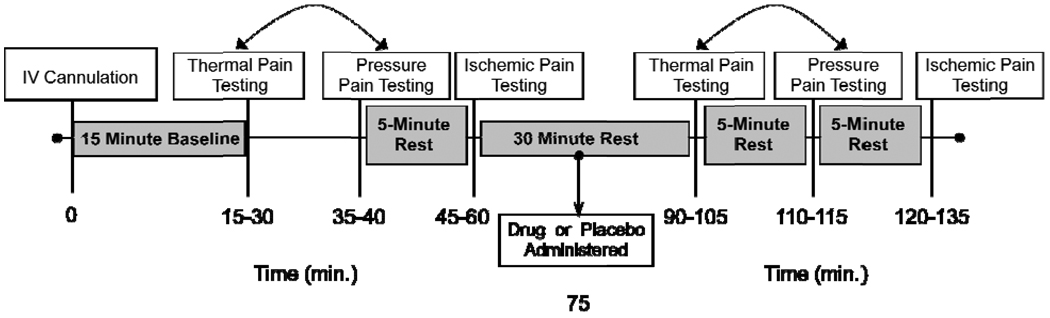
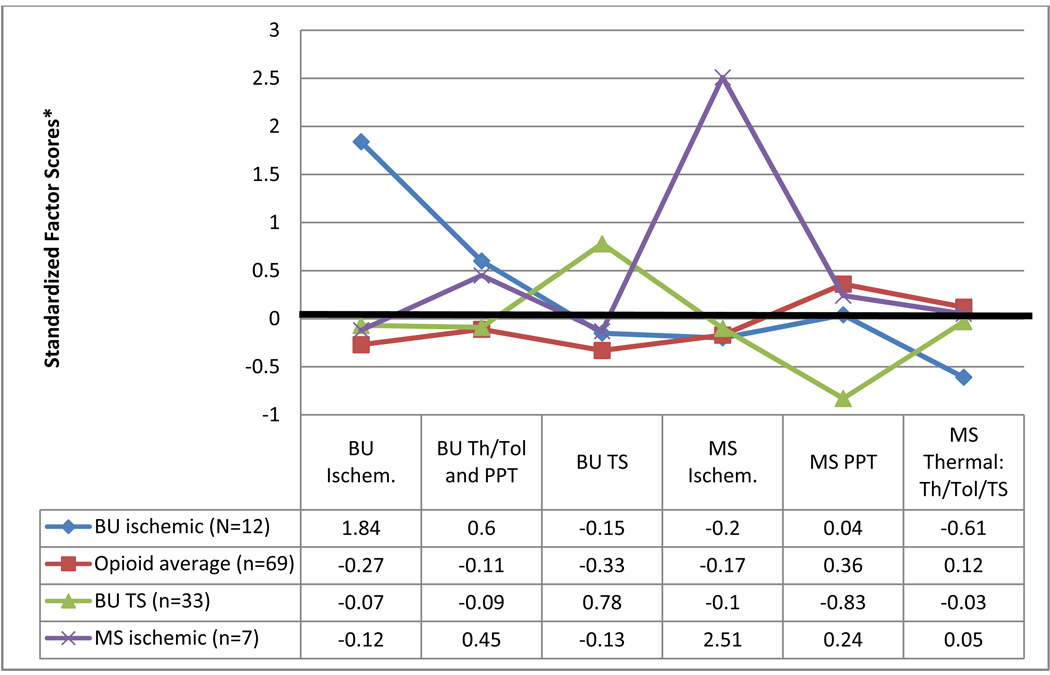
Given our limited ability to predict analgesic efficacy, further research is needed to understand factors influencing analgesic response patterns. The aim of this study was to better understand the relationship between morphine and butorphanol analgesic efficacy tested against multiple pain modalities within the same individuals. Participants included healthy men (n = 72) and women (n = 67) who underwent thermal, pressure, and ischemic experimental pain testing before and after the double-blind administration of morphine and butorphanol during separate testing sessions. Factor analysis revealed 6 factors with analgesic effects grouped primarily by pain modality and specific to either morphine or butorphanol. Hierarchical cluster analysis of individual factor scores led to 4 distinct drug response profiles. Three groups displayed exceptional analgesic efficacy produced by 1 type of opioid on 1 pain stimulus modality, whereas the fourth drug response profile was characterized by average analgesic efficacy across all pain modalities for both opioids. These findings suggest that opioids with varying efficacy at the μ and κ receptors produce independent effects on unique pain mechanisms and that individual responsiveness for some is dependent on pain mechanism and opioid type, although a subset of the population is moderately responsive to opioids regardless of efficacy of receptor binding or predominant pain mechanism being activated.
This investigation provides a foundation for understanding patterns of opioid efficacy in varying types of pain. Our findings suggest that opioid response patterns are more complex than originally thought with about half of individuals exhibiting opioid and pain modality specific analgesic response profiles.
鉴于我们预测镇痛疗效的能力有限,需要进一步研究以了解影响镇痛反应模式的因素。本研究旨在更好地了解同一人群中多种疼痛模式下吗啡和丁丙诺啡镇痛疗效之间的关系。参与者包括健康男性(n = 72)和女性(n = 67),他们在接受双盲吗啡和丁丙诺啡给药前后分别进行了热、压和缺血性实验性疼痛测试。因子分析显示,6 个因素具有镇痛作用,主要按疼痛模式分组,且特定于吗啡或丁丙诺啡。个体因子评分的层次聚类分析导致了 4 种不同的药物反应谱。三组显示出由 1 种阿片类药物对 1 种疼痛刺激模式产生的异常镇痛效果,而第四种药物反应谱的特点是两种阿片类药物在所有疼痛模式下的平均镇痛效果。这些发现表明,μ 和 κ 受体具有不同疗效的阿片类药物对独特的疼痛机制产生独立的影响,而某些个体的反应能力取决于疼痛机制和阿片类药物类型,尽管人群中有一部分对阿片类药物的反应中等,而不管受体结合的疗效或激活的主要疼痛机制如何。
这项研究为理解不同类型疼痛中的阿片类药物疗效模式提供了基础。我们的发现表明,阿片类药物的反应模式比最初想象的要复杂得多,大约一半的个体表现出阿片类药物和疼痛模式特异性的镇痛反应谱。