Department of Pediatrics, Duke University School of Medicine, Durham, NC; Duke Clinical Research Institute, Duke University Medical Center, Durham, NC 27715, USA.
Am Heart J. 2010 Dec;160(6):1099-104. doi: 10.1016/j.ahj.2010.08.010.
The use of clinical registries and administrative data sets in pediatric cardiovascular research has become increasingly common. However, this approach is limited by relatively few existing datasets, each of which contain limited data, and do not communicate with one another. We describe the implementation and validation of methodology using indirect patient identifiers to link The Society of Thoracic Surgeons Congenital Heart Surgery (STS-CHS) Database to The Pediatric Health Information Systems (PHIS) Database (a pediatric administrative database).
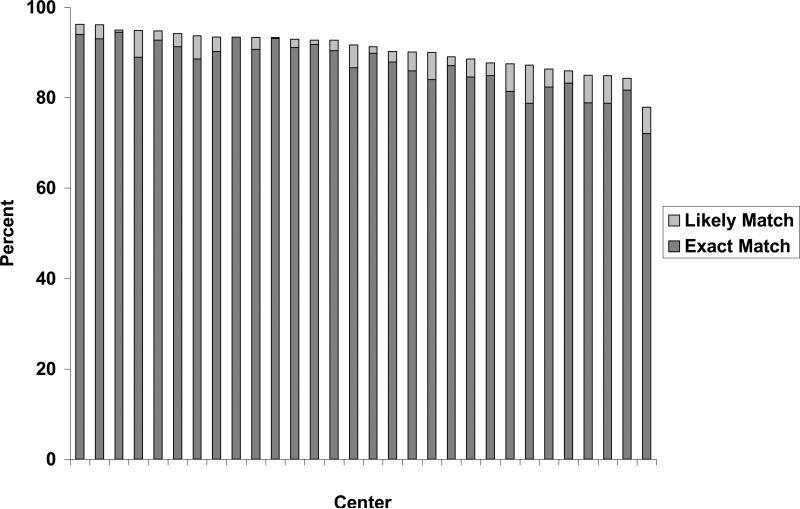
Centers submitting data to STS-CHS and PHIS during 2004 to 2008 were included (n=30). Both data sets were limited to patients 0 to 18 years old undergoing cardiac surgery. An exact match was defined as an exact match on each of the following: date of birth, date of admission, date of discharge, sex, and center. Likely matches were defined as an exact match for all variables except ±1 day for one of the date variables.
Of 45,830 STS-CHS records, 87.4% matched to PHIS using the exact match criteria and 90.3% using the exact or likely match criteria. Validation in a subset of patients revealed that 100% of exact and likely matches were true matches.
This analysis demonstrates that indirect identifiers can be used to create high-quality link between a clinical registry and administrative data set in the congenital heart surgery population. This methodology, which can also be applied to other data sets, allows researchers to capitalize on the strengths of both types of data and expands the pool of data available to answer important clinical questions.
临床注册和行政数据集在儿科心血管研究中的应用越来越普遍。然而,这种方法受到相对较少的现有数据集的限制,每个数据集都包含有限的数据,并且彼此之间无法交流。我们描述了使用间接患者标识符将胸外科医师学会先天性心脏病手术(STS-CHS)数据库链接到儿科健康信息系统(PHIS)数据库(儿科行政数据库)的方法的实施和验证。
包括 2004 年至 2008 年期间向 STS-CHS 和 PHIS 提交数据的中心(n=30)。两个数据集均限于 0 至 18 岁接受心脏手术的患者。精确匹配定义为以下各项的精确匹配:出生日期、入院日期、出院日期、性别和中心。可能的匹配定义为所有变量的精确匹配,但日期变量中的一个变量允许 ±1 天的差异。
在 45830 个 STS-CHS 记录中,87.4%使用精确匹配标准与 PHIS 匹配,90.3%使用精确或可能匹配标准匹配。在患者的一个亚组中进行的验证表明,100%的精确和可能匹配都是真实匹配。
这项分析表明,间接标识符可用于在先天性心脏病手术人群中创建临床注册和行政数据集之间的高质量链接。这种方法也可应用于其他数据集,使研究人员能够利用这两种类型数据的优势,并扩大可用于回答重要临床问题的数据集池。