Health Behavior Research Center, Department of Psychiatry, University of Vermont, 1 South Prospect Street, Burlington, VT 05401, USA.
Drug Alcohol Depend. 2011 Jun 1;115(3):205-12. doi: 10.1016/j.drugalcdep.2010.10.022. Epub 2010 Dec 13.
Research on the relation of stress to alcohol consumption is inconsistent regarding the direction of effects, and this association has been shown to vary by sex and type of stress. We sought to build upon the stress-drinking literature by examining the direction of the stress-drinking association over time as well as sex and stressor differences using daily data.
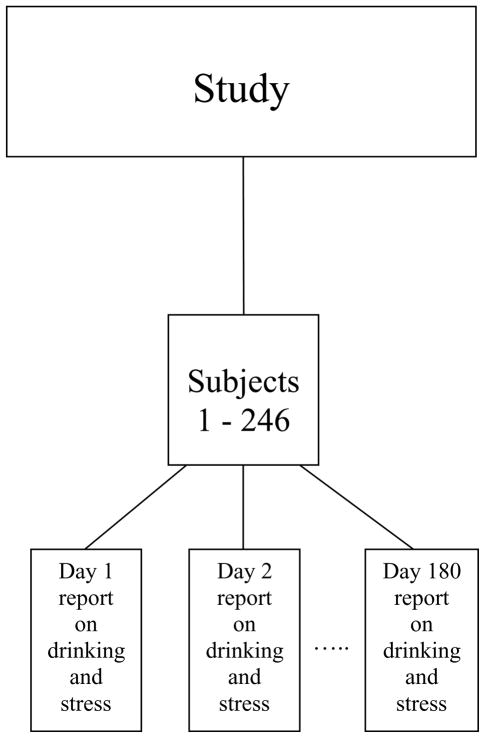
246 heavy drinking adults (67% men) aged 21-82 reported daily stress levels and alcohol consumption over 180 days using Interactive Voice Response (IVR). Baseline daily hassles were examined as an alternative measure of stress. Generalized estimating equations (GEEs) were conducted to test the stress-drinking association accounting for alcohol dependency at baseline and sex and stressor type as moderators.
IVR daily stress predicted increased alcohol consumption the following day, whereas baseline level of daily hassles did not. Examining the opposite direction of effects, IVR ratings of daily alcohol consumption predicted decreased next-day stress. Stress predicted higher alcohol consumption the next day for men but there was no significant association for women. For both sexes, drinking predicted decreased stress the next day, but this effect was stronger for women.
This study generally supported the drinking to cope and self-medication hypotheses, with findings that increased stress led to increased drinking. The time-varying relation between stress and alcohol appears to be sex- and measure-specific, however. Therefore, interventions targeted at stress management found to be effective for one sex should not be presumed to be applicable to the other.
关于压力与饮酒之间关系的研究在影响方向上不一致,而且这种关联已被证明因性别和压力类型而异。我们试图通过使用日常数据来检验随着时间的推移压力与饮酒之间关联的方向以及性别和压力源差异,从而在压力与饮酒的文献基础上更进一步。
246 名年龄在 21-82 岁之间的重度饮酒成年人(67%为男性)使用交互式语音应答(IVR)系统在 180 天内每天报告压力水平和饮酒量。将基线日常烦心事作为压力的替代测量指标进行检查。使用广义估计方程(GEE)检验压力与饮酒之间的关联,同时考虑到基线时的酒精依赖程度以及性别和压力源类型的调节作用。
IVR 每日压力预测次日饮酒量增加,而基线水平的每日烦心事则没有预测作用。检验相反的影响方向,IVR 对每日饮酒量的评定预测次日压力降低。压力预测男性次日饮酒量增加,但女性则没有显著关联。对于男性和女性,饮酒预测次日压力降低,但女性的效果更强。
本研究总体上支持了饮酒应对和自我药物治疗的假设,发现压力增加会导致饮酒量增加。然而,压力和酒精之间的时变关系似乎具有性别和测量特异性。因此,针对某一性别有效的压力管理干预措施不应假定适用于另一性别。