Glomerular Disease Therapeutics Laboratory, and Nephrology Research and Training Center, University of Alabama at Birmingham, Birmingham, Alabama, USA.
Nat Med. 2011 Jan;17(1):117-22. doi: 10.1038/nm.2261. Epub 2010 Dec 12.
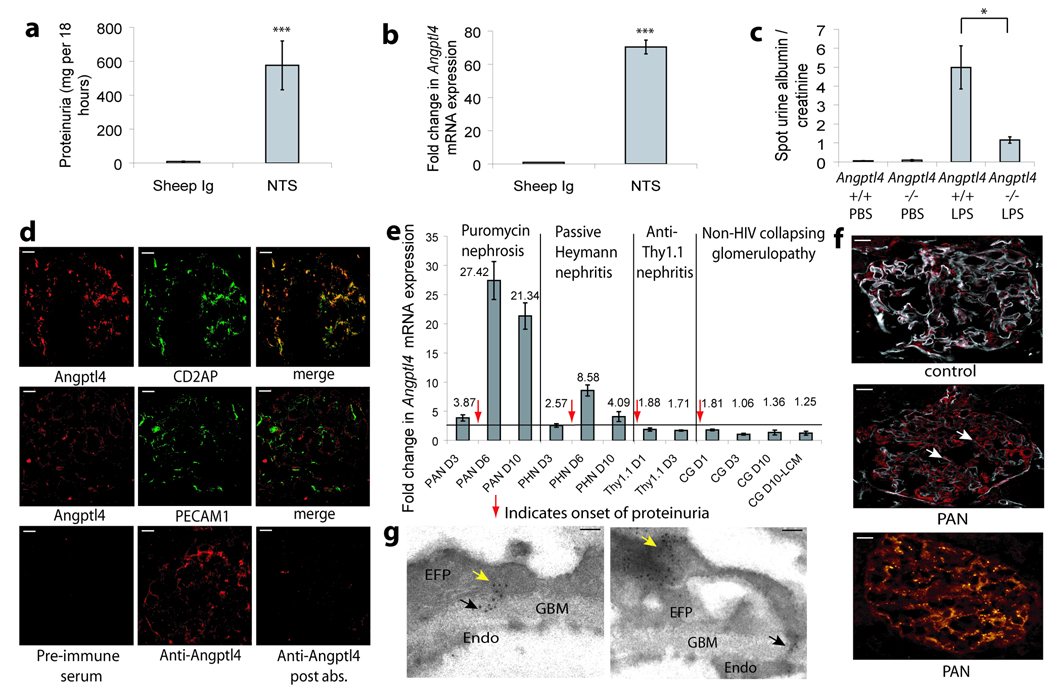
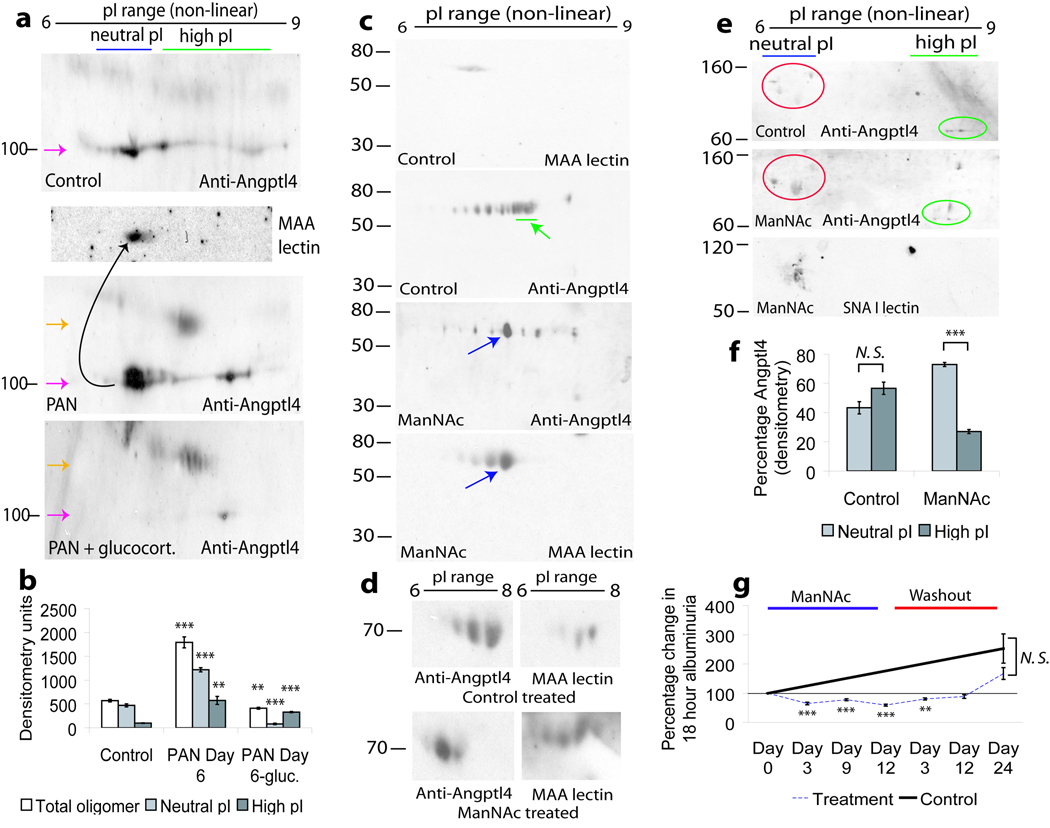
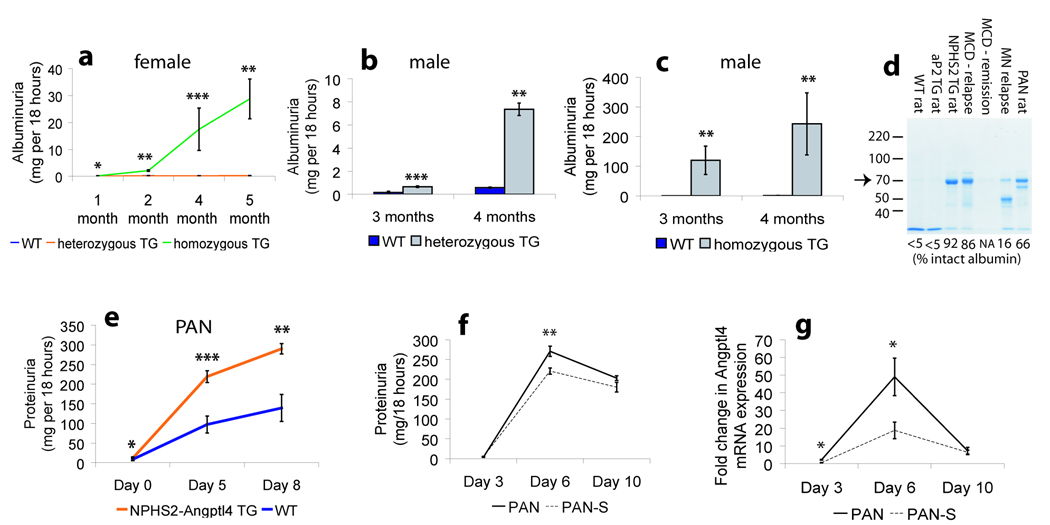
The main manifestations of nephrotic syndrome include proteinuria, hypoalbuminemia, edema, hyperlipidemia and lipiduria. Common causes of nephrotic syndrome are diabetic nephropathy, minimal change disease (MCD), focal and segmental glomerulosclerosis (FSGS) and membranous nephropathy. Among the primary glomerular diseases, MCD is usually sensitive to glucocorticoid treatment, whereas the other diseases show variable responses. Despite the identification of key structural proteins in the glomerular capillary loop which may contribute to defects in ultrafiltration, many of the disease mechanisms of nephrotic syndrome remain unresolved. In this study, we show that the glomerular expression of angiopoietin-like-4 (Angptl4), a secreted glycoprotein, is glucocorticoid sensitive and is highly upregulated in the serum and in podocytes in experimental models of MCD and in the human disease. Podocyte-specific transgenic overexpression of Angptl4 (NPHS2-Angptl4) in rats induced nephrotic-range, and selective, proteinuria (over 500-fold increase in albuminuria), loss of glomerular basement membrane (GBM) charge and foot process effacement, whereas transgenic expression specifically in the adipose tissue (aP2-Angptl4) resulted in increased circulating Angptl4, but no proteinuria. Angptl4(-/-) mice that were injected with lipopolysaccharide (LPS) or nephritogenic antisera developed markedly less proteinuria than did control mice. Angptl4 secreted from podocytes in some forms of nephrotic syndrome lacks normal sialylation. When we fed the sialic acid precursor N-acetyl-D-mannosamine (ManNAc) to NPHS2-Angptl4 transgenic rats it increased the sialylation of Angptl4 and decreased albuminuria by more than 40%. These results suggest that podocyte-secreted Angptl4 has a key role in nephrotic syndrome.
肾病综合征的主要表现包括蛋白尿、低白蛋白血症、水肿、高脂血症和脂尿。肾病综合征的常见病因包括糖尿病肾病、微小病变病(MCD)、局灶节段性肾小球硬化(FSGS)和膜性肾病。在原发性肾小球疾病中,MCD 通常对糖皮质激素治疗敏感,而其他疾病则表现出不同的反应。尽管已经鉴定出肾小球毛细血管袢中的关键结构蛋白可能导致超滤缺陷,但肾病综合征的许多发病机制仍未得到解决。在这项研究中,我们表明,血管生成素样蛋白 4(Angptl4)的肾小球表达是糖皮质激素敏感的,并且在 MCD 的实验模型和人类疾病中,血清和足细胞中的表达高度上调。Angptl4 在大鼠肾小球中的特异性过表达(NPHS2-Angptl4)诱导了肾病范围的、选择性的蛋白尿(白蛋白尿增加 500 倍以上)、肾小球基底膜(GBM)电荷丧失和足突融合,而特异性在脂肪组织中的过表达(aP2-Angptl4)导致循环 Angptl4 增加,但没有蛋白尿。注射脂多糖(LPS)或肾炎抗血清的 Angptl4(-/-) 小鼠比对照小鼠产生的蛋白尿明显减少。某些形式的肾病综合征中从足细胞分泌的 Angptl4 缺乏正常的唾液酸化。当我们用唾液酸前体 N-乙酰-D-甘露糖胺(ManNAc)喂养 NPHS2-Angptl4 转基因大鼠时,它增加了 Angptl4 的唾液酸化,并使白蛋白尿减少了 40%以上。这些结果表明,足细胞分泌的 Angptl4 在肾病综合征中起关键作用。