House Andrew A, Haapio Mikko, Lentini Paolo, Bobek Ilona, de Cal Massimo, Cruz Dinna N, Virzì Grazia M, Carraro Rizzieri, Gallo Giampiero, Piccinni Pasquale, Ronco Claudio
Division of Nephrology, London Health Sciences Center, London, Canada N6A 5A5.
Int J Nephrol. 2010 Dec 2;2011:413760. doi: 10.4061/2011/413760.
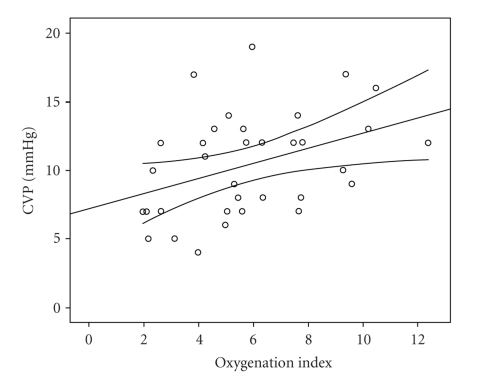
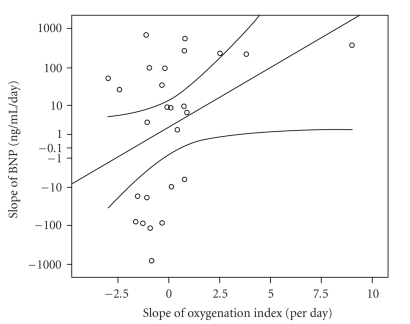
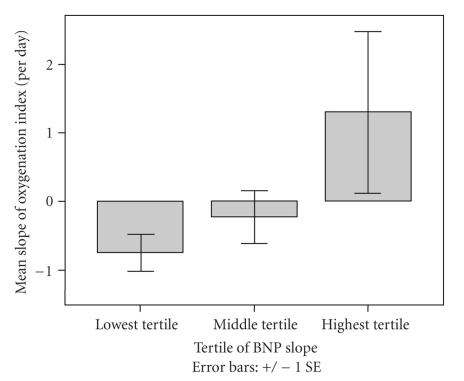
Purpose. Strategies for volume assessment of critically ill patients are limited, yet early goal-directed therapy improves outcomes. Central venous pressure (CVP), Bioimpedance Vectorial Analysis (BIVA), and brain natriuretic peptide (BNP) are potentially useful tools. We studied the utility of these measures, alone and in combination, to predict changing oxygenation. Methods. Thirty-four mechanically ventilated patients, 26 of whom had data beyond the first study day, were studied. Relationships were assessed between CVP, BIVA, BNP, and oxygenation index (O(2)I) in a cross-sectional (baseline) and longitudinal fashion using both univariate and multivariable modeling. Results. At baseline, CVP and O(2)I were positively correlated (R = 0.39; P = .021), while CVP and BIVA were weakly correlated (R = -0.38; P = .025). The association between slopes of variables over time was negligible, with the exception of BNP, whose slope was correlated with O(2)I (R = 0.40; P = .044). Comparing tertiles of CVP, BIVA, and BNP slopes with the slope of O(2)I revealed only modest agreement between BNP and O(2)I (kappa = 0.25; P = .067). In a regression model, only BNP was significantly associated with O(2)I; however, this was strengthened by including CVP in the model. Conclusions. BNP seems to be a valuable noninvasive measure of volume status in critical care and should be assessed in a prospective manner.
目的。评估危重症患者容量的策略有限,但早期目标导向治疗可改善预后。中心静脉压(CVP)、生物电阻抗矢量分析(BIVA)和脑钠肽(BNP)是潜在有用的工具。我们研究了这些指标单独及联合使用对预测氧合变化的效用。方法。对34例机械通气患者进行研究,其中26例患者的数据超过首个研究日。采用单变量和多变量建模,以横断面(基线)和纵向方式评估CVP、BIVA、BNP与氧合指数(O₂I)之间的关系。结果。在基线时,CVP与O₂I呈正相关(R = 0.39;P = 0.021),而CVP与BIVA呈弱相关(R = -0.38;P = 0.025)。除BNP外,各变量随时间变化的斜率之间的关联可忽略不计,BNP的斜率与O₂I相关(R = 0.40;P = 0.044)。将CVP、BIVA和BNP斜率的三分位数与O₂I的斜率进行比较,结果显示BNP与O₂I之间仅有适度一致性(kappa = 0.25;P = 0.067)。在回归模型中,只有BNP与O₂I显著相关;然而,将CVP纳入模型后这种相关性增强。结论。BNP似乎是危重症护理中评估容量状态的一种有价值的非侵入性指标,应进行前瞻性评估。