Cao Jianghong, Wang Beibei, Zhu Lili, Song Lu
Department of Intensive Care Unit, Shanxi Provincial People's Hospital, Taiyuan, China.
Department of Cardiology, The First People's Hospital of Jinzhong, Jinzhong, China.
Front Physiol. 2022 Jul 15;13:858046. doi: 10.3389/fphys.2022.858046. eCollection 2022.
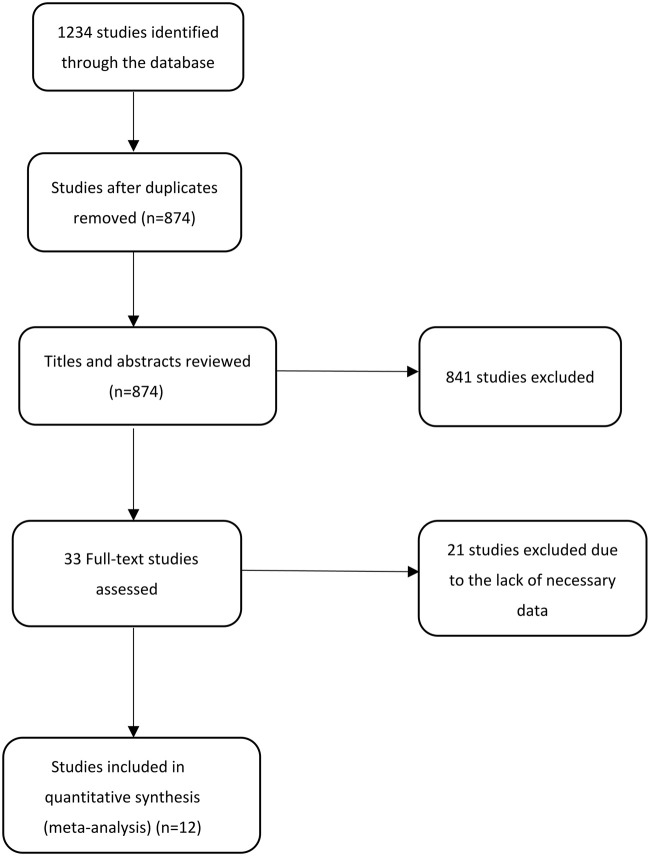
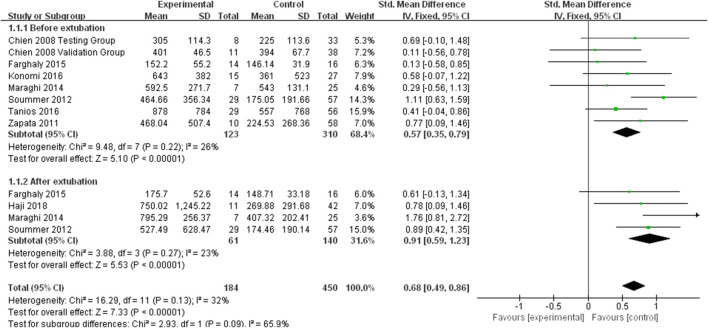
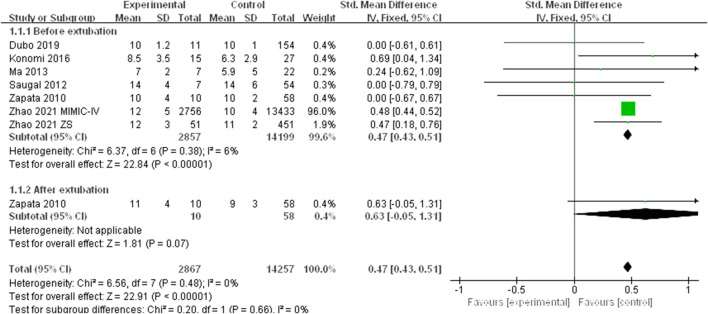
Cardiac insufficiency has been considered to be a common cause of extubation failure. Some studies have shown that central venous pressure (CVP) and brain natriuretic peptide (BNP) are able to predict extubation outcomes. Therefore, we conducted a pooled analysis to evaluate the potential of CVP and BNP levels as predictors of extubation outcomes, using a cohort of critically ill patients who were on mechanical ventilation (MV). We searched three online electronic databases up to October 2021. All data were analyzed using Review Manager 5.4. For each study, the analysis was performed using standardized mean differences (SMD) with 95% confidence intervals (CI). The pooled analysis of seven studies on CVP levels and extubation outcomes showed that elevated CVP levels were significantly associated with extubation failure (SMD:0.47, 95% CI: 0. 43-0.51, < 0.00001). This association also appeared before extubation (SMD:0.47, 95% CI: 0. 43-0.51, < 0.00001), but it did not appear after extubation (SMD: 0.63, 95% CI: -0.05-1.31, =0.07). Similarly, pooled analysis of eight studies on BNP levels and extubation outcomes showed that increased BNP levels are closely related to extubation failure (SMD:0.68, 95% CI: 0.49-0.86, < 0.00001). This relationship also occurs before (SMD: 0.57, 95% CI: 0.35-0.79, < 0.00001) and after (SMD: 0.91, 95% CI: 0.59-1.23, < 0.00001) extubation. This study showed that elevated CVP and BNP levels are associated with extubation failure in critically ill patients. However, BNP levels are more valuable than CVP levels in predicting extubation outcomes.
心脏功能不全一直被认为是拔管失败的常见原因。一些研究表明,中心静脉压(CVP)和脑钠肽(BNP)能够预测拔管结果。因此,我们进行了一项汇总分析,以评估CVP和BNP水平作为拔管结果预测指标的潜力,研究对象为一组接受机械通气(MV)的重症患者。我们检索了截至2021年10月的三个在线电子数据库。所有数据均使用Review Manager 5.4进行分析。对于每项研究,分析采用标准化均数差(SMD)和95%置信区间(CI)。对七项关于CVP水平与拔管结果的研究进行的汇总分析表明,CVP水平升高与拔管失败显著相关(SMD:0.47,95%CI:0.43 - 0.51,<0.00001)。这种关联在拔管前也存在(SMD:0.47,95%CI:0.43 - 0.51,<0.00001),但在拔管后不存在(SMD:0.63,95%CI: - 0.05 - 1.31,=0.07)。同样,对八项关于BNP水平与拔管结果的研究进行的汇总分析表明,BNP水平升高与拔管失败密切相关(SMD:0.68,95%CI:0.49 - 0.86,<0.00001)。这种关系在拔管前(SMD:0.57,95%CI:0.35 - 0.79,<0.00001)和拔管后(SMD:0.91,95%CI:0.59 - 1.23,<0.00001)均存在。这项研究表明,CVP和BNP水平升高与重症患者的拔管失败有关。然而,在预测拔管结果方面,BNP水平比CVP水平更有价值。