Jäger Simon, Stange Eduard F, Wehkamp Jan
Department of Internal Medicine I, Robert Bosch Hospital, Dr. Margarete Fischer-Bosch-Institute of Clinical Pharmacology, Auerbachstr. 112, 70376 Stuttgart, Germany.
Int J Inflam. 2010 Nov 25;2010:910283. doi: 10.4061/2010/910283.
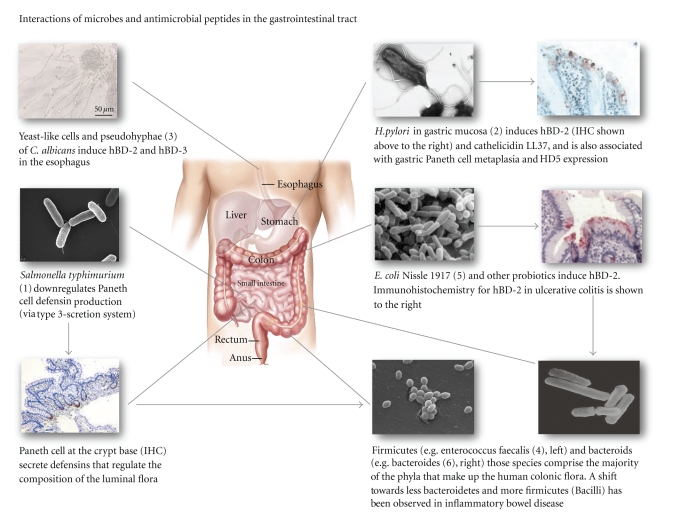
Acute and chronic inflammations of mucosal surfaces are complex events in which the effector mechanisms of innate and adaptive immune systems interact with pathogenic and commensal bacteria. The role of constitutive and inducible antimicrobial peptides in intestinal inflammation has been investigated thoroughly over the recent years, and their involvement in various disease states is expanded ever more. Especially in the intestines, a critical balance between luminal bacteria and the antimicrobial peptides is essential, and a breakdown in barrier function by impaired production of defensins is already implicated in Crohn's disease. In this paper, we focus on the role of antimicrobial peptides in inflammatory processes along the gastrointestinal tract, while considering the resident and pathogenic flora encountered at the specific sites. The role of antimicrobial peptides in the primary events of inflammatory bowel diseases receives special attention.
黏膜表面的急性和慢性炎症是复杂的过程,其中固有免疫系统和适应性免疫系统的效应机制与致病细菌和共生细菌相互作用。近年来,组成型和诱导型抗菌肽在肠道炎症中的作用已得到充分研究,并且它们在各种疾病状态中的参与度也在不断扩大。特别是在肠道中,管腔细菌和抗菌肽之间的关键平衡至关重要,防御素产生受损导致的屏障功能破坏已被认为与克罗恩病有关。在本文中,我们关注抗菌肽在胃肠道炎症过程中的作用,同时考虑在特定部位遇到的常驻菌群和致病菌群。抗菌肽在炎症性肠病主要事件中的作用受到特别关注。