Department of Biology, Hull York Medical School, Centre for Immunology and Infection, University of York, York, United Kingdom.
PLoS Negl Trop Dis. 2010 Dec 7;4(12):e906. doi: 10.1371/journal.pntd.0000906.
Diverse clinical features have been reported in human African trypanosomiasis (HAT) foci caused by Trypanosoma brucei rhodesiense (T.b.rhodesiense) giving rise to the hypothesis that HAT manifests as a chronic disease in South-East African countries and increased in virulence towards the North. Such variation in disease severity suggests there are differences in host susceptibility to trypanosome infection and/or genetic variation in trypanosome virulence. Our molecular tools allow us to study the role of host and parasite genotypes, but obtaining matched extensive clinical data from a large cohort of HAT patients has previously proved problematic.
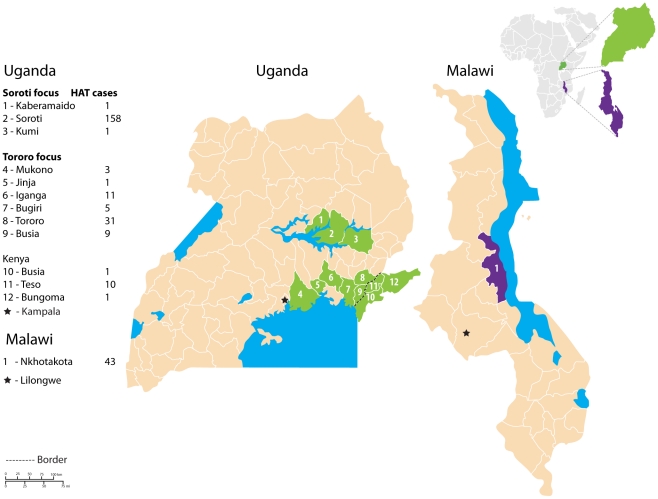
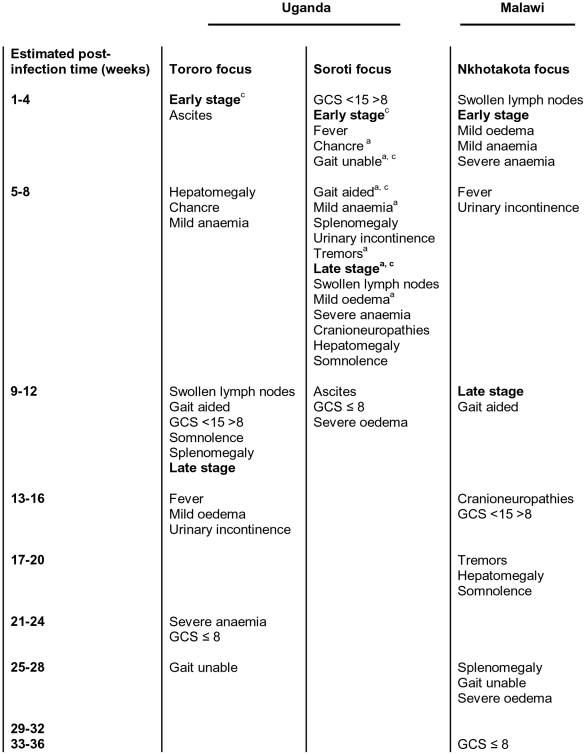
METHODS/PRINCIPAL FINDINGS: We present a retrospective cohort study providing detailed clinical profiles of 275 HAT patients recruited in two northern foci (Uganda) and one southern focus (Malawi) in East Africa. Characteristic clinical signs and symptoms of T.b.rhodesiense infection were recorded and the degree of neurological dysfunction determined on admission. Clinical observations were mapped by patient estimated post-infection time. We have identified common presenting symptoms in T.b.rhodesiense infection; however, marked differences in disease progression and severity were identified between foci. HAT was characterised as a chronic haemo-lymphatic stage infection in Malawi, and as an acute disease with marked neurological impairment in Uganda. Within Uganda, a more rapid progression to meningo-encephaltic stage of infection was observed in one focus (Soroti) where HAT was characterised by early onset neurodysfunction; however, severe neuropathology was more frequently observed in patients in a second focus (Tororo).
CONCLUSIONS/SIGNIFICANCE: We have established focus-specific HAT clinical phenotypes showing dramatic variations in disease severity and rate of stage progression both between northern and southern East African foci and between Ugandan foci. Understanding the contribution of host and parasite factors in causing such clinical diversity in T.b.rhodesiense HAT has much relevance for both improvement of disease management and the identification of new drug therapy.
不同的临床特征已在由布氏冈比亚锥虫(T.b.rhodesiense)引起的人类非洲锥虫病(HAT)病灶中报告,这导致了这样的假设,即 HAT 在东南非国家表现为慢性疾病,并向北增加了毒力。这种疾病严重程度的变化表明宿主对锥虫感染的易感性和/或锥虫毒力的遗传变异存在差异。我们的分子工具使我们能够研究宿主和寄生虫基因型的作用,但从大量 HAT 患者中获得匹配的广泛临床数据以前一直是个问题。
方法/主要发现:我们进行了一项回顾性队列研究,提供了在东非两个北部(乌干达)和一个南部(马拉维)焦点招募的 275 名 HAT 患者的详细临床概况。记录了特征性的临床体征和症状布氏冈比亚锥虫感染,并在入院时确定了神经功能障碍的程度。临床观察通过患者估计感染后的时间进行映射。我们已经确定了布氏冈比亚锥虫感染的常见表现症状;然而,在不同焦点之间,疾病的进展和严重程度存在明显差异。在马拉维,HAT 被定义为慢性血液淋巴期感染;在乌干达,HAT 是一种急性疾病,伴有明显的神经损伤。在乌干达,在一个焦点(索罗蒂)中观察到更快速地进展为脑膜脑炎期感染,其中 HAT 的特征是早期出现神经功能障碍;然而,在第二个焦点(托罗罗)中,更频繁地观察到严重的神经病理学。
结论/意义:我们已经建立了特定焦点的 HAT 临床表型,显示了北部和南部东非焦点之间以及乌干达焦点之间疾病严重程度和阶段进展速度的巨大差异。了解宿主和寄生虫因素在引起布氏冈比亚锥虫 HAT 如此临床多样性中的作用,对于改善疾病管理和确定新的药物治疗都具有重要意义。