Department of Infectious Diseases, Ruijin Hospital, Shanghai Jiaotong University School of Medicine, Shanghai, China.
PLoS One. 2010 Dec 6;5(12):e14237. doi: 10.1371/journal.pone.0014237.
The hepatitis C virus (HCV) Alternate Reading Frame Protein (ARFP or F protein) presents a double-frame shift product of the HCV core gene. We and others have previously reported that the specific antibodies against the F protein could be raised in the sera of HCV chronically infected patients. However, the specific CD4(+) T cell responses against the F protein during HCV infection and the pathological implications remained unclear. In the current study, we screened the MHC class II-presenting epitopes of the F protein through HLA-transgenic mouse models and eventually validated the specific CD4(+) T cell responses in HCV chronically infected patients.
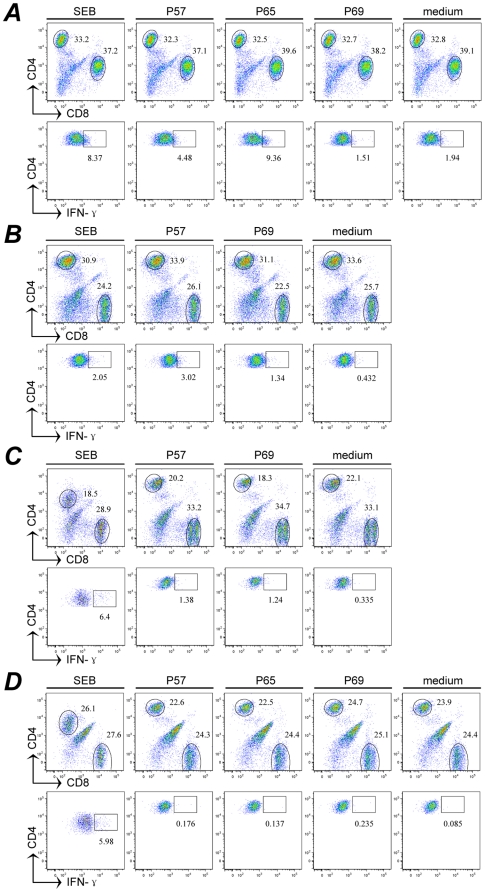
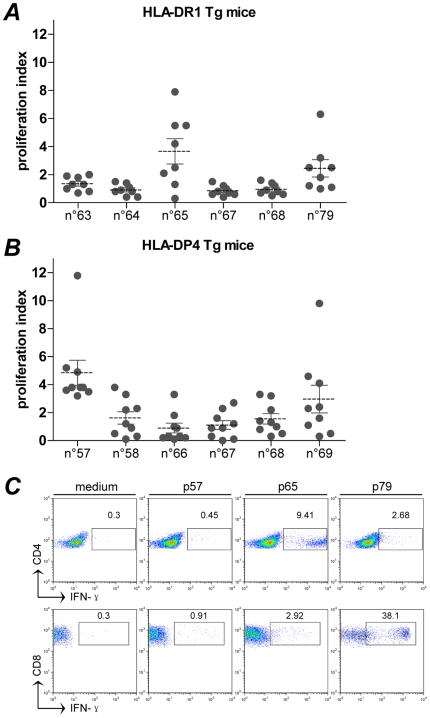
DNA vaccination in HLA-DR1 and-DP4 transgenic mouse models, proliferation assay to test the F protein specific T cell response, genotyping of Chronic HCV patients and testing the F-peptide stimulated T cell response in the peripheral blood mononuclear cell (PBMC) by in vitro expansion and interferon (IFN)- γ intracellular staining.
At least three peptides within HCV F protein were identified as HLA-DR or HLA-DP4 presenting epitopes by the proliferation assays in mouse models. Further study with human PBMCs evidenced the specific CD4(+) T cell responses against HCV F protein as well in patients chronically infected with HCV.
The current study provided the evidence for the first time that HCV F protein could elicit specific CD4(+) T cell response, which may provide an insight into the immunopathogenesis during HCV chronic infection.
丙型肝炎病毒(HCV)的交替阅读框蛋白(ARFP 或 F 蛋白)是 HCV 核心基因的双重移码产物。我们和其他人之前曾报道过,慢性 HCV 感染患者的血清中可以产生针对 F 蛋白的特异性抗体。然而,HCV 感染期间针对 F 蛋白的特异性 CD4+T 细胞反应及其病理意义尚不清楚。在本研究中,我们通过 HLA 转基因小鼠模型筛选 F 蛋白的 MHC Ⅱ类呈递表位,最终在慢性 HCV 感染患者中验证了针对 F 蛋白的特异性 CD4+T 细胞反应。
用 HLA-DR1 和-DP4 转基因小鼠模型进行 DNA 疫苗接种,增殖试验检测 F 蛋白特异性 T 细胞反应,对慢性 HCV 患者进行基因分型,并通过体外扩增和干扰素(IFN)-γ细胞内染色检测 F 肽刺激的外周血单个核细胞(PBMC)中的 T 细胞反应。
通过小鼠模型中的增殖试验,在 HCV F 蛋白内至少鉴定出三个肽段是 HLA-DR 或 HLA-DP4 呈递的表位。对慢性 HCV 感染患者的人 PBMC 进行的进一步研究也证实了针对 HCV F 蛋白的特异性 CD4+T 细胞反应。
本研究首次提供了 HCV F 蛋白可诱导特异性 CD4+T 细胞反应的证据,这可能为 HCV 慢性感染期间的免疫发病机制提供了新的见解。