Department of Biochemistry and Molecular Biology, University of Louisville School of Medicine, Louisville, Kentucky, United States of America.
PLoS One. 2010 Dec 6;5(12):e14238. doi: 10.1371/journal.pone.0014238.
Intracellular vesicle fusion is mediated by the interactions of SNARE (soluble N-ethylmaleimide-sensitive factor attachment protein receptor) proteins on vesicles (v-SNAREs) and on target membranes (t-SNAREs). The vesicle-associated membrane proteins (VAMPs) are v-SNAREs that reside in various post-Golgi vesicular compartments. To fully understand the specific role of each VAMP in vesicle trafficking, it is important to determine if VAMPs have differential membrane fusion activities.
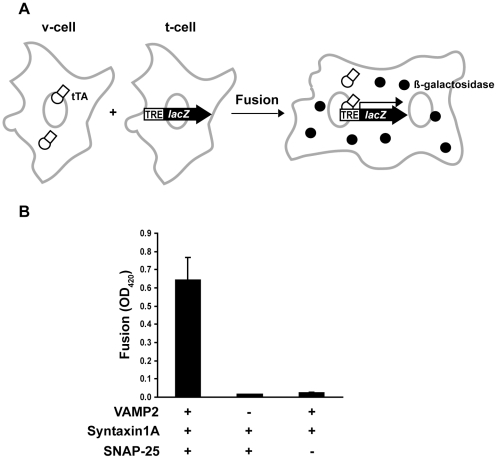
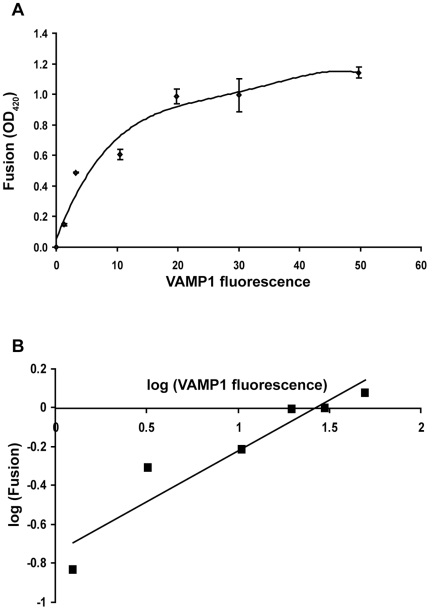
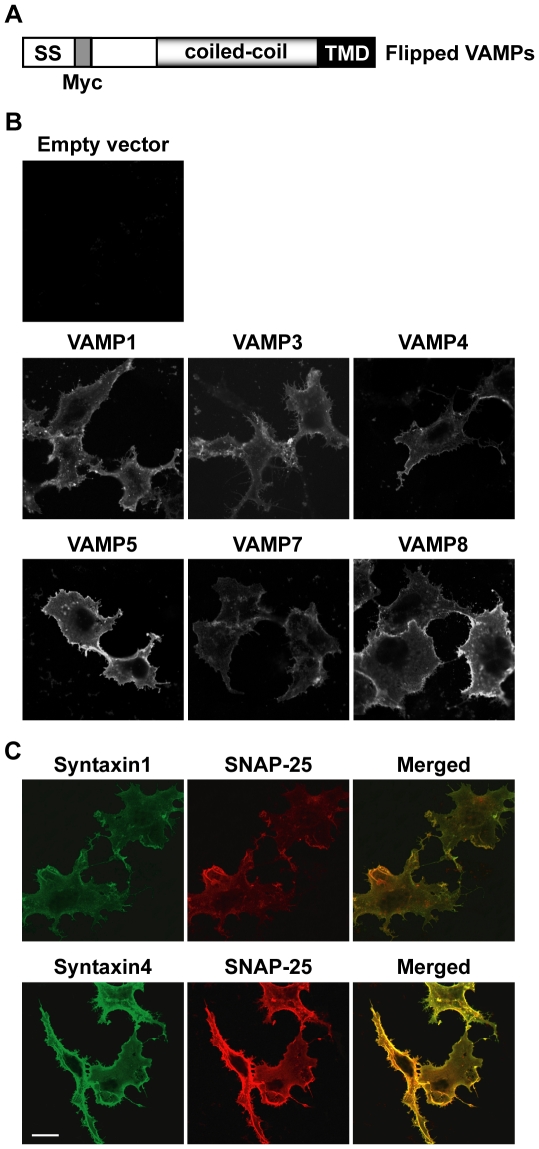
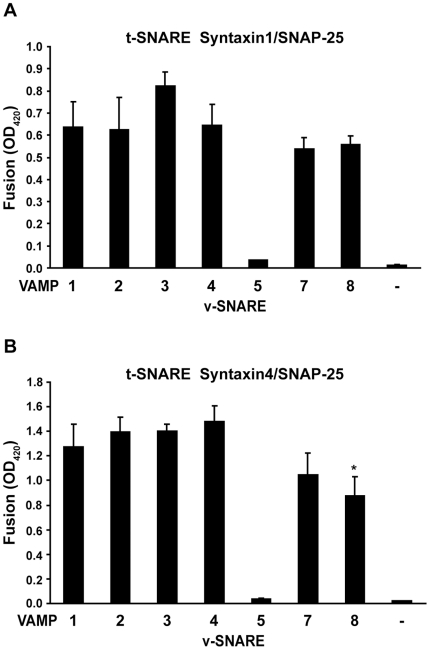
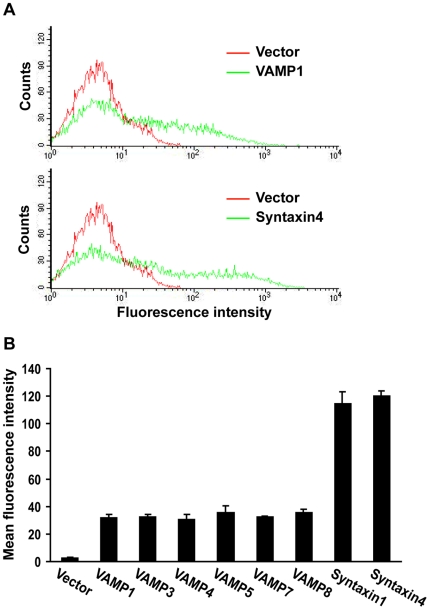
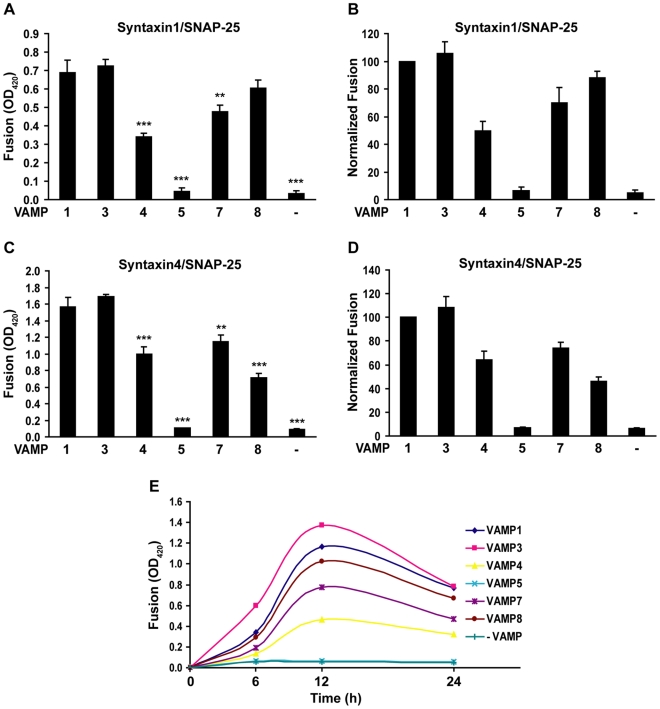
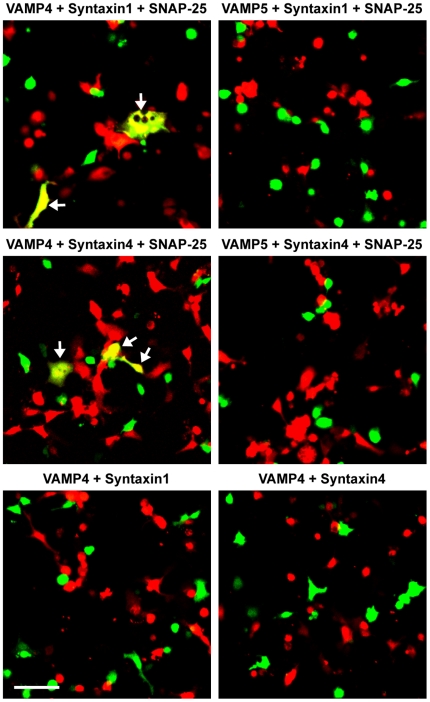
METHODOLOGY/PRINCIPAL FINDINGS: In this study, we developed a cell fusion assay that quantifies SNARE-mediated membrane fusion events by activated expression of β-galactosidase, and examined fusogenic pairings between the seven VAMPs, i.e., VAMPs 1, 2, 3, 4, 5, 7 and 8, and two plasma membrane t-SNARE complexes, syntaxin1/SNAP-25 and syntaxin4/SNAP-25. VAMPs 1, 2, 3, 4, 7 and 8 drove fusion efficiently, whereas VAMP5 was unable to mediate fusion with the t-SNAREs. By expressing VAMPs 1, 3, 4, 7 and 8 at the same level, we further compared their membrane fusion activities. VAMPs 1 and 3 had comparable and the highest fusion activities, whereas VAMPs 4, 7 and 8 exhibited 30-50% lower fusion activities. Moreover, we determined the dependence of cell fusion activity on VAMP1 expression level. Analysis of the dependence data suggested that there was no cooperativity of VAMP proteins in the cell fusion reaction.
CONCLUSIONS/SIGNIFICANCE: These data indicate that VAMPs have differential membrane fusion capacities, and imply that with the exception of VAMP5, VAMPs are essentially redundant in mediating fusion with plasma membrane t-SNAREs.
细胞内囊泡融合是由囊泡(v-SNARE)和靶膜(t-SNARE)上 SNARE(可溶性 N-乙基马来酰亚胺敏感因子附着蛋白受体)蛋白的相互作用介导的。囊泡相关膜蛋白(VAMPs)是存在于各种高尔基后囊泡中的 v-SNARE。为了充分了解每种 VAMP 在囊泡运输中的特定作用,确定 VAMPs 是否具有不同的膜融合活性非常重要。
方法/主要发现:在这项研究中,我们开发了一种细胞融合测定法,通过β-半乳糖苷酶的激活表达来定量测量 SNARE 介导的膜融合事件,并研究了七种 VAMPs(即 VAMPs 1、2、3、4、5、7 和 8)与两种质膜 t-SNARE 复合物( syntaxin1/SNAP-25 和 syntaxin4/SNAP-25)之间的融合配对。VAMPs 1、2、3、4、7 和 8 能有效地驱动融合,而 VAMP5 不能与 t-SNARE 介导融合。通过以相同水平表达 VAMPs 1、3、4、7 和 8,我们进一步比较了它们的膜融合活性。VAMPs 1 和 3 具有可比的和最高的融合活性,而 VAMPs 4、7 和 8 则表现出 30-50%较低的融合活性。此外,我们确定了细胞融合活性对 VAMP1 表达水平的依赖性。对依赖性数据的分析表明,VAMP 蛋白在细胞融合反应中没有协同作用。
结论/意义:这些数据表明 VAMPs 具有不同的膜融合能力,并暗示除了 VAMP5 之外,VAMPs 在介导与质膜 t-SNARE 的融合方面基本上是冗余的。