Kreiman Jody, Gerratt Bruce R, Khan Sameer Ud Dowla
UCLA School of Medicine, Division of Head and Neck Surgery, 31-24 Rehab Center, Los Angeles, CA 90095-1794, Tel: 310-825-0736.
J Phon. 2010 Oct 1;38(4):588-593. doi: 10.1016/j.wocn.2010.08.004.
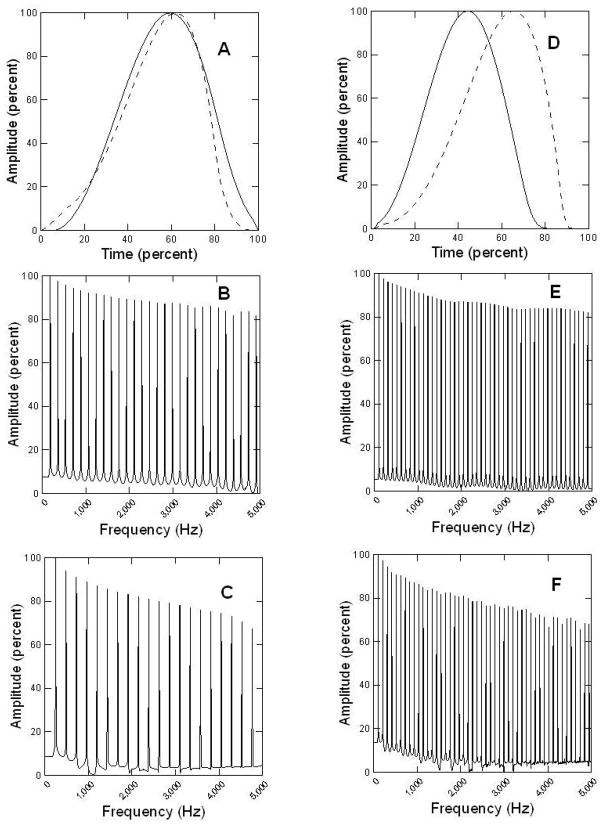
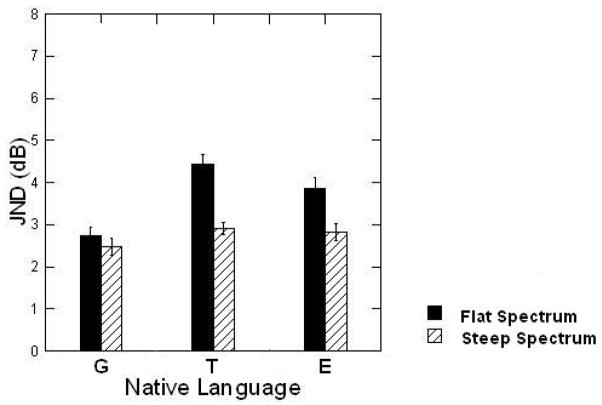
Little is known about how listeners judge phonemic versus allophonic (or freely varying) versus post-lexical variations in voice quality, or about which acoustic attributes serve as perceptual cues in specific contexts. To address this issue, native speakers of Gujarati, Thai, and English discriminated among pairs of voices that differed only in the relative amplitudes of the first versus second harmonics (H1-H2). Results indicate that speakers of Gujarati (which contrasts H1-H2 phonemically) were more sensitive to changes than are speakers of Thai or English. Further, sensitivity was not affected by the overall source spectral slope for Gujarati speakers, unlike Thai and English speakers, who were most sensitive when the spectrum fell away steeply. In combination with previous findings from Mandarin speakers, these results suggest a continuum of sensitivity to H1-H2. In Gujarati, the independence of sensitivity and spectral context is consistent with use of H1-H2 as a cue to the language's phonemic phonation contrast. Speakers of Mandarin, in which creaky phonation occurs in conjunction with the low dipping Tone 3, apparently also learn to hear these contrasts, but sensitivity is conditioned by spectral context. Finally, for Thai and English speakers, who vary phonation only post-lexically, sensitivity is both lower and contextually-determined, reflecting the smaller role of H1-H2 in these languages.
关于听众如何判断语音质量中的音位变异与音位变体(或自由变异)以及词汇后变异,或者关于哪些声学属性在特定语境中作为感知线索,我们所知甚少。为了解决这个问题,古吉拉特语、泰语和英语的母语者对仅在一次谐波与二次谐波(H1 - H2)相对振幅上存在差异的成对声音进行了区分。结果表明,古吉拉特语使用者(其在音位上区分H1 - H2)比泰语或英语使用者对变化更敏感。此外,与泰语和英语使用者不同,古吉拉特语使用者的敏感度不受整体声源频谱斜率的影响,泰语和英语使用者在频谱急剧下降时最为敏感。结合之前对说普通话者的研究结果,这些结果表明对H1 - H2的敏感度存在一个连续体。在古吉拉特语中,敏感度与频谱语境的独立性与将H1 - H2用作该语言音位发声对比线索的情况一致。普通话中,伴随低调的第三声会出现嘎吱声发声,说普通话的人显然也学会了听这些对比,但敏感度受频谱语境制约。最后,对于泰语和英语使用者来说,他们仅在词汇后改变发声方式,其敏感度较低且由语境决定,这反映了H1 - H2在这些语言中的作用较小。