
新型含4,4'-二吡啶基硫醚镍配位聚合物的合成与表征。一维链对外界刺激(温度变化和客体释放/再包合)的动态重排。
Syntheses and characterization of new nickel coordination polymers with 4,4'-dipyridylsulfide. Dynamic rearrangements of one-dimensional chains responding to external stimuli: temperature variation and guest releases/re-inclusions.
作者信息
Kondo Mitsuru, Takahashi Hideaki, Watanabe Hirotaka, Shimizu Yusuke, Yamanishi Katsunori, Miyazawa Makoto, Nishina Naoko, Ishida Yutaka, Kawaguchi Hiroyuki, Uchida Fumio
机构信息
Center for Instrumental Analysis, Shizuoka University, 836 Ohya, Suruga-kul, Shizuoka 422-8529, Japan.
出版信息
Int J Mol Sci. 2010 Aug 2;11(8):2821-38. doi: 10.3390/ijms11082821.
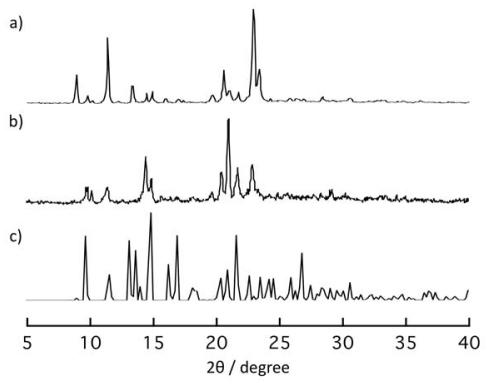
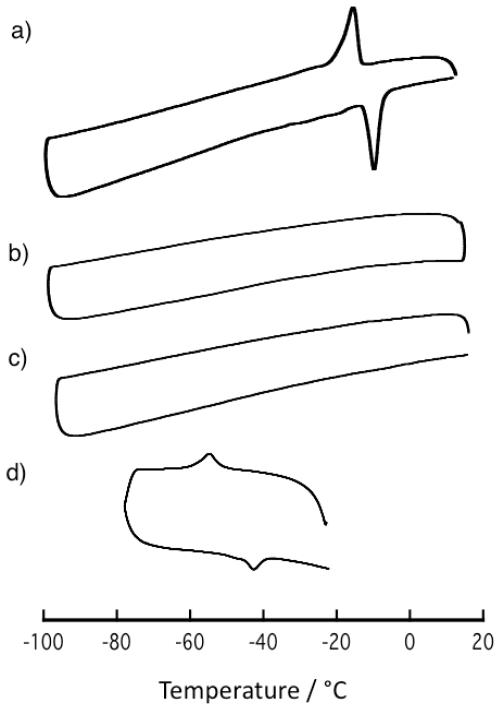
Crystal structures and dynamic rearrangements of one-dimensional coordination polymers with 4,4'-dipyridylsulfide (dps) have been studied. Reaction of Ni(NO(3))(2)·6H(2)O with dps in EtOH yielded [Ni(dps)(2)(NO(3))(2)] ·EtOH (1), which had channels filled with guest EtOH molecules among the four Ni(dps)(2) chains. This coordination polymer reversibly transformed the channel structure responding to temperature variations. Immersion of 1 in m-xylene released guest EtOH molecules to yield a guest-free coordination polymer [Ni(dps)(2)(NO(3))(2)] (2a), which was also obtained by treatment of Ni(NO(3))(2)·6H(2)O with dps in MeOH. On the other hand, removal of the guest molecules from 1 upon heating at 130 °C under reduced pressure produced a guest-free coordination polymer [Ni(dps)(2)(NO(3))(2)] (2b). Although the 2a and 2b guest-free coordination polymers have the same formula, they showed differences in the assembled structures of the one-dimensional chains. Exposure of 2b to EtOH vapor reproduced 1, while 2a did not convert to 1 in a similar reaction. Reaction of Ni(NO(3))(2)·6H(2)O with dps in acetone provided [Ni(dps)(NO(3))(2)(H(2)O)] ·Me(2)CO (4) with no channel structure. When MeOH or acetone was used as a reaction solvent, the [Ni(dps)(2)(NO(3))(2)] · (guest molecule) type coordination polymer, which was observed in 1, was not formed. Nevertheless, the reaction of Ni(NO(3))(2)·6H(2)O with dps in MeOH/acetone mixed solution produced [Ni(dps)(2)(NO(3))(2)]·0.5(MeOH·acetone) (5), which has an isostructural Ni-dps framework to 1.
对含有4,4'-二吡啶硫醚(dps)的一维配位聚合物的晶体结构和动态重排进行了研究。硝酸镍(II)六水合物(Ni(NO₃)₂·6H₂O)与dps在乙醇中反应生成[Ni(dps)₂(NO₃)₂]·EtOH(1),在四条Ni(dps)₂链之间的通道中填充有客体乙醇分子。这种配位聚合物会随着温度变化可逆地转变其通道结构。将1浸入间二甲苯中会释放客体乙醇分子,从而生成无客体配位聚合物[Ni(dps)₂(NO₃)₂](2a),用硝酸镍(II)六水合物与dps在甲醇中反应也可得到2a。另一方面,在减压下于130℃加热使1中的客体分子去除,得到无客体配位聚合物[Ni(dps)₂(NO₃)₂](2b)。尽管2a和2b这两种无客体配位聚合物具有相同的化学式,但它们在一维链的组装结构上存在差异。将2b暴露于乙醇蒸气中可重现1,而在类似反应中2a不会转化为1。硝酸镍(II)六水合物与dps在丙酮中反应得到[Ni(dps)(NO₃)₂(H₂O)]·Me₂CO(4),其没有通道结构。当使用甲醇或丙酮作为反应溶剂时,未形成在1中观察到的[Ni(dps)₂(NO₃)₂]·(客体分子)型配位聚合物。然而,硝酸镍(II)六水合物与dps在甲醇/丙酮混合溶液中反应生成[Ni(dps)₂(NO₃)₂]·0.5(MeOH·acetone)(5),其具有与1同构的Ni-dps骨架。






 Zotero 插件