Stowers Institute for Medical Research, Kansas City, MO 64110, USA.
Mol Biol Cell. 2010 Dec;21(24):4306-11. doi: 10.1091/mbc.E10-05-0451.
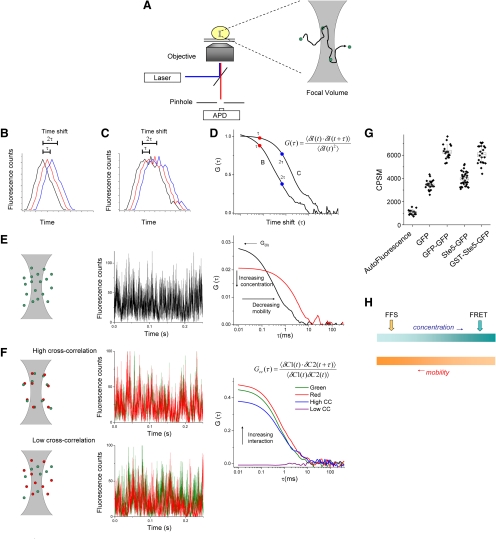
Quantitative description of protein dynamics and interactions in vivo with temporal and spatial resolution is a key step in dissecting molecular mechanisms in cell biology. Fluorescence fluctuation spectroscopy (FFS) has recently emerged as a powerful in vivo tool for assessing molecular concentration and movement and formation of hetero- and homo-oligomeric complexes. This article discusses point FFS-based analysis methods that have proven useful to cell biologists, focusing on the kinds of information they provide, their pros and cons, and the basic instrumentation required. Along the way, we describe briefly a few recent examples where these analyses have helped address important biological questions.
定量描述蛋白质在体内的动态和相互作用,具有时间和空间分辨率,是解析细胞生物学中分子机制的关键步骤。荧光波动光谱(FFS)最近作为一种强大的活体工具出现,可用于评估分子浓度以及同种和异种寡聚体复合物的运动和形成。本文讨论了基于点 FFS 的分析方法,这些方法已被细胞生物学家证明是有用的,重点介绍了它们提供的信息类型、优缺点以及所需的基本仪器。在这个过程中,我们简要描述了一些最近的例子,这些分析有助于解决重要的生物学问题。