Roy and Diana Vagelos Laboratories, Department of Chemistry, University of Pennsylvania, 231 South 34th Street, Philadelphia, Pennsylvania 19104-6323, USA.
Nature. 2011 Jan 6;469(7328):116-20. doi: 10.1038/nature09628. Epub 2010 Dec 15.
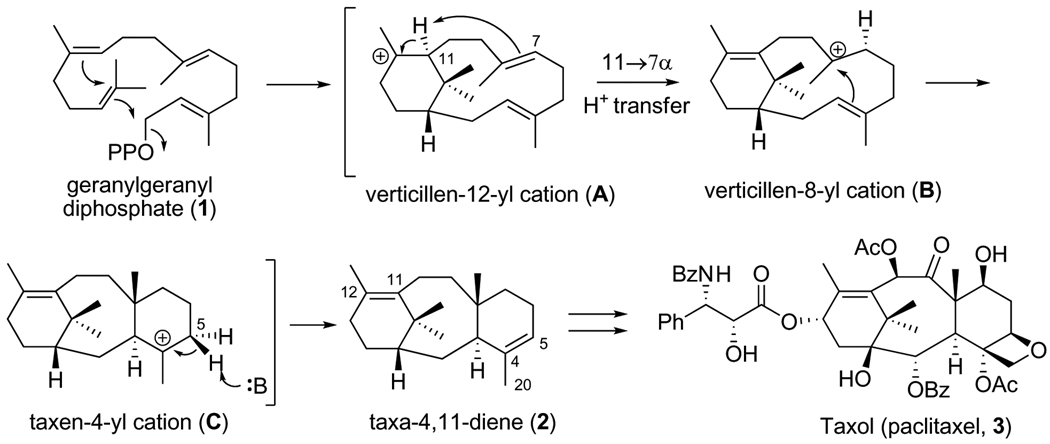
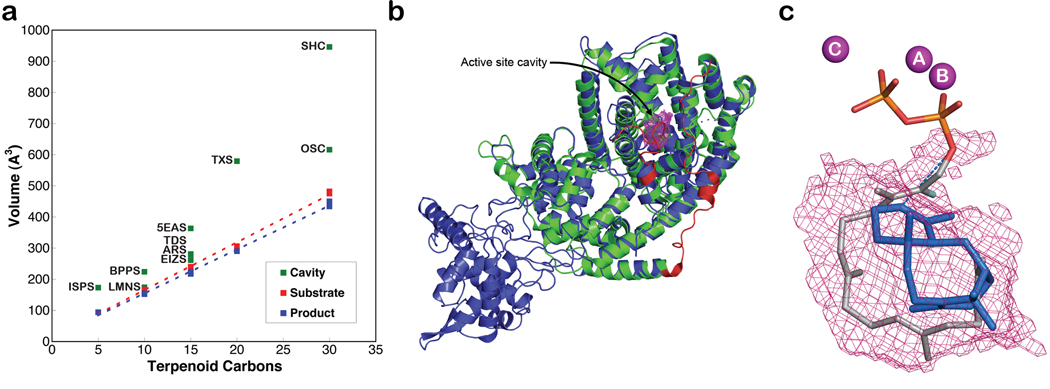
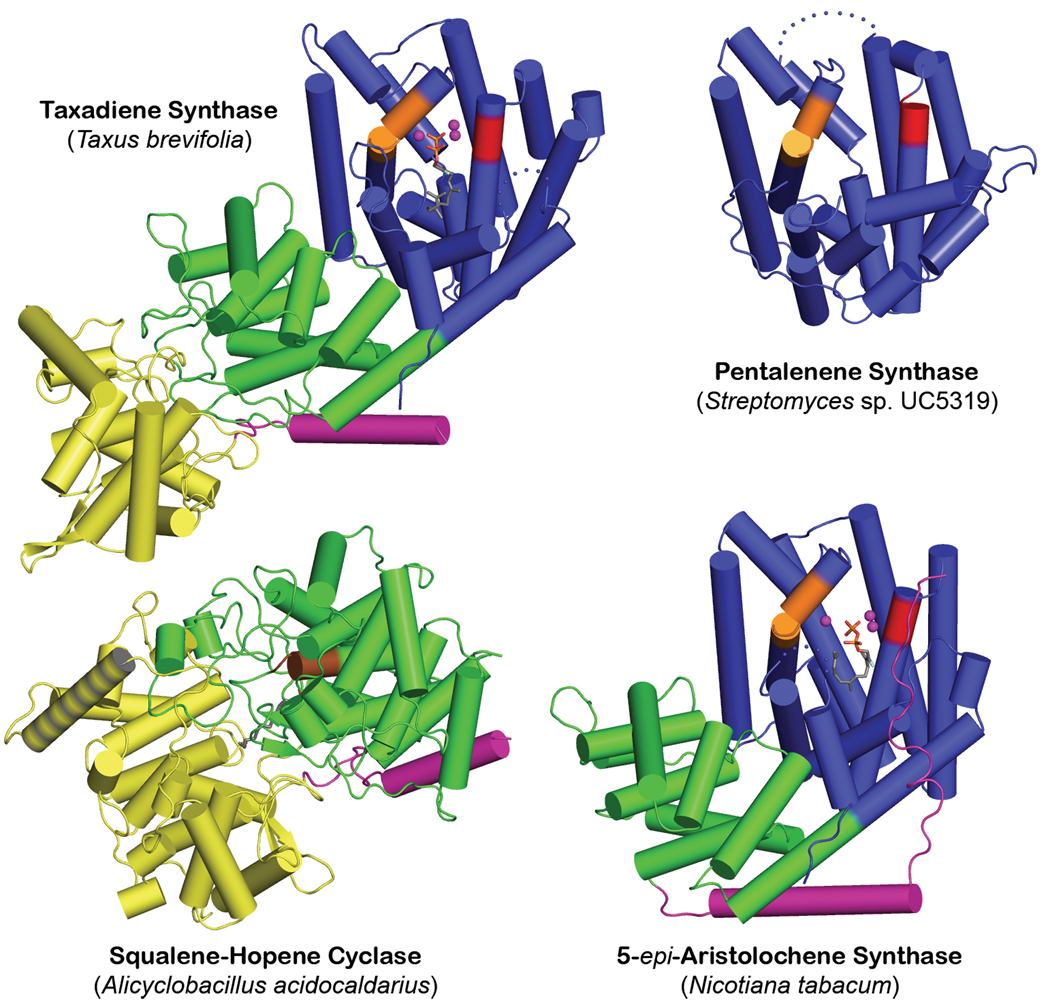
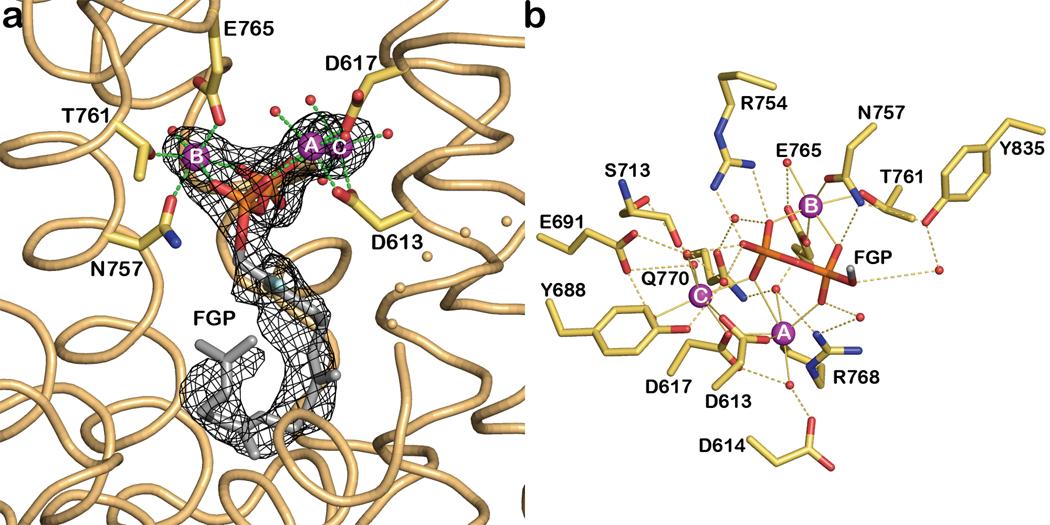
With more than 55,000 members identified so far in all forms of life, the family of terpene or terpenoid natural products represents the epitome of molecular biodiversity. A well-known and important member of this family is the polycyclic diterpenoid Taxol (paclitaxel), which promotes tubulin polymerization and shows remarkable efficacy in cancer chemotherapy. The first committed step of Taxol biosynthesis in the Pacific yew (Taxus brevifolia) is the cyclization of the linear isoprenoid substrate geranylgeranyl diphosphate (GGPP) to form taxa-4(5),11(12)diene, which is catalysed by taxadiene synthase. The full-length form of this diterpene cyclase contains 862 residues, but a roughly 80-residue amino-terminal transit sequence is cleaved on maturation in plastids. We now report the X-ray crystal structure of a truncation variant lacking the transit sequence and an additional 27 residues at the N terminus, hereafter designated TXS. Specifically, we have determined structures of TXS complexed with 13-aza-13,14-dihydrocopalyl diphosphate (1.82 Å resolution) and 2-fluorogeranylgeranyl diphosphate (2.25 Å resolution). The TXS structure reveals a modular assembly of three α-helical domains. The carboxy-terminal catalytic domain is a class I terpenoid cyclase, which binds and activates substrate GGPP with a three-metal ion cluster. The N-terminal domain and a third 'insertion' domain together adopt the fold of a vestigial class II terpenoid cyclase. A class II cyclase activates the isoprenoid substrate by protonation instead of ionization, and the TXS structure reveals a definitive connection between the two distinct cyclase classes in the evolution of terpenoid biosynthesis.
迄今为止,已在所有生命形式中鉴定出超过 55,000 种萜类或类萜天然产物,萜烯家族代表了分子生物多样性的缩影。这个家族中的一个著名且重要的成员是多环二萜紫杉醇(紫杉醇),它促进微管蛋白聚合,并在癌症化疗中显示出显著的疗效。太平洋紫杉(Taxus brevifolia)中紫杉醇生物合成的第一步是线性异戊二烯底物香叶基香叶基二磷酸(GGPP)的环化形成紫杉烯-4(5),11(12)-二烯,这由紫杉烯合酶催化。这种二萜环化酶的全长形式含有 862 个残基,但在质体成熟过程中会切割大约 80 个残基的氨基末端转运序列。我们现在报告了一种缺失转运序列和 N 末端另外 27 个残基的截断变体的 X 射线晶体结构,以下简称 TXS。具体来说,我们已经确定了 TXS 与 13-氮杂-13,14-二氢古巴烯二磷酸(1.82 Å 分辨率)和 2-氟香叶基香叶基二磷酸(2.25 Å 分辨率)复合物的结构。TXS 结构揭示了三个α-螺旋结构域的模块化组装。羧基末端催化结构域是一种 I 类萜烯环化酶,它与三金属离子簇结合并激活底物 GGPP。N 末端结构域和第三个“插入”结构域共同采用残余 II 类萜烯环化酶的折叠。II 类环化酶通过质子化而不是离子化激活异戊二烯底物,并且 TXS 结构揭示了萜烯生物合成进化中两种不同环化酶类之间的明确联系。