Department of Systems Ecology, Stockholm University, Stockholm, Sweden.
Oecologia. 2011 Jun;166(2):337-47. doi: 10.1007/s00442-010-1865-0. Epub 2010 Dec 16.
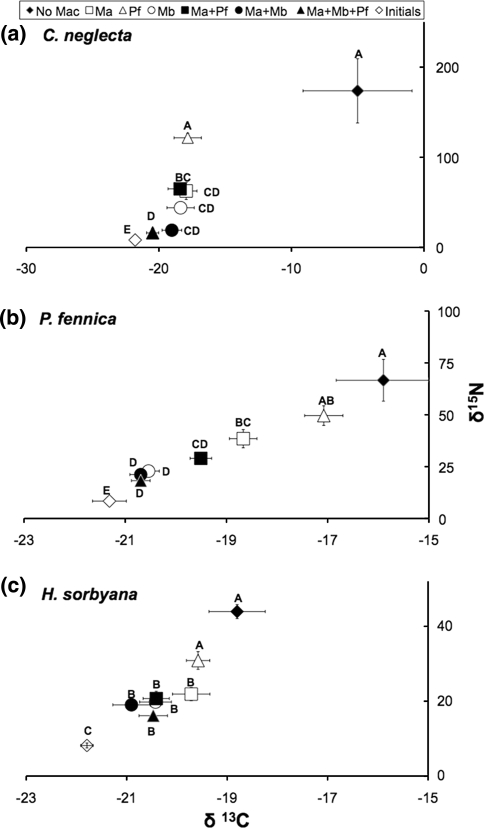
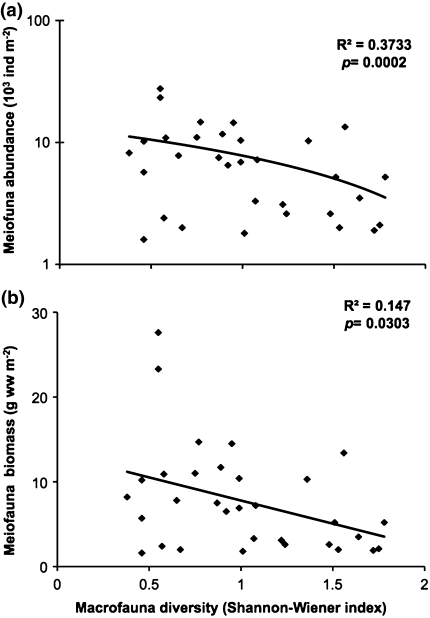
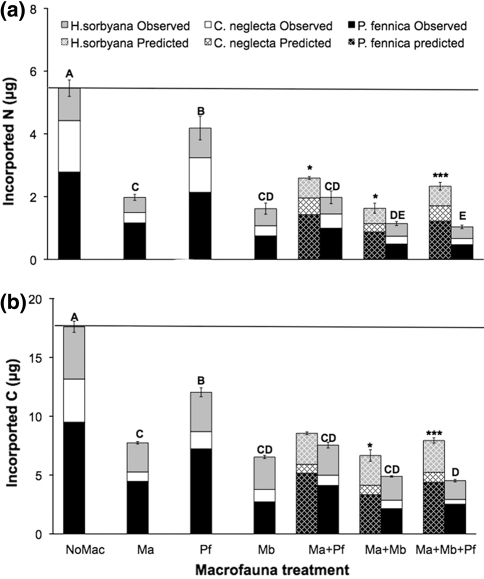
Competition between large and small species for the same food is common in a number of ecosystems including aquatic ones. How diversity of larger consumers affects the access of smaller competitors to a limiting resource is not well understood. We tested experimentally how species richness (0-3 spp.) of benthic deposit-feeding macrofauna changes meiofaunal ostracods' incorporation of fresh organic matter from a stable-isotope-labeled cyanobacterial bloom, using fauna from the species-poor Baltic Sea. Presence of macrofauna mostly decreased meiofaunal incorporation of bloom material, depending on the macrofauna species present. As expected, the species identity of macrofauna influenced the incorporation of organic matter by meiofauna. Interestingly, our results show that, in addition, species richness of the macrofauna significantly reduced meiofauna incorporation of freshly settled nitrogen and carbon. With more than one macrofauna species, the reduction was always greater than expected from the single-species treatments. Field data from the Baltic Sea showed a negative correlation between macrofauna diversity and meiofaunal ostracod abundance, as expected from the experimental results. We argue that this is caused by interference competition, due to spatial niche differentiation between macrofauna species reducing the sediment volume in which ostracods can feed undisturbed by larger competitors. Interference from macrofauna significantly reduces organic matter incorporation by meiofauna, indicating that diversity of larger consumers is an important factor controlling the access of smaller competitors to a limiting food resource.
在包括水生生态系统在内的许多生态系统中,大型和小型物种争夺相同食物的竞争是很常见的。大型消费者多样性如何影响较小竞争者获得限制资源的情况,目前还不太清楚。我们使用来自物种较少的波罗的海的动物群,通过实验测试了底栖沉积物食性大型动物的物种丰富度(0-3 种)如何改变小型有孔虫对稳定同位素标记的蓝藻水华新鲜有机物质的吸收。大型动物的存在大多减少了小型后生动物对水华物质的吸收,这取决于存在的大型动物物种。正如预期的那样,大型动物的物种身份影响后生动物对有机物质的吸收。有趣的是,我们的结果表明,此外,大型动物的物种丰富度还显著降低了后生动物对新沉降氮和碳的吸收。当存在多种大型动物时,这种减少总是大于单一物种处理的预期。来自波罗的海的实地数据显示,大型动物多样性与后生动物有孔虫丰度之间呈负相关,这与实验结果一致。我们认为,这是由于空间生态位分化导致的干扰竞争造成的,这种分化减少了有孔虫可以在不受大型竞争者干扰的情况下进食的底栖沉积物体积。大型动物的干扰显著降低了后生动物对有机物质的吸收,这表明较大消费者的多样性是控制较小竞争者获得限制食物资源的一个重要因素。