Department of Orthopaedic Surgery, Orthopaedic Research Center Amsterdam, Academic Medical Center, University of Amsterdam, Meibergdreef 9, 1105 AZ, Amsterdam, The Netherlands.
Arch Orthop Trauma Surg. 2011 Jul;131(7):893-901. doi: 10.1007/s00402-010-1227-8. Epub 2010 Dec 17.
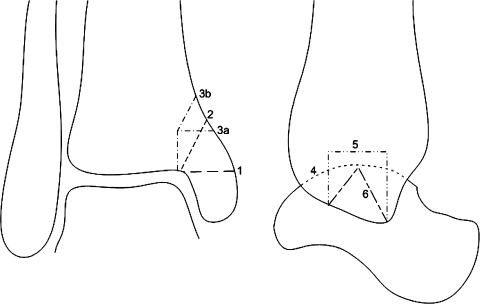
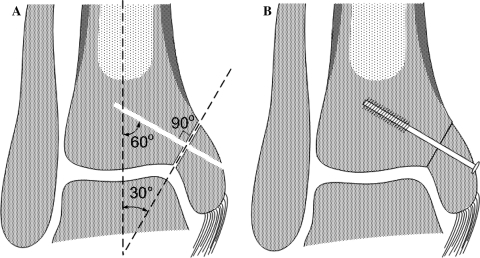
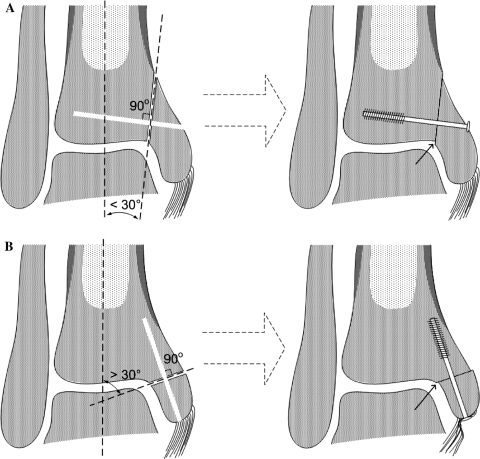
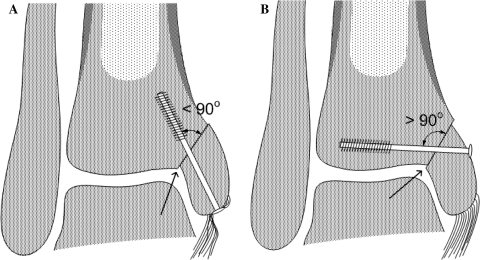
A medial malleolar osteotomy is often indicated for operative exposure of posteromedial osteochondral defects and fractures of the talus. To obtain a congruent joint surface after refixation, the oblique osteotomy should be directed perpendicularly to the articular surface of the tibia at the intersection between the tibial plafond and medial malleolus. The purpose of this study was to determine this perpendicular direction in relation to the longitudinal tibial axis for use during surgery.
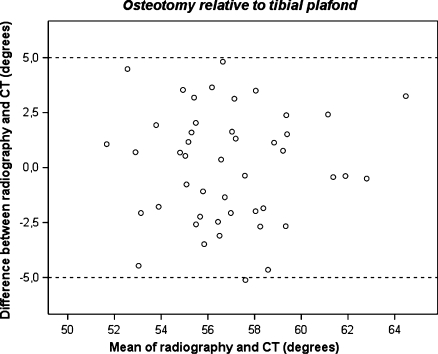
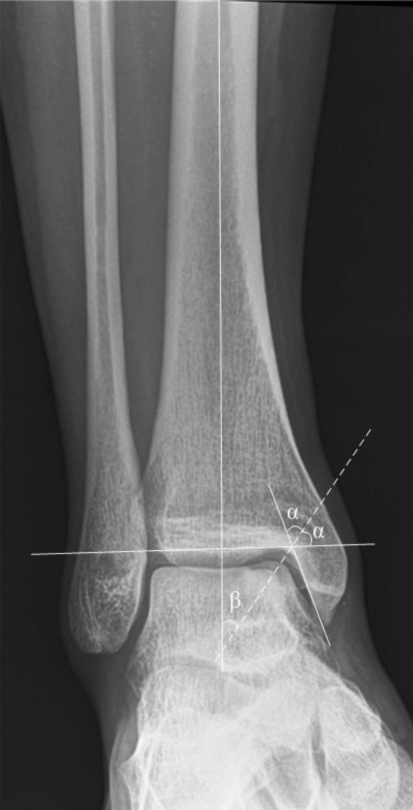
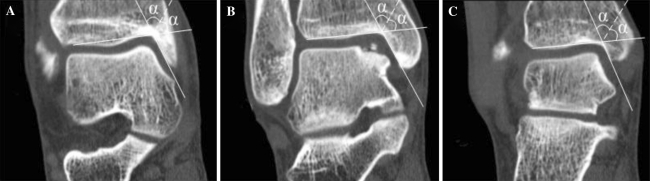
Using anteroposterior mortise radiographs and coronal computed tomography (CT) scans of 46 ankles (45 patients) with an osteochondral lesion of the talus, two observers independently measured the intersection angle between the tibial plafond and medial malleolus. The bisector of this angle indicated the osteotomy perpendicular to the tibial articular surface. This osteotomy was measured relative to the longitudinal tibial axis on radiographs. Intraclass correlation coefficients (ICC) were calculated to assess reliability.
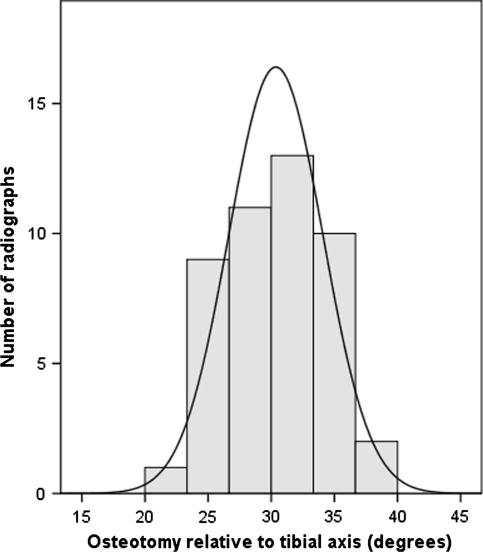
The mean osteotomy was 57.2 ± 3.2° relative to the tibial plafond on radiographs and 56.5 ± 2.8 on CT scans. This osteotomy corresponded to 30.4 ± 3.7° relative to the longitudinal tibial axis. The intraobserver (ICC, 0.90-0.93) and interobserver (ICC, 0.65-0.91) reliability of these measurements were good to excellent.
A medial malleolar osteotomy directed at a mean 30° relative to the tibial axis enters the joint perpendicularly to the tibial cartilage, and will likely result in a congruent joint surface after reduction.
对于后内侧骨软骨缺损和距骨骨折的手术暴露,常需要进行内踝切开术。为了在重新固定后获得一致的关节面,斜行切开应垂直于胫骨关节面,在胫骨平台和内踝的交点处进行。本研究的目的是确定在手术过程中与胫骨长轴相关的垂直方向。
使用 46 例(45 例患者)距骨骨软骨损伤的前后位跗骨间关节 X 线片和冠状 CT 扫描,两名观察者独立测量胫骨平台和内踝的交点角度。该角度的平分线表示与胫骨关节面垂直的切开。在 X 线片上,相对于胫骨长轴测量该切开。计算组内相关系数(ICC)以评估可靠性。
在 X 线片上,平均切开相对于胫骨平台为 57.2 ± 3.2°,在 CT 扫描上为 56.5 ± 2.8°。相对于胫骨长轴,该切开相当于 30.4 ± 3.7°。这些测量的观察者内(ICC,0.90-0.93)和观察者间(ICC,0.65-0.91)可靠性均良好至优秀。
相对于胫骨轴定向 30°的内踝切开垂直于胫骨软骨进入关节,在复位后可能会产生一致的关节面。