Department of Cancer Prevention and Control, Roswell Park Cancer Institute, Buffalo, New York 14263, USA.
Clin Cancer Res. 2010 Dec 15;16(24):6169-76. doi: 10.1158/1078-0432.CCR-10-0281.
There are no established genetic markers for prediction of outcomes after cyclophosphamide (CP)-containing adjuvant therapy for breast cancer. In an ancillary study to a SWOG (Southwest Oncology Group) trial (S8897), we investigated functional polymorphisms in 4 genes in CP pharmacokinetic pathways in relation to hematologic toxicity and disease-free survival (DFS).
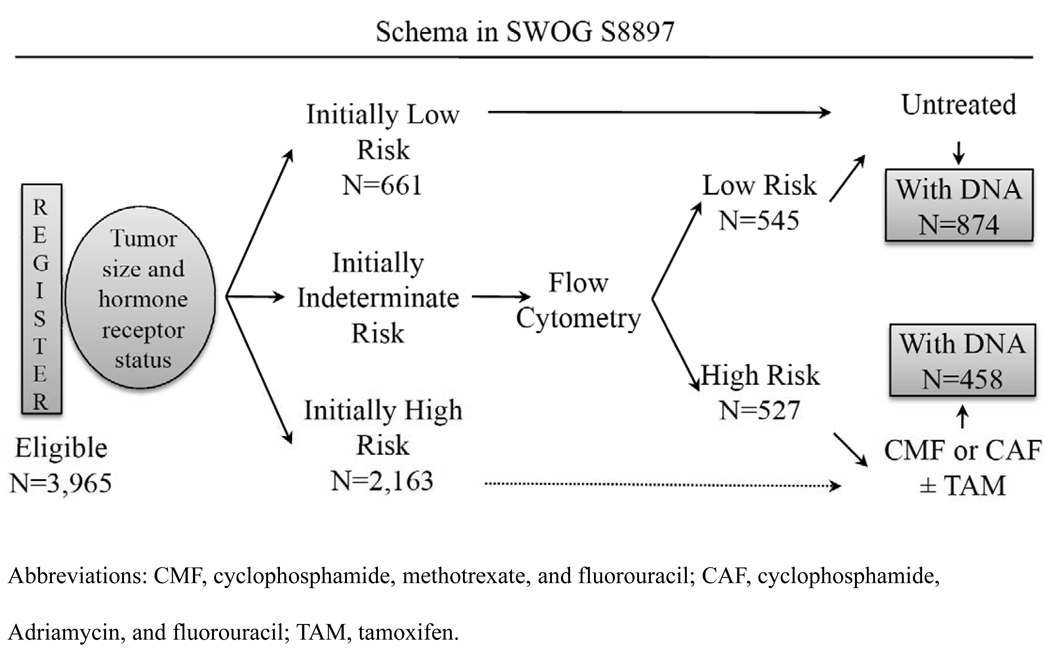
Germline DNA was available from 458 women who were at high risk of relapse and was randomized to CAF (CP, intravenous doxorubicin, and 5-fluorouracil) versus CMF (CP, intravenous methotrexate, and 5-fluorouracil) ± tamoxifen, and from 874 women who had a presumed favorable prognosis and did not receive adjuvant therapy. Odds ratios for grade 3 and 4 hematologic toxicity in the treated group and hazard ratios for DFS associated with selected functional polymorphisms in CYP2B6CYP3A4GSTA1 and GSTP1 were estimated by logistic regression and Cox proportional hazard regression.
Compared with women with AA genotypes, those with at least 1 GSTP1 variant G allele had reduced risk of grade 3 and 4 neutropenia [odds ratios (OR) = 0.63, 95% CI = 0.41-0.97] and leucopenia (OR = 0.59, 95% CI = 0.39-0.89). No other associations between single nucleotide polymorphisms and toxicity or survival were found in the treated or untreated group.
Known genetic variants in genes involved in CP pharmacokinetics may not have major effects on DFS in breast cancer patients. The lower risk of developing high-grade hematologic toxicity among women with variant GSTP1 alleles suggests that genetic markers in combination with clinical factors may be useful in defining a subgroup of women who are less susceptible to adverse hematologic toxicities with CP-containing therapies.
对于接受含环磷酰胺(CP)辅助治疗的乳腺癌患者,目前尚无明确的遗传标志物可预测其预后。在 SWOG(西南肿瘤协作组)试验(S8897)的一项辅助研究中,我们研究了 CP 药代动力学途径中 4 个基因的功能多态性与血液毒性和无病生存(DFS)的关系。
从高危复发的 458 名妇女和未接受辅助治疗的 874 名假定预后良好的妇女中获得了骨髓 DNA。CAF(CP、静脉注射阿霉素和 5-氟尿嘧啶)与 CMF(CP、静脉注射甲氨蝶呤和 5-氟尿嘧啶)±他莫昔芬组的妇女接受随机分组。通过 logistic 回归和 Cox 比例风险回归,估计了治疗组中 3 级和 4 级血液毒性的比值比(OR)和与 CYP2B6、CYP3A4、GSTA1 和 GSTP1 中选定功能多态性相关的 DFS 危险比(HR)。
与 AA 基因型的妇女相比,至少携带 1 个 GSTP1 变异 G 等位基因的妇女发生 3 级和 4 级中性粒细胞减少症(OR=0.63,95%CI=0.41-0.97)和白细胞减少症(OR=0.59,95%CI=0.39-0.89)的风险降低。在治疗组或未治疗组中,未发现其他单核苷酸多态性与毒性或生存之间的关联。
CP 药代动力学相关基因中的已知遗传变异可能对乳腺癌患者的 DFS 无主要影响。携带 GSTP1 变异等位基因的妇女发生高级别血液毒性的风险较低,提示遗传标记与临床因素相结合可能有助于确定对 CP 联合治疗不易发生不良血液毒性的亚组妇女。