Institut Curie, Centre de Recherche, Paris, France.
PLoS One. 2010 Dec 8;5(12):e14249. doi: 10.1371/journal.pone.0014249.
Gene amplification is thought to promote over-expression of genes favouring tumour development. Because amplified regions are usually megabase-long, amplification often concerns numerous syntenic or non-syntenic genes, among which only a subset is over-expressed. The rationale for these differences remains poorly understood.
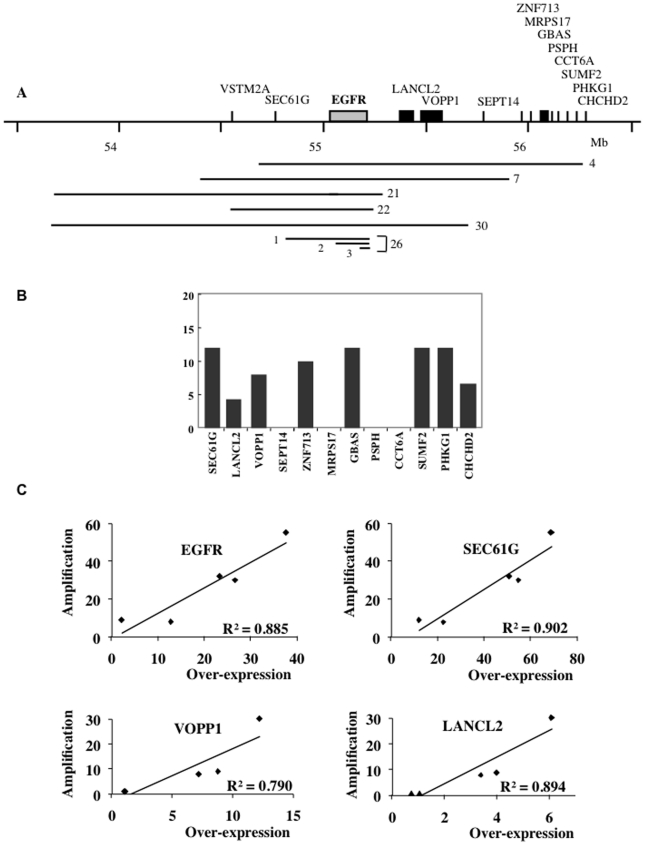
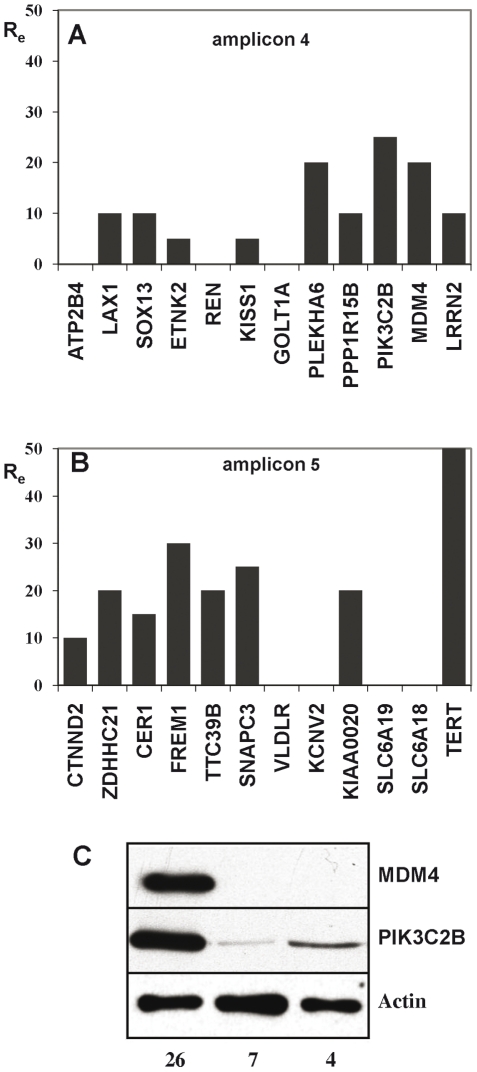
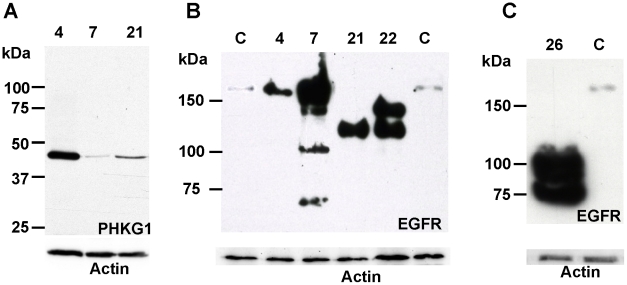
METHODOLOGY/PRINCIPAL FINDING: To address this question, we used quantitative RT-PCR to determine the expression level of a series of co-amplified genes in five xenografted and one fresh human gliomas. These gliomas were chosen because we have previously characterised in detail the genetic content of their amplicons. In all the cases, the amplified sequences lie on extra-chromosomal DNA molecules, as commonly observed in gliomas. We show here that genes transcribed in non-amplified gliomas are over-expressed when amplified, roughly in proportion to their copy number, while non-expressed genes remain inactive. When specific antibodies were available, we also compared protein expression in amplified and non-amplified tumours. We found that protein accumulation barely correlates with the level of mRNA expression in some of these tumours.
CONCLUSIONS/SIGNIFICANCE: Here we show that the tissue-specific pattern of gene expression is maintained upon amplification in gliomas. Our study relies on a single type of tumour and a limited number of cases. However, it strongly suggests that, even when amplified, genes that are normally silent in a given cell type play no role in tumour progression. The loose relationships between mRNA level and protein accumulation and/or activity indicate that translational or post-translational events play a key role in fine-tuning the final outcome of amplification in gliomas.
基因扩增被认为促进了有利于肿瘤发展的基因的过度表达。由于扩增区域通常长达 megabase,因此扩增通常涉及许多同线性或非同线性基因,其中只有一部分被过度表达。这些差异的原理仍知之甚少。
方法/主要发现:为了解决这个问题,我们使用定量 RT-PCR 来确定五个异种移植和一个新鲜的人类神经胶质瘤中一系列共扩增基因的表达水平。这些神经胶质瘤被选择是因为我们之前已经详细地描述了它们扩增子的遗传内容。在所有情况下,扩增的序列都位于染色体外的 DNA 分子上,这在神经胶质瘤中很常见。我们在这里表明,在未扩增的神经胶质瘤中转录的基因在扩增时被过度表达,大致与其拷贝数成比例,而未表达的基因仍然保持不活跃。当有特定的抗体时,我们还比较了扩增和未扩增肿瘤中的蛋白质表达。我们发现,在这些肿瘤中的一些肿瘤中,蛋白质积累与 mRNA 表达水平几乎没有相关性。
结论/意义:在这里,我们表明在神经胶质瘤中,基因表达的组织特异性模式在扩增时得以维持。我们的研究依赖于单一类型的肿瘤和有限数量的病例。然而,它强烈表明,即使在扩增时,在给定细胞类型中通常沉默的基因在肿瘤进展中不起作用。mRNA 水平与蛋白质积累和/或活性之间的松散关系表明,翻译或翻译后事件在精细调节神经胶质瘤中扩增的最终结果中起着关键作用。