Lopes Marta B, Martins Eduarda P, Vinga Susana, Costa Bruno M
Center for Mathematics and Applications (CMA), FCT, UNL, 2829-516 Caparica, Portugal.
NOVA Laboratory for Computer Science and Informatics (NOVA LINCS), FCT, UNL, 2829-516 Caparica, Portugal.
Cancers (Basel). 2021 Mar 2;13(5):1045. doi: 10.3390/cancers13051045.
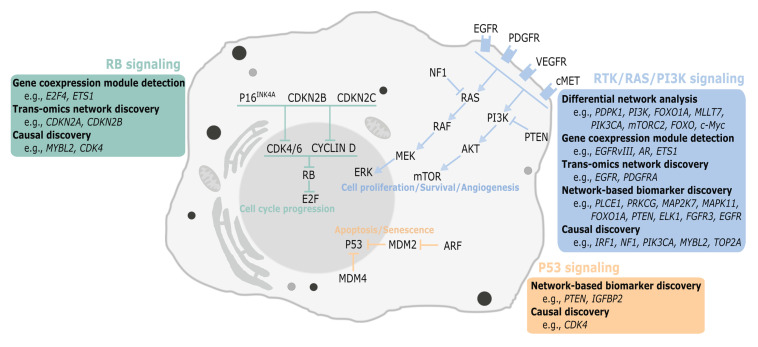
Network science has long been recognized as a well-established discipline across many biological domains. In the particular case of cancer genomics, network discovery is challenged by the multitude of available high-dimensional heterogeneous views of data. Glioblastoma (GBM) is an example of such a complex and heterogeneous disease that can be tackled by network science. Identifying the architecture of molecular GBM networks is essential to understanding the information flow and better informing drug development and pre-clinical studies. Here, we review network-based strategies that have been used in the study of GBM, along with the available software implementations for reproducibility and further testing on newly coming datasets. Promising results have been obtained from both bulk and single-cell GBM data, placing network discovery at the forefront of developing a molecularly-informed-based personalized medicine.
长期以来,网络科学在许多生物领域都被公认为一门成熟的学科。在癌症基因组学的特定情况下,网络发现面临着大量可用的高维异构数据视图的挑战。胶质母细胞瘤(GBM)就是这样一种复杂的异质性疾病,网络科学可以用来解决它。识别分子GBM网络的架构对于理解信息流以及更好地为药物开发和临床前研究提供信息至关重要。在这里,我们回顾了在GBM研究中使用的基于网络的策略,以及用于再现性和对新数据集进行进一步测试的可用软件实现。从批量和单细胞GBM数据中都获得了有前景的结果,将网络发现置于基于分子信息的个性化医学发展的前沿。