Division of Developmental Cognitive Neuroscience at the Institute of Development, Aging and Cancer, Tohoku University, Sendai, Japan.
PLoS One. 2010 Dec 8;5(12):e15213. doi: 10.1371/journal.pone.0015213.
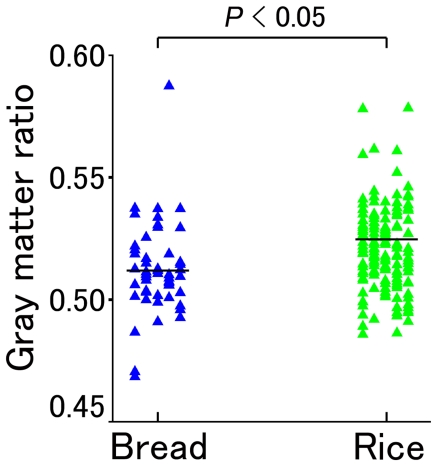
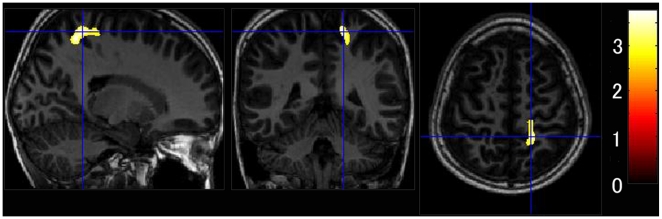
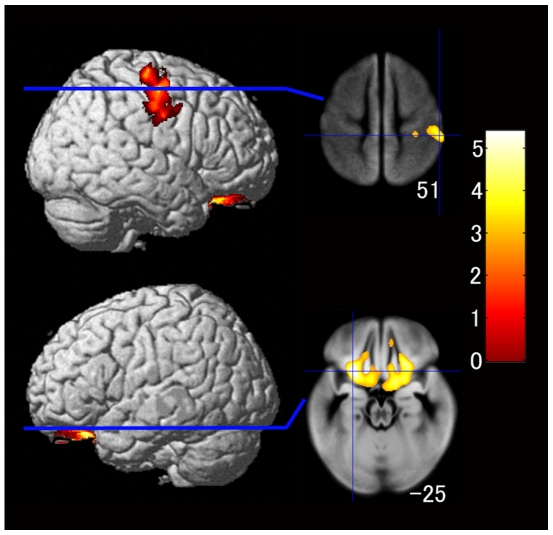
Childhood diet is important for brain development. Furthermore, the quality of breakfast is thought to affect the cognitive functioning of well-nourished children. To analyze the relationship among breakfast staple type, gray matter volume, and intelligence quotient (IQ) in 290 healthy children, we used magnetic resonance images and applied voxel-based morphometry. We divided subjects into rice, bread, and both groups according to their breakfast staple. We showed that the rice group had a significantly larger gray matter ratio (gray matter volume percentage divided by intracranial volume) and significantly larger regional gray matter volumes of several regions, including the left superior temporal gyrus. The bread group had significantly larger regional gray and white matter volumes of several regions, including the right frontoparietal region. The perceptual organization index (POI; IQ subcomponent) of the rice group was significantly higher than that of the bread group. All analyses were adjusted for age, gender, intracranial volume, socioeconomic status, average weekly frequency of having breakfast, and number of side dishes eaten for breakfast. Although several factors may have affected the results, one possible mechanism underlying the difference between the bread and the rice groups may be the difference in the glycemic index (GI) of these two substances; foods with a low GI are associated with less blood-glucose fluctuation than are those with a high GI. Our study suggests that breakfast staple type affects brain gray and white matter volumes and cognitive function in healthy children; therefore, a diet of optimal nutrition is important for brain maturation during childhood and adolescence.
儿童时期的饮食对于大脑发育很重要。此外,人们认为早餐的质量会影响营养良好的儿童的认知功能。为了分析 290 名健康儿童的早餐主食类型、灰质体积和智商(IQ)之间的关系,我们使用磁共振成像和基于体素的形态测量学。我们根据早餐主食将受试者分为米饭组、面包组和两者皆食组。结果显示,与面包组相比,米饭组的灰质比例(灰质体积除以颅内体积)显著更大,左颞上回等几个区域的灰质体积也显著更大。面包组的右侧额顶区域等几个区域的灰质和白质体积均显著更大。米饭组的知觉组织指数(POI;IQ 子成分)显著高于面包组。所有分析均调整了年龄、性别、颅内体积、社会经济地位、每周早餐平均频率和早餐所吃配菜数量。尽管有几个因素可能影响了结果,但面包组和米饭组之间差异的一个可能机制可能是这两种物质的血糖指数(GI)不同;GI 低的食物与 GI 高的食物相比,血糖波动较小。我们的研究表明,早餐主食类型会影响健康儿童的大脑灰质和白质体积以及认知功能;因此,在儿童和青少年时期,最佳营养的饮食对于大脑成熟很重要。