Laboratório Interdisciplinar de Pesquisas Médicas, Instituto Oswaldo Cruz -FIOCRUZ, Av, Brasil 4365, Rio de Janeiro CEP 21040-360, Brazil.
BMC Infect Dis. 2010 Dec 20;10:358. doi: 10.1186/1471-2334-10-358.
Concomitant infections may influence HIV progression by causing chronic activation leading to decline in T-cell function. In the Americas, visceral (AVL) and tegumentary leishmaniasis (ATL) have emerged as important opportunistic infections in HIV-AIDS patients and both of those diseases have been implicated as potentially important co-factors in disease progression. We investigated whether leishmaniasis increases lymphocyte activation in HIV-1 co-infected patients. This might contribute to impaired cellular immune function.
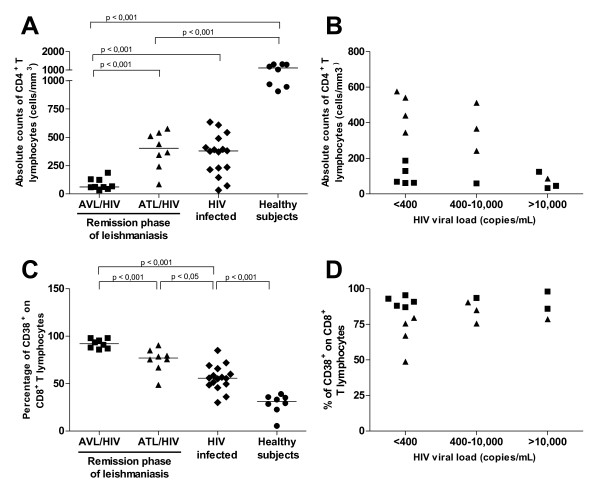
To address this issue we analyzed CD4+ T absolute counts and the proportion of CD8+ T cells expressing CD38 in Leishmania/HIV co-infected patients that recovered after anti-leishmanial therapy.
We found that, despite clinical remission of leishmaniasis, AVL co-infected patients presented a more severe immunossupression as suggested by CD4+ T cell counts under 200 cells/mm3, differing from ATL/HIV-AIDS cases that tends to show higher lymphocytes levels (over 350 cells/mm3). Furthermore, five out of nine, AVL/HIV-AIDS presented low CD4+ T cell counts in spite of low or undetectable viral load. Expression of CD38 on CD8+ T lymphocytes was significantly higher in AVL or ATL/HIV-AIDS cases compared to HIV/AIDS patients without leishmaniasis or healthy subjects.
Leishmania infection can increase the degree of immune system activation in individuals concomitantly infected with HIV. In addition, AVL/HIV-AIDS patients can present low CD4+ T cell counts and higher proportion of activated T lymphocytes even when HIV viral load is suppressed under HAART. This fact can cause a misinterpretation of these laboratorial markers in co-infected patients.
合并感染可能通过导致 T 细胞功能下降的慢性激活来影响 HIV 进展。在美洲,内脏(AVL)和皮肤利什曼病(ATL)已成为 HIV-AIDS 患者中重要的机会性感染,这两种疾病都被认为是疾病进展的潜在重要共同因素。我们研究了利什曼病是否会增加 HIV-1 合并感染患者的淋巴细胞活化。这可能会导致细胞免疫功能受损。
为了解决这个问题,我们分析了抗利什曼病治疗后恢复的利什曼病/HIV 合并感染患者的 CD4+T 细胞绝对计数和表达 CD38 的 CD8+T 细胞比例。
我们发现,尽管利什曼病临床缓解,但 AVL 合并感染患者的免疫抑制更为严重,表现在 CD4+T 细胞计数低于 200 个细胞/mm3,与 ATL/HIV-AIDS 病例不同,后者倾向于表现出更高的淋巴细胞水平(超过 350 个细胞/mm3)。此外,9 例 AVL/HIV-AIDS 中有 5 例尽管病毒载量低或无法检测,但 CD4+T 细胞计数较低。与未感染利什曼病的 HIV/AIDS 患者或健康受试者相比,AVL 或 ATL/HIV-AIDS 患者的 CD8+T 淋巴细胞表达 CD38 的比例明显更高。
利什曼感染可增加同时感染 HIV 的个体免疫系统的激活程度。此外,即使在接受高效抗逆转录病毒治疗(HAART)后 HIV 病毒载量被抑制,AVL/HIV-AIDS 患者仍可表现出低 CD4+T 细胞计数和更高比例的活化 T 淋巴细胞。这一事实可能导致对合并感染患者这些实验室标志物的错误解释。