University of California, San Diego, CA, USA.
J Neurovirol. 2011 Feb;17(1):3-16. doi: 10.1007/s13365-010-0006-1. Epub 2010 Dec 21.
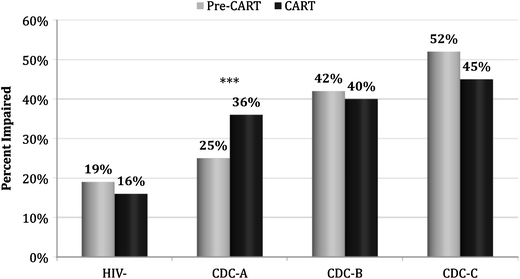
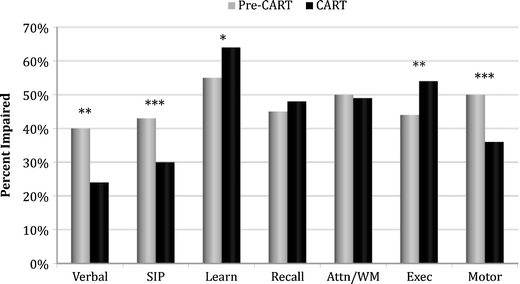
Combination antiretroviral therapy (CART) has greatly reduced medical morbidity and mortality with HIV infection, but high rates of HIV-associated neurocognitive disorders (HAND) continue to be reported. Because large HIV-infected (HIV+) and uninfected (HIV-) groups have not been studied with similar methods in the pre-CART and CART eras, it is unclear whether CART has changed the prevalence, nature, and clinical correlates of HAND. We used comparable methods of subject screening and assessments to classify neurocognitive impairment (NCI) in large groups of HIV + and HIV - participants from the pre-CART era (1988-1995; N = 857) and CART era (2000-2007; N = 937). Impairment rate increased with successive disease stages (CDC stages A, B, and C) in both eras: 25%, 42%, and 52% in pre-CART era and 36%, 40%, and 45% in CART era. In the medically asymptomatic stage (CDC-A), NCI was significantly more common in the CART era. Low nadir CD4 predicted NCI in both eras, whereas degree of current immunosuppression, estimated duration of infection, and viral suppression in CSF (on treatment) were related to impairment only pre-CART. Pattern of NCI also differed: pre-CART had more impairment in motor skills, cognitive speed, and verbal fluency, whereas CART era involved more memory (learning) and executive function impairment. High rates of mild NCI persist at all stages of HIV infection, despite improved viral suppression and immune reconstitution with CART. The consistent association of NCI with nadir CD4 across eras suggests that earlier treatment to prevent severe immunosuppression may also help prevent HAND. Clinical trials targeting HAND prevention should specifically examine timing of ART initiation.
联合抗逆转录病毒疗法(CART)大大降低了 HIV 感染的医疗发病率和死亡率,但仍有很高的 HIV 相关神经认知障碍(HAND)发病率。由于在 CART 治疗前和 CART 治疗时代,没有使用类似的方法对大型 HIV 感染(HIV +)和未感染(HIV -)人群进行研究,因此尚不清楚 CART 是否改变了 HAND 的流行率、性质和临床相关性。我们使用了可比的研究对象筛选和评估方法,对 CART 治疗前时代(1988-1995 年;N = 857)和 CART 治疗时代(2000-2007 年;N = 937)的大量 HIV +和 HIV -参与者进行神经认知障碍(NCI)分类。在两个时代,随着疾病阶段的连续进展(CDC 阶段 A、B 和 C),损害率都有所增加:CART 治疗前时代为 25%、42%和 52%,CART 治疗时代为 36%、40%和 45%。在医学无症状期(CDC-A),CART 治疗时代的 NCI 更为常见。在两个时代,最低 CD4 预测了 NCI,而当前免疫抑制程度、感染持续时间和 CSF 中的病毒抑制(治疗中)仅与 CART 治疗前的损害有关。NCI 的模式也不同:CART 治疗前时代的运动技能、认知速度和言语流畅性受损更为严重,而 CART 治疗时代的记忆(学习)和执行功能受损更为严重。尽管 CART 治疗可改善病毒抑制和免疫重建,但在 HIV 感染的所有阶段,仍存在较高的轻度 NCI 发生率。在整个 HIV 感染阶段,NCI 与最低 CD4 之间持续存在关联,这表明早期治疗以防止严重免疫抑制也可能有助于预防 HAND。针对 HAND 预防的临床试验应特别研究 ART 启动的时机。