Farrell C F, Rest R F
Department of Microbiology and Immunology, Hahnemann University School of Medicine, Philadelphia, Pennsylvania 19102-1192.
Infect Immun. 1990 Sep;58(9):2777-84. doi: 10.1128/iai.58.9.2777-2784.1990.
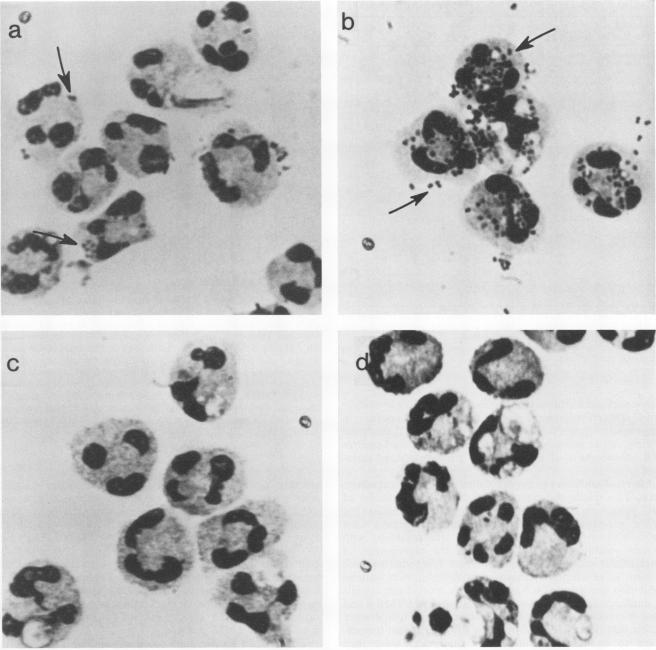
In the absence of serum, nonpiliated gonococci expressing PII outer membrane proteins (PIIs) adhere to human neutrophils whereas non-PII-expressing (PII-) gonococci do not. After an observation that neutrophils in monolayers bound more gonococci than neutrophils in suspension, we treated neutrophil suspensions with known stimulants of degranulation and measured subsequent gonococcal adherence to suspended neutrophils. The chemotactic peptide N-formyl-methionyl-leucyl-phenylalanine (fmlp), the potent secretagogue phorbol myristate acetate, and the calcium ionophore A23187 all caused increased adherence of PII+ gonococci, but not PII- gonococci, to neutrophils in a dose-responsive manner. Increased adherence of gonococci to neutrophils was paralleled by increased degranulation of neutrophil myeloperoxidase, lysozyme, and lactoferrin. Inhibition of fmlp-induced neutrophil degranulation by pertussis toxin, the calmodulin inhibitors trifluoperazine and N-5-chloronaphthalene sulfonamide, or the intracellular calcium-binding agent trimethoxybenzoic acid also inhibited fmlp-induced gonococcal adherence to neutrophils. Neither undifferentiated nor myelocytically differentiated HL-60 cells, which possess primary but defective or nonexistent secondary granules, bound PII+ or PII- gonococci. Gonococci did not adhere to human monocytes, monocyte-derived macrophages, lymphocytes, platelets, or erythrocytes, indicating that several receptors, such as the complement receptors CR1, CR3 (CD11b/CD18), and CR4 (CD11c/CD18) or the adherence complex LFA-1 (CD11a/CD18), were probably not involved in gonococcal adherence to human neutrophils.
在无血清的情况下,表达PII外膜蛋白(PII)的非菌毛淋病奈瑟菌可黏附于人类中性粒细胞,而不表达PII(PII-)的淋病奈瑟菌则不能。在观察到单层培养的中性粒细胞比悬浮状态的中性粒细胞结合更多淋病奈瑟菌后,我们用已知的脱颗粒刺激剂处理中性粒细胞悬液,并测定随后淋病奈瑟菌对悬浮中性粒细胞的黏附情况。趋化肽N-甲酰甲硫氨酰亮氨酰苯丙氨酸(fmlp)、强效促分泌剂佛波酯肉豆蔻酸乙酸酯以及钙离子载体A23187均以剂量依赖方式导致PII+淋病奈瑟菌而非PII-淋病奈瑟菌对中性粒细胞的黏附增加。淋病奈瑟菌对中性粒细胞黏附的增加与中性粒细胞髓过氧化物酶、溶菌酶和乳铁蛋白脱颗粒的增加平行。百日咳毒素、钙调蛋白抑制剂三氟拉嗪和N-5-氯萘磺酰胺或细胞内钙结合剂三甲氧基苯甲酸对fmlp诱导的中性粒细胞脱颗粒的抑制也抑制了fmlp诱导的淋病奈瑟菌对中性粒细胞的黏附。未分化的或经髓细胞分化的HL-60细胞,它们具有初级但有缺陷或不存在的次级颗粒,不结合PII+或PII-淋病奈瑟菌。淋病奈瑟菌不黏附于人类单核细胞、单核细胞衍生的巨噬细胞、淋巴细胞、血小板或红细胞,这表明几种受体,如补体受体CR1、CR3(CD11b/CD18)和CR4(CD11c/CD18)或黏附复合物LFA-1(CD11a/CD18),可能不参与淋病奈瑟菌对人类中性粒细胞的黏附。