Unité mixte de Recherche en Génomique Végétale (URGV), INRA UEVE ERL CNRS, 2 rue Gaston Crémieux, 91 057 Evry cedex, France.
BMC Plant Biol. 2010 Dec 22;10:284. doi: 10.1186/1471-2229-10-284.
Unlike in tomato, little is known about the genetic and molecular control of fleshy fruit development of perennial fruit trees like grapevine (Vitis vinifera L.). Here we present the study of the sequence polymorphism in a 1 Mb grapevine genome region at the top of chromosome 18 carrying the fleshless berry mutation (flb) in order, first to identify SNP markers closely linked to the gene and second to search for possible signatures of domestication.
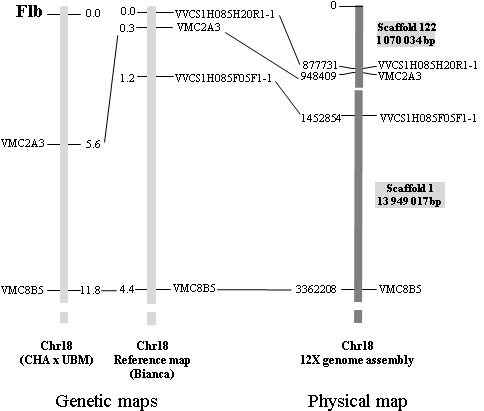
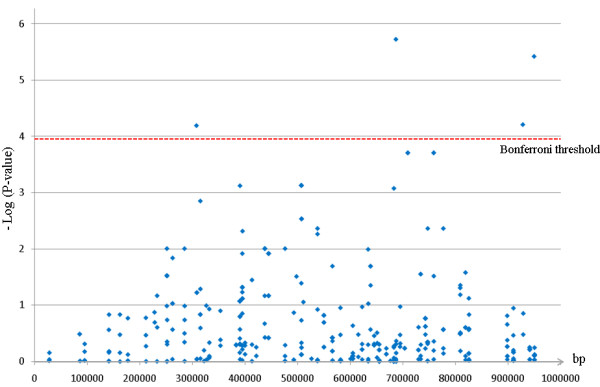
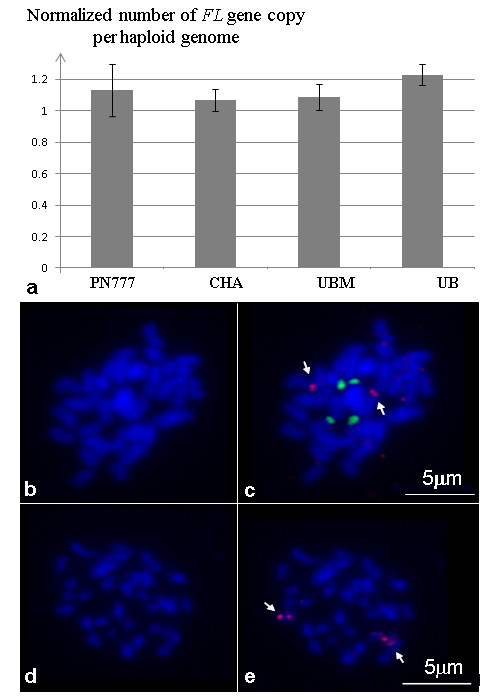
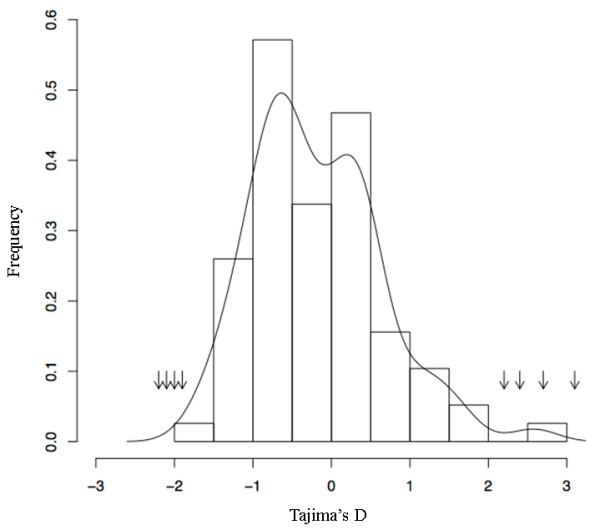
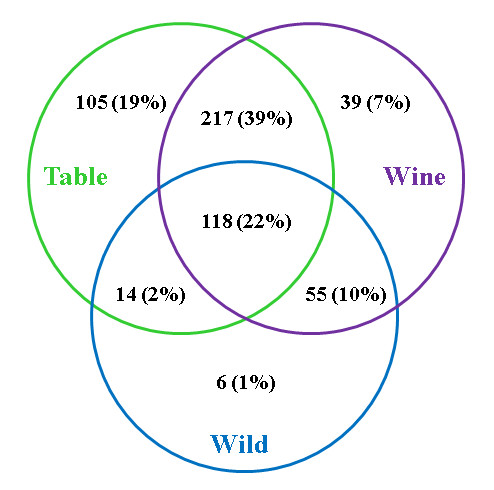
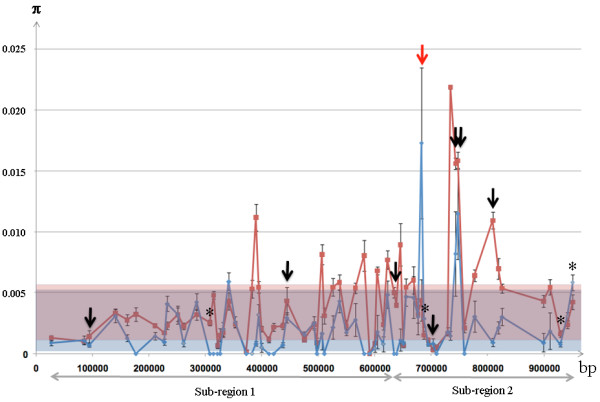
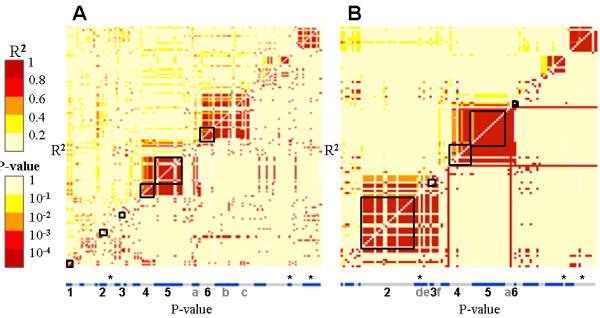
In total, 62 regions (17 SSR, 3 SNP, 1 CAPS and 41 re-sequenced gene fragments) were scanned for polymorphism along a 3.4 Mb interval (85,127-3,506,060 bp) at the top of the chromosome 18, in both V. vinifera cv. Chardonnay and a genotype carrying the flb mutation, V. vinifera cv. Ugni Blanc mutant. A nearly complete homozygosity in Ugni Blanc (wild and mutant forms) and an expected high level of heterozygosity in Chardonnay were revealed. Experiments using qPCR and BAC FISH confirmed the observed homozygosity. Under the assumption that flb could be one of the genes involved into the domestication syndrome of grapevine, we sequenced 69 gene fragments, spread over the flb region, representing 48,874 bp in a highly diverse set of cultivated and wild V. vinifera genotypes, to identify possible signatures of domestication in the cultivated V. vinifera compartment. We identified eight gene fragments presenting a significant deviation from neutrality of the Tajima's D parameter in the cultivated pool. One of these also showed higher nucleotide diversity in the wild compartments than in the cultivated compartments. In addition, SNPs significantly associated to berry weight variation were identified in the flb region.
We observed the occurrence of a large homozygous region in a non-repetitive region of the grapevine otherwise highly-heterozygous genome and propose a hypothesis for its formation. We demonstrated the feasibility to apply BAC FISH on the very small grapevine chromosomes and provided a specific probe for the identification of chromosome 18 on a cytogenetic map. We evidenced genes showing putative signatures of selection and SNPs significantly associated with berry weight variation in the flb region. In addition, we provided to the community 554 SNPs at the top of chromosome 18 for the development of a genotyping chip for future fine mapping of the flb gene in a F2 population when available.
与番茄不同,人们对像葡萄(Vitis vinifera L.)这样的多年生果树肉质果实发育的遗传和分子控制知之甚少。在这里,我们研究了在染色体 18 顶部携带无果肉浆果突变(flb)的 1 Mb 葡萄基因组区域的序列多态性,首先是为了鉴定与基因紧密连锁的 SNP 标记,其次是为了寻找可能的驯化特征。
总共在葡萄品种霞多丽和携带 flb 突变的葡萄品种 Ugni Blanc 中,在染色体 18 顶部的 3.4 Mb 区间(85127-3506060 bp)内,对 62 个区域(17 个 SSR、3 个 SNP、1 个 CAPS 和 41 个重新测序的基因片段)进行了多态性扫描。在 Ugni Blanc(野生和突变形式)中几乎完全纯合,而在霞多丽中预期有很高的杂合度。使用 qPCR 和 BAC FISH 的实验证实了观察到的纯合性。假设 flb 可能是参与葡萄驯化综合征的基因之一,我们对 69 个基因片段进行了测序,这些基因片段分布在 flb 区域,代表了 48874 bp,涵盖了高度多样化的栽培和野生 V. vinifera 基因型,以鉴定驯化在栽培 V. vinifera 区室中的可能特征。我们鉴定了 8 个基因片段,其 Tajima 的 D 参数偏离中性的显著性。其中一个在野生区室中的核苷酸多样性也高于栽培区室。此外,还在 flb 区域鉴定到与浆果重量变化显著相关的 SNPs。
我们观察到在葡萄高度杂合基因组的非重复区域中发生了一个大的纯合区域,并提出了其形成的假说。我们证明了在非常小的葡萄染色体上应用 BAC FISH 的可行性,并提供了用于在细胞遗传学图谱上鉴定第 18 号染色体的特定探针。我们证明了在 flb 区域中存在具有潜在选择特征的基因和与浆果重量变化显著相关的 SNPs。此外,我们为社区提供了在第 18 号染色体顶部的 554 个 SNP,用于在 F2 群体中进一步精细定位 flb 基因时开发基因分型芯片,当有可用的 F2 群体时。