Istituto Zooprofilattico Sperimentale della Lombardia e dell'Emilia Romagna B. Ubertini (IZSLER), Brescia, Italy.
PLoS One. 2010 Dec 15;5(12):e14324. doi: 10.1371/journal.pone.0014324.
In recent years human diseases due to mosquito-borne viruses were increasingly reported in Emilia-Romagna region (Italy), from the chikungunya virus in 2007 to the West Nile virus (WNV) in 2008. An extensive entomological survey was performed in 2009 to establish the presence and distribution of mosquito arboviruses in this region, with particular reference to flaviviruses.
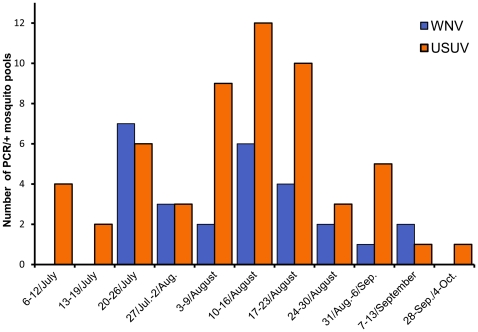
METHODOLOGY/PRINCIPAL FINDINGS: From May 6 to October 31, a total of 190,516 mosquitoes were sampled in georeferenced stations, grouped in 1,789 pools according date of collection, location, and species, and analyzed by reverse transcription polymerase chain reaction (RT-PCR) to detect the presence of RNA belong to Flavivirus genus. WNV was detected in 27 mosquito pools, producing sequences similar to those of birds and human strains obtained in 2008 outbreak, pointed out the probable virus overwintering. Isolation of WNV was achieved from one of these pools. Moreover 56 pools of mosquitoes tested positive for Usutu virus (USUV). Most PCR positive pools consisted of Culex pipiens, which also was the most analyzed mosquito species (81.4% of specimens); interestingly, USUV RNA was also found in two Aedes albopictus mosquito pools. Simultaneous circulation of WNV and USUV in the survey area was highlighted by occurrence of 8 mosquito WNV- and USUV-positive pools and by the overlaying of the viruses "hot spots", obtained by kernel density estimation (KDE) analysis. Land use of sampled stations pointed out a higher proportion of WNV-positive Cx. pipiens pool in rural environments respect the provenience of total sampled pool, while the USUV-positive pools were uniformly captured in the different environments.
CONCLUSIONS/SIGNIFICANCE: Obtained data highlighting the possible role of Cx. pipiens mosquito as the main vector for WNV and USUV in Northern Italy, and the possible involvement of Ae. albopictus mosquito in USUV cycle. The described mosquito-based surveillance could constitute the foundation for a public health alert system targeting mosquito borne arboviruses.
近年来,意大利艾米利亚-罗马涅地区(Emilia-Romagna region)不断有蚊媒病毒引起的人类疾病报告,包括 2007 年的基孔肯雅热病毒(chikungunya virus)和 2008 年的西尼罗河病毒(West Nile virus,WNV)。2009 年进行了广泛的昆虫学调查,以确定该地区蚊媒病毒的存在和分布情况,特别是黄病毒(flaviviruses)。
方法/主要发现:2009 年 5 月 6 日至 10 月 31 日,在地理参考站共采集了 190516 只蚊子,根据采集日期、地点和种类将蚊子分为 1789 个样本池,并通过逆转录聚合酶链反应(reverse transcription polymerase chain reaction,RT-PCR)进行分析,以检测 RNA 属黄病毒属的存在。在 27 个蚊子样本池中检测到 WNV,其序列与 2008 年暴发时鸟类和人类分离株相似,表明病毒可能越冬。从其中一个样本池中分离出了 WNV。此外,56 个蚊子样本池检测出乌苏图病毒(Usutu virus,USUV)阳性。大多数 PCR 阳性样本池由库蚊(Culex pipiens)组成,这也是分析最多的蚊子种类(81.4%的标本);有趣的是,在两个白纹伊蚊(Aedes albopictus)样本池中也发现了 USUV RNA。在调查区域中,WNV 和 USUV 的同时循环通过发生 8 个蚊子 WNV-和 USUV-阳性池以及通过核密度估计(kernel density estimation,KDE)分析获得的病毒“热点”的叠加得到强调。采样站的土地利用指出,在农村环境中,WNV 阳性的库蚊(Cx. pipiens)样本池比例高于总采样池,而 USUV 阳性的样本池则均匀分布在不同的环境中。
结论/意义:研究结果强调了库蚊作为意大利北部 WNV 和 USUV 的主要传播媒介的可能作用,以及白纹伊蚊可能参与 USUV 循环。所描述的基于蚊子的监测可能为针对蚊媒 arboviruses 的公共卫生预警系统奠定基础。