Bio-Imaging Lab, University of Antwerp, Antwerp, Belgium.
PLoS One. 2010 Dec 15;5(12):e14337. doi: 10.1371/journal.pone.0014337.
Possibly due to the small size of the olfactory bulb (OB) as compared to rodents, it was generally believed that songbirds lack a well-developed sense of smell. This belief was recently revised by several studies showing that various bird species, including passerines, use olfaction in many respects of life. During courtship and nest building, male European starlings (Sturnus vulgaris) incorporate aromatic herbs that are rich in volatile compounds (e.g., milfoil, Achillea millefolium) into the nests and they use olfactory cues to identify these plants. Interestingly, European starlings show seasonal differences in their ability to respond to odour cues: odour sensitivity peaks during nest-building in the spring, but is almost non-existent during the non-breeding season.
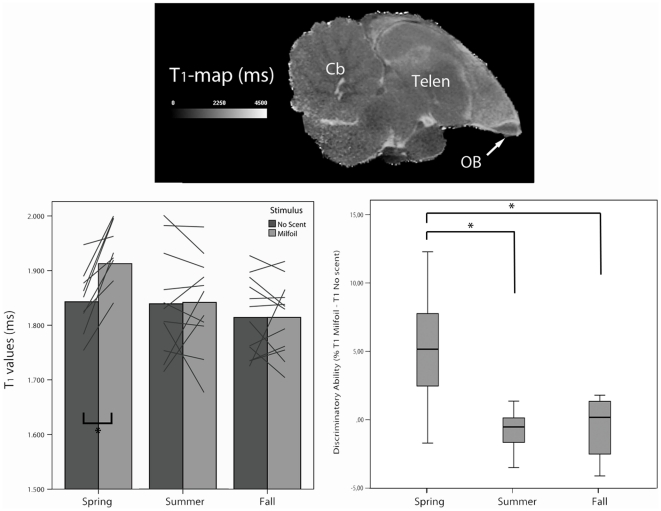
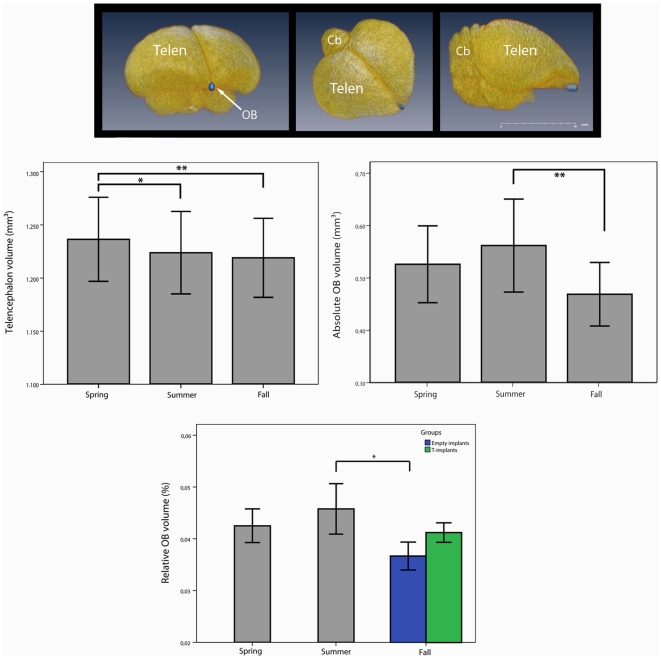
METHODOLOGY/PRINCIPAL FINDINGS: This study used repeated in vivo Manganese-enhanced MRI to quantify for the first time possible seasonal changes in the anatomy and activity of the OB in starling brains. We demonstrated that the OB of the starling exhibits a functional seasonal plasticity of certain plant odour specificity and that the OB is only able to detect milfoil odour during the breeding season. Volumetric analysis showed that this seasonal change in activity is not linked to a change in OB volume. By subsequently experimentally elevating testosterone (T) in half of the males during the non-breeding season we showed that the OB volume was increased compared to controls.
CONCLUSIONS/SIGNIFICANCE: By investigating the neural substrate of seasonal olfactory sensitivity changes we show that the starlings' OB loses its ability during the non-breeding season to detect a natural odour of a plant preferred as green nest material by male starlings. We found that testosterone, applied during the non-breeding season, does not restore the discriminatory ability of the OB but has an influence on its size.
由于与啮齿动物相比,嗅球(OB)体积较小,人们普遍认为鸣禽的嗅觉不发达。然而,最近的几项研究表明,包括雀形目在内的多种鸟类在生活的许多方面都利用嗅觉,这一观点得到了修正。在求偶和筑巢过程中,雄性欧洲椋鸟(Sturnus vulgaris)会将富含挥发性化合物(如牛至、Achillea millefolium)的芳香草本植物纳入巢中,它们利用嗅觉线索来识别这些植物。有趣的是,欧洲椋鸟对气味线索的反应能力在季节上存在差异:在春季筑巢期间,其嗅觉敏感性达到峰值,但在非繁殖季节几乎不存在。
方法/主要发现:本研究首次使用重复活体锰增强 MRI 来量化星鸟大脑中 OB 解剖结构和活性的可能季节性变化。我们证明,星鸟的 OB 表现出特定植物气味特异性的功能季节性可塑性,并且 OB 只能在繁殖季节检测到牛至气味。体积分析表明,这种活动的季节性变化与 OB 体积的变化无关。随后,我们在非繁殖季节通过实验性地将一半雄性的睾丸激素(T)水平升高,发现 OB 体积与对照组相比有所增加。
结论/意义:通过研究季节性嗅觉敏感性变化的神经基质,我们表明,在非繁殖季节,星鸟的 OB 失去了检测雄性星鸟作为绿色巢材首选的一种植物天然气味的能力。我们发现,在非繁殖季节应用的睾丸激素不会恢复 OB 的辨别能力,但对其大小有影响。