Integrative Neuroscience Section, Integrative Neuroscience Branch, National Institute on Drug Abuse/Intramural Research Program (NIDA/IRP), 333 Cassell Drive, Baltimore, MD 21224, USA.
Addict Biol. 2011 Apr;16(2):229-37. doi: 10.1111/j.1369-1600.2010.00272.x. Epub 2010 Dec 23.
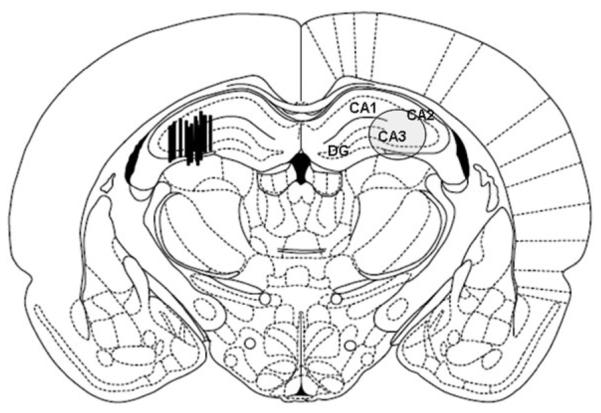
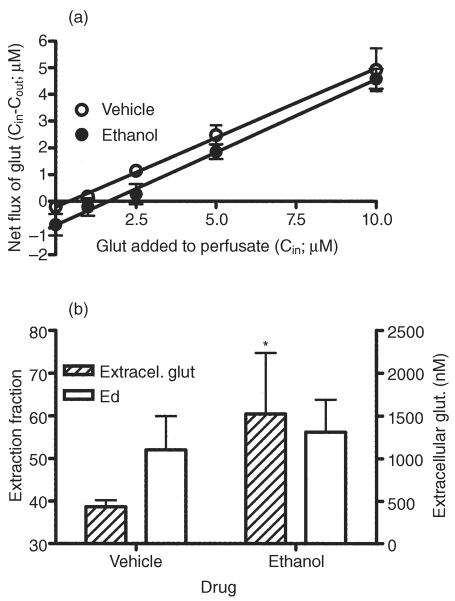
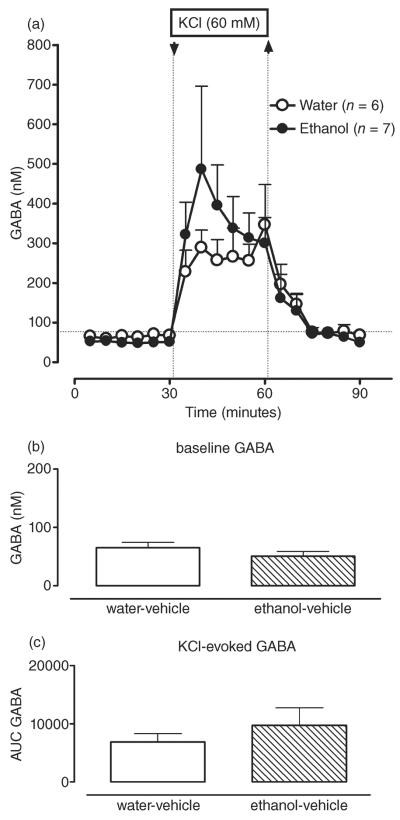
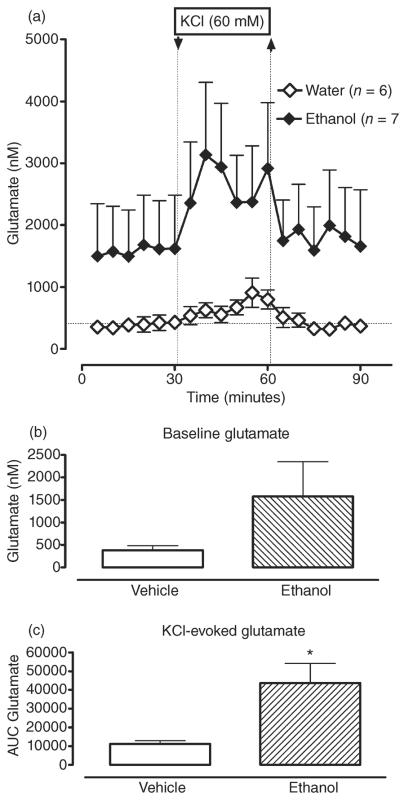
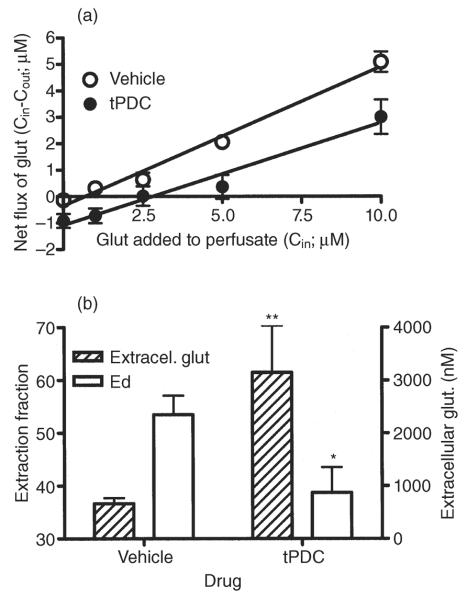
The present study used conventional and quantitative microdialysis to assess glutamatergic and GABAergic neurotransmission in the hippocampal CA3 area of the rat following a moderate-dose ethanol treatment regimen. Male Wistar rats received 3.4 g/kg of ethanol or water for 6 days via gastric gavage. Microdialysis experiments commenced 2 days later. Basal and depolarization-induced glutamate overflow were significantly elevated in ethanol-treated animals. Basal and depolarization-induced gamma-aminobutyric acid (GABA) overflow were unaltered. Quantitative no-net-flux microdialysis was used to determine if changes in dialysate glutamate levels following ethanol administration are due to an increase in release or a decrease in uptake. To confirm the validity of this method for quantifying basal glutamate dynamics, extracellular concentrations of glutamate and the extraction fraction, which reflects changes in analyte clearance, were quantified in response to retro-dialysis of the glutamate uptake blocker trans-pyrrolidine-2,4-dicarboxylic acid (tPDC). tPDC significantly decreased the extraction fraction for glutamate, resulting in augmented extracellular glutamate concentrations. Repeated ethanol administration did not alter the glutamate extraction fraction. However, extracellular glutamate concentrations were significantly elevated, indicating that glutamate release is increased as a consequence of repeated ethanol administration. These data demonstrate that repeated bouts of moderate ethanol consumption alter basal glutamate dynamics in the CA3 region of the dorsal hippocampus. Basal glutamate release is augmented, whereas glutamate uptake is unchanged. Furthermore, they suggest that dysregulation of glutamate transmission in this region may contribute to the previously documented deficits in cognitive function associated with moderate dose ethanol use.
本研究采用常规和定量微透析技术,评估了中等剂量乙醇处理方案后大鼠海马 CA3 区的谷氨酸能和 GABA 能神经传递。雄性 Wistar 大鼠通过胃灌胃接受 3.4 g/kg 的乙醇或水,共 6 天。微透析实验在 2 天后开始。乙醇处理动物的基础和去极化诱导的谷氨酸溢出明显增加。基础和去极化诱导的γ-氨基丁酸(GABA)溢出未改变。定量无净流量微透析用于确定乙醇给药后透析液中谷氨酸水平的变化是由于释放增加还是摄取减少所致。为了证实这种方法定量测定基础谷氨酸动力学的有效性,我们在响应谷氨酸摄取抑制剂反吡咯烷-2,4-二羧酸(tPDC)的逆行透析时,定量了细胞外谷氨酸浓度和提取分数,该分数反映了分析物清除的变化。tPDC 显著降低了谷氨酸的提取分数,导致细胞外谷氨酸浓度增加。重复乙醇给药不会改变谷氨酸的提取分数。然而,细胞外谷氨酸浓度明显升高,表明重复乙醇给药会增加谷氨酸释放。这些数据表明,反复摄入中等剂量的乙醇会改变背侧海马 CA3 区的基础谷氨酸动力学。基础谷氨酸释放增加,而谷氨酸摄取不变。此外,它们表明该区域谷氨酸传递的失调可能导致与中等剂量乙醇使用相关的先前记录的认知功能缺陷。