Department of Microbiology and Molecular Genetics, Harvard Medical School, Boston, MA 02115, USA.
Cell. 2010 Dec 23;143(7):1110-20. doi: 10.1016/j.cell.2010.11.037.
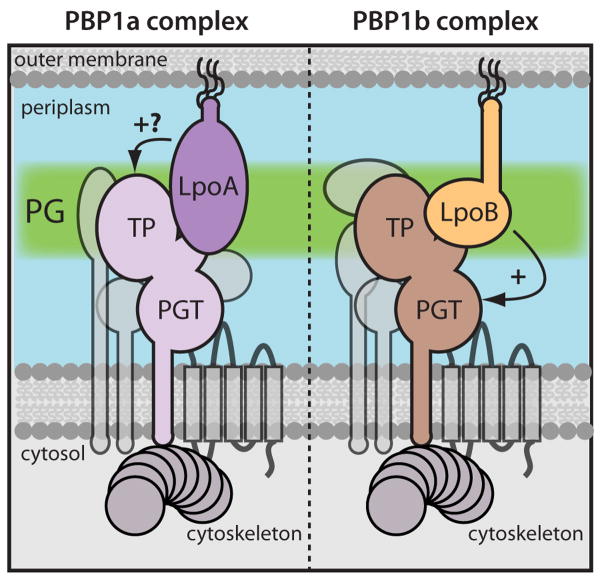
Most bacteria surround themselves with a peptidoglycan (PG) exoskeleton synthesized by polysaccharide polymerases called penicillin-binding proteins (PBPs). Because they are the targets of penicillin and related antibiotics, the structure and biochemical functions of the PBPs have been extensively studied. Despite this, we still know surprisingly little about how these enzymes build the PG layer in vivo. Here, we identify the Escherichia coli outer-membrane lipoproteins LpoA and LpoB as essential PBP cofactors. We show that LpoA and LpoB form specific trans-envelope complexes with their cognate PBP and are critical for PBP function in vivo. We further show that LpoB promotes PG synthesis by its partner PBP in vitro and that it likely does so by stimulating glycan chain polymerization. Overall, our results indicate that PBP accessory proteins play a central role in PG biogenesis, and like the PBPs they work with, these factors are attractive targets for antibiotic development.
大多数细菌用多糖聚合酶合成的肽聚糖(PG)外壳包裹自身,这些多糖聚合酶被称为青霉素结合蛋白(PBP)。由于它们是青霉素和相关抗生素的作用靶点,因此 PBP 的结构和生化功能已得到广泛研究。尽管如此,我们对于这些酶如何在体内构建 PG 层仍然知之甚少。在这里,我们确定了大肠杆菌外膜脂蛋白 LpoA 和 LpoB 是必需的 PBP 辅助因子。我们表明,LpoA 和 LpoB 与它们的同源 PBP 形成特定的跨膜复合物,并且对于 PBP 在体内的功能至关重要。我们进一步表明,LpoB 在体外通过其伴侣 PBP 促进 PG 合成,并且可能通过刺激聚糖链聚合来实现这一点。总的来说,我们的结果表明,PBP 辅助蛋白在 PG 生物合成中起着核心作用,并且与它们所作用的 PBP 一样,这些因子是抗生素开发的有吸引力的目标。