Department of Physiology and Pharmacology, Oregon Health and Science University, Portland, OR 97239, USA.
Front Biosci (Landmark Ed). 2011 Jan 1;16(4):1560-73. doi: 10.2741/3805.
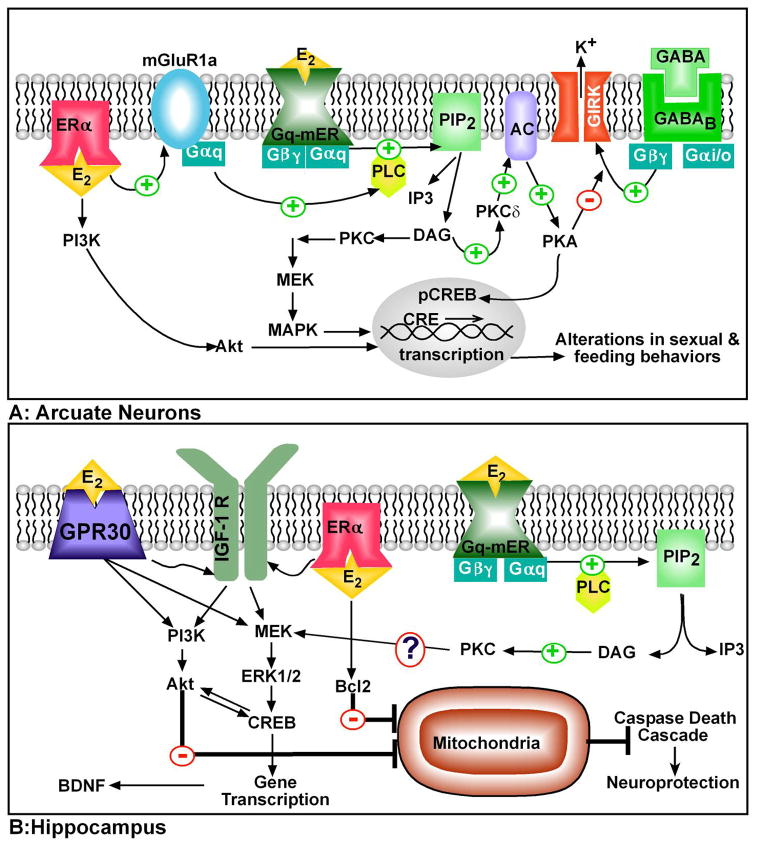
Many of the actions of 17beta-estradiol (E2) in the central nervous system (CNS) are mediated via the classical nuclear steroid receptors, ER(alpha) and ERbeta, which interact with the estrogen response element to modulate gene expression. In addition to the nuclear-initiated estrogen signaling, E2 signaling in the brain can occur rapidly within minutes prior to any sufficient effects on transcription of relevant genes. These rapid, membrane-initiated E2 signaling mechanisms have now been characterized in many brain regions, most importantly in neurons of the hypothalamus and hippocampus. Furthermore, our understanding of the physiological effects of membrane-initiated pathways is now a major field of interest in the hypothalamic control of reproduction, energy balance, thermoregulation and other homeostatic functions as well as the effects of E2 on physiological and pathophysiological functions of the hippocampus. Membrane signaling pathways impact neuronal excitability, signal transduction, cell death, neurotransmitter release and gene expression. This review will summarize recent findings on membrane-initiated E2 signaling in the hypothalamus and hippocampus and its contribution to the control of physiological and behavioral functions.
许多 17β-雌二醇(E2)在中枢神经系统(CNS)中的作用是通过经典的核甾体受体 ER(alpha)和 ERbeta 介导的,它们与雌激素反应元件相互作用,调节基因表达。除了核启动的雌激素信号外,E2 在大脑中的信号传递可以在对相关基因转录产生任何足够影响之前的几分钟内迅速发生。这些快速的、膜起始的 E2 信号传递机制已经在许多脑区得到了描述,最重要的是在下丘脑和海马体的神经元中。此外,我们对膜起始途径的生理效应的理解现在是下丘脑对生殖、能量平衡、体温调节和其他体内平衡功能的控制以及 E2 对海马体的生理和病理生理功能的影响的一个主要研究领域。膜信号传递途径影响神经元兴奋性、信号转导、细胞死亡、神经递质释放和基因表达。这篇综述将总结最近关于下丘脑和海马体中膜起始的 E2 信号传递及其对生理和行为功能控制的研究结果。