Department of Systems Aging Science and Medicine, Tokyo Metropolitan Institute for Geriatrics and Gerontology (TMIG), Tokyo, Japan.
Integrated Research Initiative for Living Well with Dementia (IRIDE), TMIG, Tokyo, Japan.
Front Endocrinol (Lausanne). 2023 Jul 4;14:1220150. doi: 10.3389/fendo.2023.1220150. eCollection 2023.
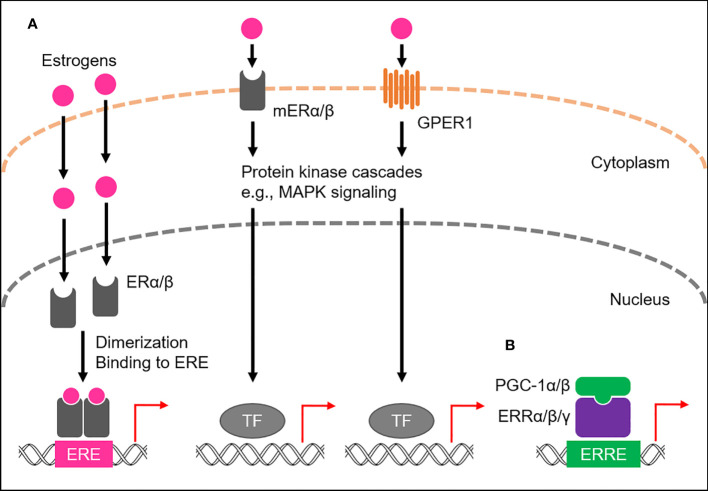
While estrogens are well known for their pivotal role in the female reproductive system, they also play a crucial function in regulating physiological processes associated with learning and memory in the brain. Moreover, they have neuroprotective effects in the pathogenesis of Alzheimer's disease (AD). Importantly, AD has a higher incidence in older and postmenopausal women than in men, and estrogen treatment might reduce the risk of AD in these women. In general, estrogens bind to and activate estrogen receptors (ERs)-mediated transcriptional machineries, and also stimulate signal transduction through membrane ERs (mERs). Estrogen-related receptors (ERRs), which share homologous sequences with ERs but lack estrogen-binding capabilities, are widely and highly expressed in the human brain and have also been implicated in AD pathogenesis. In this review, we primarily provide a summary of ER and ERR expression patterns in the human brain. In addition, we summarize recent studies on their role in learning and memory. We then review and discuss research that has elucidated the functions and importance of ERs and ERRs in AD pathogenesis, including their role in Aβ clearance and the reduction of phosphorylated tau levels. Elucidation of the mechanisms underlying ER- and ERR-mediated transcriptional machineries and their functions in healthy and diseased brains would provide new perspectives for the diagnosis and treatment of AD. Furthermore, exploring the potential role of estrogens and their receptors, ERs, in AD will facilitate a better understanding of the sex differences observed in AD, and lead to novel sex-specific therapeutic approaches.
虽然雌激素在女性生殖系统中起着至关重要的作用,但它们在调节大脑中与学习和记忆相关的生理过程中也起着关键作用。此外,它们在阿尔茨海默病(AD)的发病机制中具有神经保护作用。重要的是,AD 在老年和绝经后妇女中的发病率高于男性,而雌激素治疗可能会降低这些妇女患 AD 的风险。一般来说,雌激素与雌激素受体(ERs)结合并激活其介导的转录机制,同时通过膜雌激素受体(mERs)刺激信号转导。雌激素相关受体(ERRs)与 ERs 具有同源序列但缺乏雌激素结合能力,在人脑中有广泛且高度的表达,并且也与 AD 的发病机制有关。在这篇综述中,我们主要总结了 ER 和 ERR 在人脑中的表达模式。此外,我们总结了它们在学习和记忆中的作用的最新研究。然后,我们回顾和讨论了阐明 ER 和 ERR 在 AD 发病机制中的作用及其重要性的研究,包括它们在 Aβ清除和降低磷酸化 tau 水平中的作用。阐明 ER 和 ERR 介导的转录机制的机制及其在健康和患病大脑中的功能将为 AD 的诊断和治疗提供新的视角。此外,探索雌激素及其受体 ER 在 AD 中的潜在作用将有助于更好地理解 AD 中观察到的性别差异,并导致新的针对特定性别的治疗方法。