School of Medicine, University of Pittsburgh, Pittsburgh, PA, USA.
Med Sci Sports Exerc. 2011 Aug;43(8):1568-74. doi: 10.1249/MSS.0b013e31820b9395.
Weight loss has been associated with higher physical activity (PA) levels and frequent dietary self-monitoring. Less is known about how PA self-monitoring affects adherence to PA goals, PA levels, and weight change.
The SMART Trial is a clinical weight loss trial in which 210 overweight adults were randomized equally to one of three arms: 1) paper record (PR), 2) personal digital assistant with self-monitoring software (PDA), and 3) PDA with daily tailored feedback message (PDA + FB). PA self-monitoring and adherence to PA goals were based on entries in weekly submitted diaries. PA levels were measured via self-report by the past 6-month Modifiable Activity Questionnaire at baseline and 6 months.
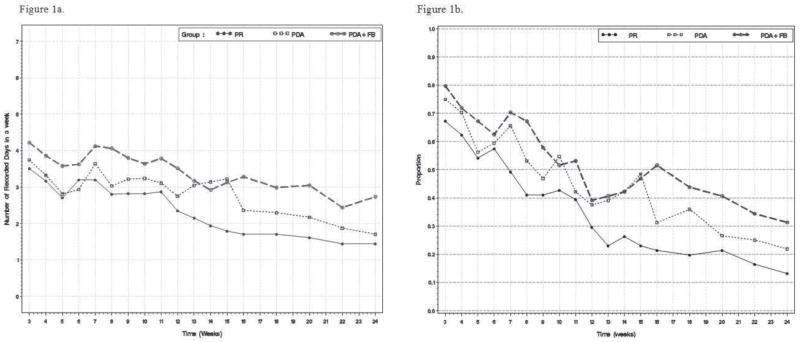
Data are presented on 189 participants with complete 6-month PA data (84% female, 77% white, mean age = 47.3 ± 8.8 yr, mean body mass index = 34.1 ± 4.5 kg·m(-2)). Median PA level was 7.96 MET·h·wk(-1) at baseline and 13.4 MET·h·wk(-1) at 6 months, with significant PA increases in all three arms. PDA + FB arm had a higher mean number of weekly self-monitoring entries than the PR arm (3.4 vs 2.4, P = 0.003) and were more likely to maintain high (i.e., 100%) adherence to PA goals over time than the PDA (P = 0.02) or PR arms (P = 0.0003). Both PA self-monitoring and adherence to PA goals were related to higher PA levels at 6 months. A higher mean rate of PA self-monitoring was associated with a greater percentage of weight decrease (ρ = -0.49, P < 0.0001) at 6 months.
PA self-monitoring and adherence to PA goals were more likely in participants in the PDA + FB arm and in turn predicted higher PA levels and weight loss.
体重减轻与更高的体力活动(PA)水平和频繁的饮食自我监测有关。关于 PA 自我监测如何影响对 PA 目标的坚持、PA 水平和体重变化知之甚少。
SMART 试验是一项临床减肥试验,其中 210 名超重成年人被平均随机分为三组:1)纸质记录(PR),2)带有自我监测软件的个人数字助理(PDA),3)带有每日定制反馈消息的 PDA(PDA + FB)。PA 自我监测和对 PA 目标的坚持基于每周提交的日记中的条目。PA 水平通过过去 6 个月的可修改活动问卷在基线和 6 个月时通过自我报告进行测量。
在有完整 6 个月 PA 数据的 189 名参与者中(84%为女性,77%为白人,平均年龄=47.3±8.8 岁,平均体重指数=34.1±4.5 kg·m(-2)),数据呈现在这里。基线时 PA 水平中位数为 7.96 MET·h·wk(-1),6 个月时为 13.4 MET·h·wk(-1),所有三组的 PA 均显著增加。PDA + FB 组每周自我监测条目数的平均值高于 PR 组(3.4 对 2.4,P=0.003),并且随着时间的推移,与 PDA(P=0.02)或 PR 组(P=0.0003)相比,更有可能保持对 PA 目标的高(即 100%)坚持。PA 自我监测和对 PA 目标的坚持均与 6 个月时的 PA 水平较高有关。较高的 PA 自我监测平均值与 6 个月时体重减轻的百分比更高(ρ=-0.49,P<0.0001)相关。
PDA + FB 组参与者更有可能进行 PA 自我监测和坚持 PA 目标,反过来又预测了更高的 PA 水平和体重减轻。