Hollis Jack F, Gullion Christina M, Stevens Victor J, Brantley Phillip J, Appel Lawrence J, Ard Jamy D, Champagne Catherine M, Dalcin Arlene, Erlinger Thomas P, Funk Kristine, Laferriere Daniel, Lin Pao-Hwa, Loria Catherine M, Samuel-Hodge Carmen, Vollmer William M, Svetkey Laura P
Center for Health Research, Kaiser Permanente Northwest, Portland, Oregon 97227, USA.
Am J Prev Med. 2008 Aug;35(2):118-26. doi: 10.1016/j.amepre.2008.04.013.
To improve methods for long-term weight management, the Weight Loss Maintenance (WLM) trial, a four-center randomized trial, was conducted to compare alternative strategies for maintaining weight loss over a 30-month period. This paper describes methods and results for the initial 6-month weight-loss program (Phase I).
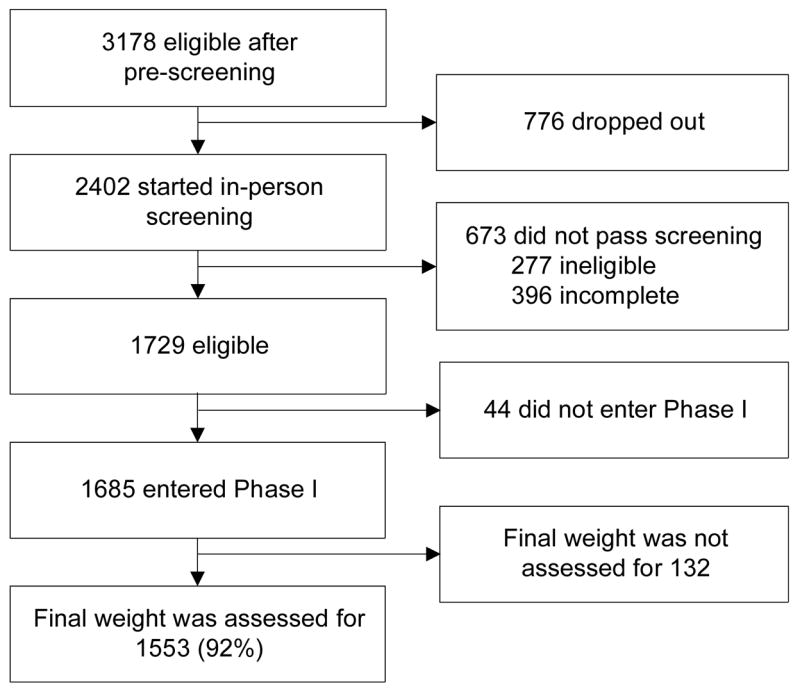
Eligible adults were aged > or =25, overweight or obese (BMI=25-45 kg/m2), and on medications for hypertension and/or dyslipidemia. Anthropomorphic, demographic, and psychosocial measures were collected at baseline and 6 months. Participants (n=1685) attended 20 weekly group sessions to encourage calorie restriction, moderate-intensity physical activity, and the DASH (dietary approaches to stop hypertension) dietary pattern. Weight-loss predictors with missing data were replaced by multiple imputation.
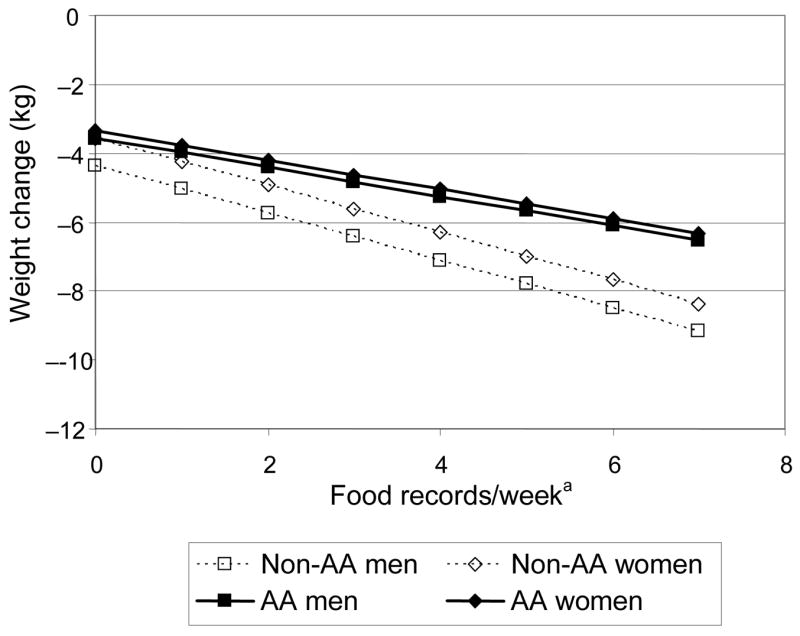
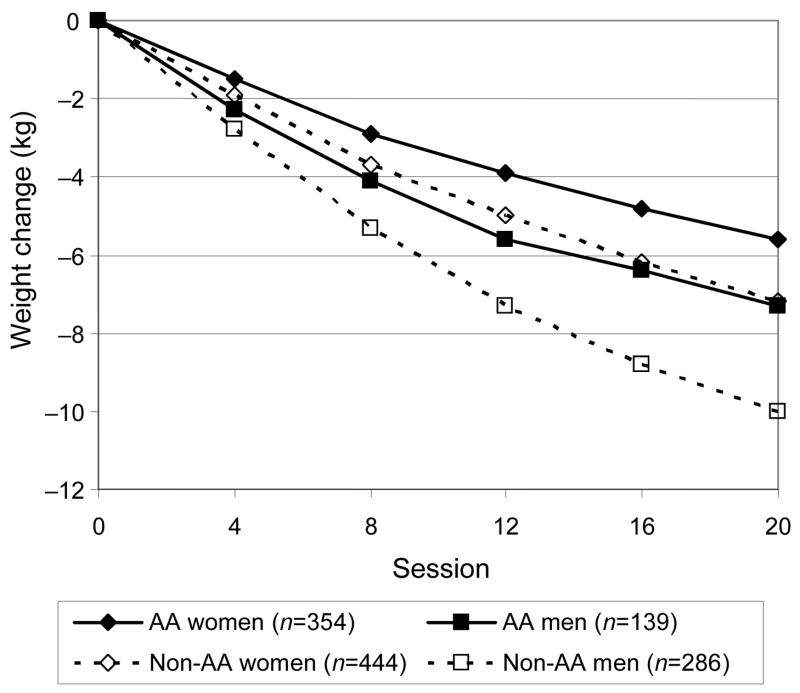
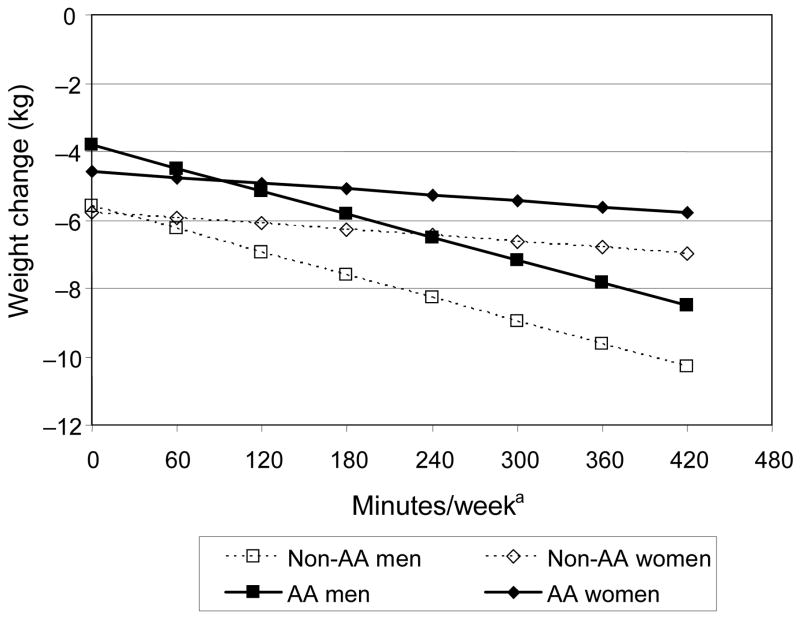
Participants were 44% African American and 67% women; 79% were obese (BMI> or =30), 87% were taking anti-hypertensive medications, and 38% were taking antidyslipidemia medications. Participants attended an average of 72% of 20 group sessions. They self-reported 117 minutes of moderate-intensity physical activity per week, kept 3.7 daily food records per week, and consumed 2.9 servings of fruits and vegetables per day. The Phase-I follow-up rate was 92%. Mean (SD) weight change was -5.8 kg (4.4), and 69% lost at least 4 kg. All race-gender subgroups lost substantial weight: African-American men (-5.4 kg +/- 7.7); African-American women (-4.1 kg +/- 2.9); non-African-American men (-8.5 kg +/- 12.9); and non-African-American women (-5.8 kg +/- 6.1). Behavioral measures (e.g., diet records and physical activity) accounted for most of the weight-loss variation, although the association between behavioral measures and weight loss differed by race and gender groups.
The WLM behavioral intervention successfully achieved clinically significant short-term weight loss in a diverse population of high-risk patients.
为改进长期体重管理方法,开展了一项四中心随机试验——体重减轻维持(WLM)试验,以比较在30个月期间维持体重减轻的替代策略。本文描述了初始6个月体重减轻计划(第一阶段)的方法和结果。
符合条件的成年人年龄≥25岁,超重或肥胖(BMI=25-45kg/m²),且正在服用治疗高血压和/或血脂异常的药物。在基线和6个月时收集人体测量、人口统计学和社会心理指标。参与者(n=1685)参加了20次每周一次的小组会议,以鼓励限制热量摄入、进行中等强度体育活动以及采用DASH(终止高血压膳食方法)饮食模式。缺失数据的体重减轻预测因素通过多重填补法进行替换。
参与者中44%为非裔美国人,67%为女性;79%为肥胖者(BMI≥30),8