Institute of Clinical Medicine and Research Center for Clinical Medicine, National Cheng Kung University and Hospital, Tainan, Taiwan.
PLoS One. 2010 Dec 28;5(12):e14414. doi: 10.1371/journal.pone.0014414.
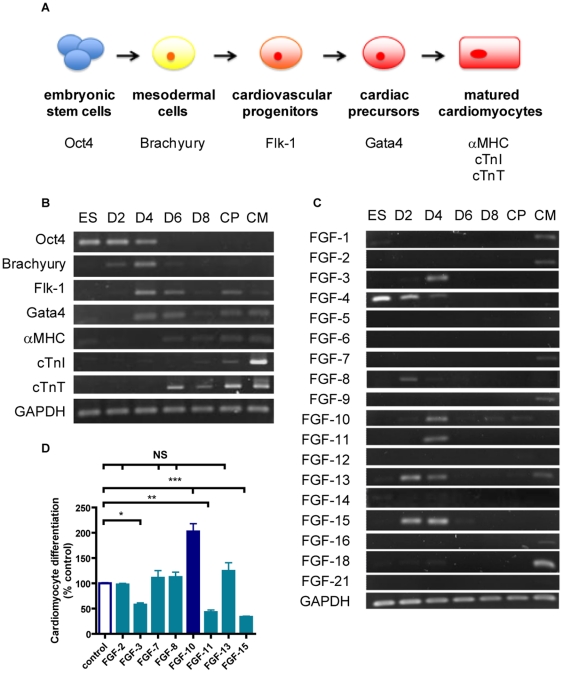
The fibroblast growth factor (FGF) family is essential to normal heart development. Yet, its contribution to cardiomyocyte differentiation from stem cells has not been systemically studied. In this study, we examined the mechanisms and characters of cardiomyocyte differentiation from FGF family protein treated embryonic stem (ES) cells and induced pluripotent stem (iPS) cells.
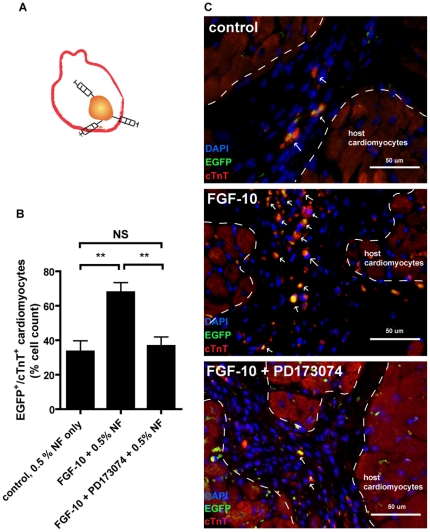
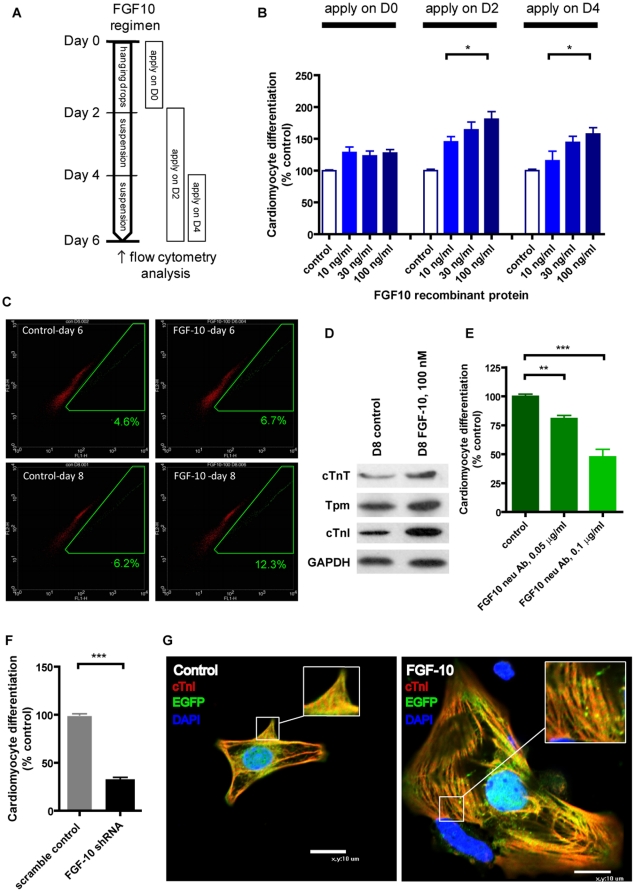
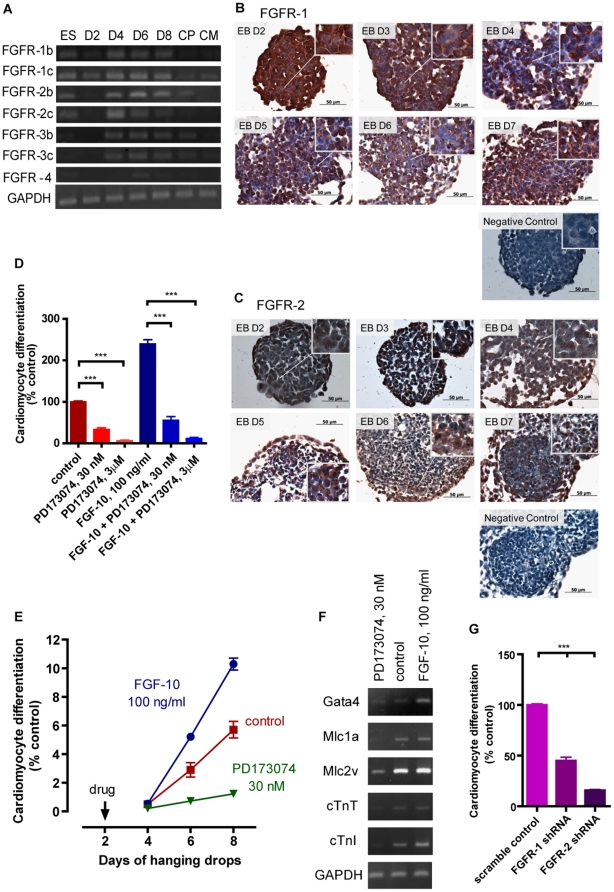
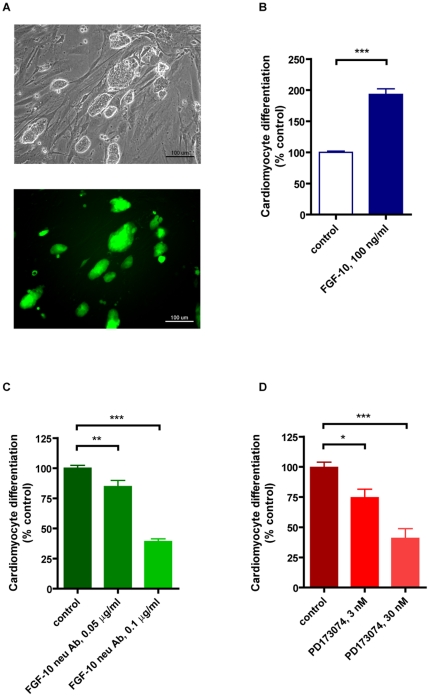
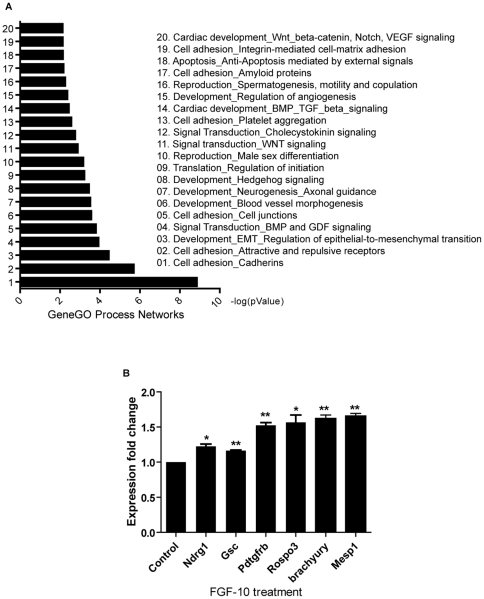
METHODOLOGY/PRINCIPAL FINDINGS: We used mouse ES cells stably transfected with a cardiac-specific α-myosin heavy chain (αMHC) promoter-driven enhanced green fluorescent protein (EGFP) and mouse iPS cells to investigate cardiomyocyte differentiation. During cardiomyocyte differentiation from mouse ES cells, FGF-3, -8, -10, -11, -13 and -15 showed an expression pattern similar to the mesodermal marker Brachyury and the cardiovascular progenitor marker Flk-1. Among them, FGF-10 induced cardiomyocyte differentiation in a time- and concentration-dependent manner. FGF-10 neutralizing antibody, small molecule FGF receptor antagonist PD173074 and FGF-10 and FGF receptor-2 short hairpin RNAs inhibited cardiomyocyte differentiation. FGF-10 also increased mouse iPS cell differentiation into cardiomyocyte lineage, and this effect was abolished by FGF-10 neutralizing antibody or PD173074. Following Gene Ontology analysis, microarray data indicated that genes involved in cardiac development were upregulated after FGF-10 treatment. In vivo, intramyocardial co-administration of FGF-10 and ES cells demonstrated that FGF-10 also promoted cardiomyocyte differentiation.
CONCLUSION/SIGNIFICANCE: FGF-10 induced cardiomyocyte differentiation from ES cells and iPS cells, which may have potential for translation into clinical applications.
成纤维细胞生长因子(FGF)家族对于正常心脏发育至关重要。然而,其在干细胞向心肌细胞分化中的作用尚未得到系统研究。本研究旨在研究 FGF 家族蛋白处理胚胎干细胞(ES)和诱导多能干细胞(iPS)分化为心肌细胞的机制和特征。
方法/主要发现:我们使用心脏特异性α-肌球蛋白重链(αMHC)启动子驱动增强型绿色荧光蛋白(EGFP)稳定转染的小鼠 ES 细胞和小鼠 iPS 细胞来研究心肌细胞分化。在小鼠 ES 细胞向心肌细胞分化过程中,FGF-3、-8、-10、-11、-13 和 -15 的表达模式与中胚层标志物 Brachyury 和心血管祖细胞标志物 Flk-1 相似。其中,FGF-10 呈时间和浓度依赖性诱导心肌细胞分化。FGF-10 中和抗体、小分子 FGF 受体拮抗剂 PD173074 和 FGF-10 和 FGF 受体-2 短发夹 RNA 抑制心肌细胞分化。FGF-10 还增加了小鼠 iPS 细胞向心肌细胞谱系的分化,而 FGF-10 中和抗体或 PD173074 则可消除这种作用。通过基因本体分析,微阵列数据表明 FGF-10 处理后与心脏发育相关的基因上调。在体内,FGF-10 与 ES 细胞共注射心肌内表明 FGF-10 也促进了心肌细胞分化。
结论/意义:FGF-10 诱导 ES 细胞和 iPS 细胞向心肌细胞分化,这可能具有转化为临床应用的潜力。