Al Farra Helmi Yousif
Yarmouk University, Irbid, Jordan; Dalhousie University, Halifax, Nova Scotia, Canada.
Indian J Hum Genet. 2010 Sep;16(3):138-43. doi: 10.4103/0971-6866.73405.
The human methionine synthase gene (MTR) is located on chromosome 1q43; it is of 105.24 kb and is made up of 33 exons. Methionine synthase is a cytoplasmic enzyme that requires methylcobalamin for activity and catalyzes the remethylation of homocysteine to methionine. In this reaction, the methyl group of 5-methyltetrahydrofolate is transferred to the enzyme bond cob(I) alamin to generate methylcobalamin, followed by the transfer of the methyl group to homocysteine to reform methionine.
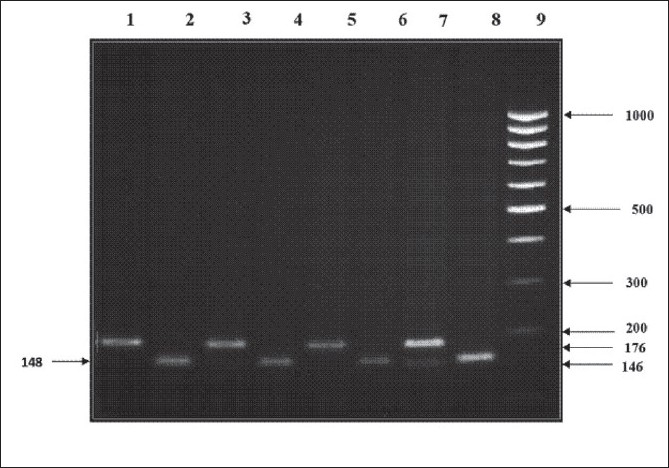
The frequencies of the polymorphisms of MTR 2756A>G and MTR 2758C>G have been determined in this study in a sample of 491 individuals collected from all regions of Jordan and representing the Jordanian population. The different alleles and genotypes at the two polymorphic sites were identified using the Polymerase Chain Reaction - Restriction Fragment Length Polymorphism (PCR-RFLP) analysis.
Showed that the percentages of the polymorphic alleles at the MTR 2756 position in the north, middle and south regions were 90.38, 92.65 and 83.69%, respectively, for the MTR 2756A allele, and were 9.61, 7.34 and 16.30%, respectively, for the MTR 2756G allele, with overall percentages in the whole Jordanian population of 90.73 and 9.27% for the MTR 2756A and MTR 2756G alleles, respectively. The percentages of the genotype MTR 2756AA were 82.90% in the northern region, 86.72% in the middle region and 71.73% in the southern region, and an overall percentage of MTR 2756AA in the whole Jordanian population was 83.50%. The frequencies of MTR 2756AG genotype in the northern, middle and southern regions were 14.95, 11.84 and 23.91%, respectively, with an overall percentage of 14.46% in the whole Jordanian population. The percentages of the genotype MTR 2756GG in the northern, middle and southern regions were 2.13, 1.42 and 4.34%, respectively, with an overall percentage of 2.04% in the whole Jordanian population. Only the wild type allele (C) of the MTR 2758C>G polymorphism was detected in this study. In addition, the association of MTR 2756A>G and MTR 2758C>G polymorphisms with the development of neural tube defects (NTDs) was examined using 17 cases of mothers from the northern part of Jordan, who gave birth to NTD affected children during the period of this study. Results showed no association between these two examined polymorphisms and the increase in maternal risk for giving birth to NTD children.
results of this study recommend that examination should be done on larger populations to arrive at better conclusions. Also, more studies on gene-gene interaction should be done to examine the associations with NTDs.
人类甲硫氨酸合成酶基因(MTR)位于1号染色体q43区域;其长度为105.24 kb,由33个外显子组成。甲硫氨酸合成酶是一种胞质酶,其活性需要甲钴胺,并催化同型半胱氨酸重新甲基化为甲硫氨酸。在这个反应中,5-甲基四氢叶酸的甲基转移到酶结合的钴胺素(I)上生成甲钴胺,随后甲基转移到同型半胱氨酸上重新生成甲硫氨酸。
本研究测定了从约旦各地收集的491名个体样本中MTR 2756A>G和MTR 2758C>G多态性的频率,这些个体代表约旦人群。使用聚合酶链反应-限制性片段长度多态性(PCR-RFLP)分析鉴定了两个多态性位点的不同等位基因和基因型。
结果显示,北部、中部和南部地区MTR 2756位点的多态性等位基因中,MTR 2756A等位基因的百分比分别为90.38%、92.65%和83.69%,MTR 2756G等位基因的百分比分别为9.61%、7.34%和16.30%,约旦总人口中MTR 2756A和MTR 2756G等位基因的总体百分比分别为90.73%和9.27%。MTR 2756AA基因型在北部地区的百分比为82.90%,中部地区为86.72%,南部地区为71.73%,约旦总人口中MTR 2756AA的总体百分比为83.50%。MTR 2756AG基因型在北部、中部和南部地区的频率分别为14.95%、11.84%和23.91%,约旦总人口中的总体百分比为14.46%。MTR 2756GG基因型在北部、中部和南部地区的百分比分别为2.13%、1.42%和4.34%,约旦总人口中的总体百分比为2.04%。本研究中仅检测到MTR 2758C>G多态性的野生型等位基因(C)。此外,使用17例来自约旦北部的母亲进行研究,她们在本研究期间生下了神经管缺陷(NTD)患儿,检测了MTR 2756A>G和MTR 2758C>G多态性与神经管缺陷发生的关联。结果显示,这两个检测的多态性与母亲生育神经管缺陷患儿的风险增加之间没有关联。
本研究结果建议应在更大规模人群中进行检测以得出更好的结论。此外,应进行更多关于基因-基因相互作用的研究,以检测与神经管缺陷的关联。