Hacettepe University Hospital, Department of Internal Medicine, Division of Hematology, Ankara, Turkey.
Int J Med Sci. 2010 Dec 28;8(1):30-8. doi: 10.7150/ijms.8.30.
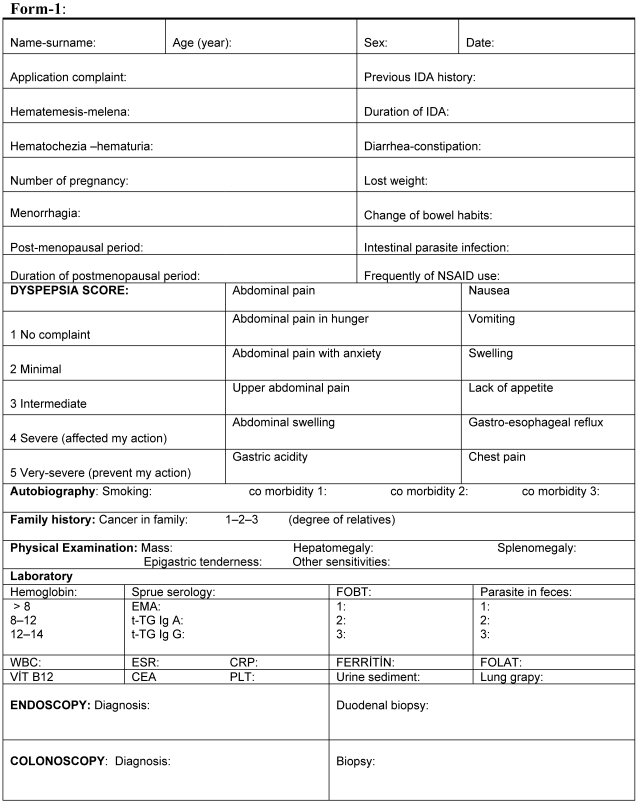
Iron deficiency anemia (IDA) is a frequent disorder. Also, it may be a sign of underlying serious diseases. Iron deficiency points to an occult or frank bleeding lesion when occurred in men or postmenopausal women. In this study, we aimed to evaluate the diagnostic yield of endoscopy in patients with IDA and to define predictive factors of gastrointestinal (GI) lesions causing IDA. Ninety-one patients (77 women, 14 men; mean age: 43 years) who were decided to have esophago-duodenoscopy and/or colonoscopy for iron deficiency anemia were interviewed and responded to a questionnaire that included clinical and biochemical variables. The endoscopic findings were recorded as GI lesions causing IDA or not causing IDA. Endoscopy revealed a source of IDA in 18.6 % of cases. The risk factors for finding GI lesions causing IDA were as follows: male gender (p= 0.004), advanced age (> 50 years) (p= 0.010), weight loss (over 20% of total body weight lost in last 6 month) (p= 0.020), chronic diarrhea (p= 0.006), change of bowel habits (p= 0.043), epigastric tenderness (p= 0.037), raised carcinoembryonic antigen (CEA) level (normal range: 0-7 ng/mL) (p= 0.039), < 10 gr/dl hemoglobin (Hb) level (p=0.054). None of these risk factors had been present in 21 (23%) women younger than 51 years. In this group, no patient had any GI lesion likely to cause IDA (negative predictive value= 100%). In multivariate analysis, advanced age (p=0.017), male gender (p< 0.01) and weight lost (p=0.012) found that associated with GI lesions in all patients. It may be an appropriate clinical approach to consider these risk factors when deciding for gastrointestinal endoscopic evaluation in iron deficiency anemia.
缺铁性贫血(IDA)是一种常见疾病。此外,它可能是潜在严重疾病的征兆。当男性或绝经后妇女发生缺铁性贫血时,缺铁性贫血提示隐匿性或明显的出血性病变。在本研究中,我们旨在评估内镜检查在缺铁性贫血患者中的诊断价值,并确定导致缺铁性贫血的胃肠道(GI)病变的预测因素。91 名患者(77 名女性,14 名男性;平均年龄:43 岁)因缺铁性贫血决定进行食管-十二指肠镜和/或结肠镜检查,对他们进行了访谈,并对包括临床和生化变量在内的问卷做出了回答。内镜检查结果记录为导致或不导致缺铁性贫血的胃肠道病变。内镜检查发现 18.6%的病例存在缺铁性贫血的病因。导致发现导致缺铁性贫血的胃肠道病变的危险因素如下:男性(p=0.004)、年龄较大(>50 岁)(p=0.010)、体重减轻(过去 6 个月内体重减轻超过 20%)(p=0.020)、慢性腹泻(p=0.006)、排便习惯改变(p=0.043)、上腹痛(p=0.037)、癌胚抗原(CEA)水平升高(正常值:0-7ng/mL)(p=0.039)、血红蛋白(Hb)水平<10g/dl(p=0.054)。在 21 名(23%)年龄小于 51 岁的女性中,没有这些危险因素存在。在这一组中,没有任何患者有任何可能导致缺铁性贫血的胃肠道病变(阴性预测值=100%)。在多变量分析中,年龄较大(p=0.017)、男性(p<0.01)和体重减轻(p=0.012)与所有患者的胃肠道病变相关。在决定缺铁性贫血的胃肠道内镜检查时,考虑这些危险因素可能是一种适当的临床方法。