Preventive Healthcare Center, Department of Internal Medicine, Kangbuk Samsung Hospital, Sungkyunkwan University School of Medicine, Seoul, Korea.
Division of Gastroenterology, Department of Internal Medicine, Kangbuk Samsung Hospital, Sungkyunkwan University School of Medicine, Seoul, Korea.
Korean J Intern Med. 2018 Nov;33(6):1084-1092. doi: 10.3904/kjim.2016.421. Epub 2018 Jan 5.
BACKGROUND/AIMS: There has been no evidence for the necessity of endoscopy in asymptomatic young men with iron deficiency anemia (IDA). To determine whether endoscopy should be recommended in asymptomatic young men with IDA, we compared the prevalence of gastrointestinal (GI) lesions between young men (< 50 years) with IDA and those without IDA.
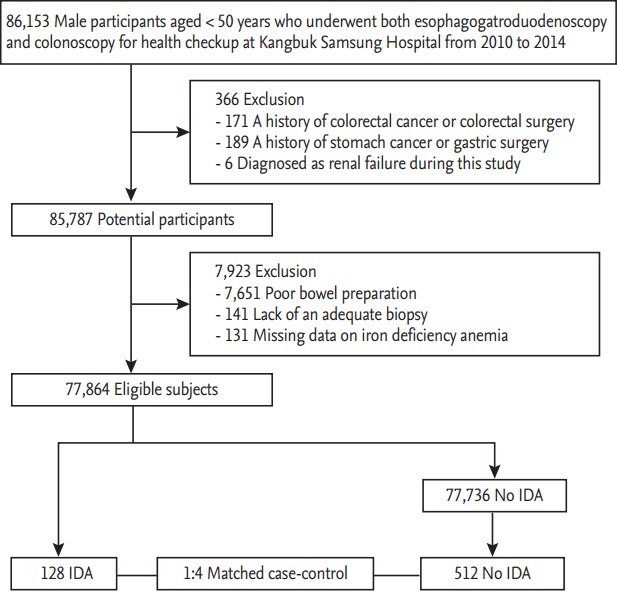
We conducted a case-control study on asymptomatic young men aged < 50 years who underwent both esophagogastroduodenoscopy (EGD) and colonoscopy as part of a health checkup between 2010 and 2014.
Of 77,864 participants, 128 (0.16%) had IDA and 512 subjects without IDA were matched for several variables including age. Young men with IDA had a significantly higher proportion of colorectal cancer (CRC) (0.8% vs. 0.0%, p = 0.045), villous adenoma (0.8% vs. 0.0%, p = 0.045), and inflammatory bowel disease (IBD; 2.3% vs. 0.4%, p = 0.025) than those without IDA. Additionally, the prevalence of advanced colorectal neoplasia (ACRN) tended to be higher in subjects with IDA than in those without IDA (3.1% vs. 1.0%, p = 0.084). The prevalence of significant lower GI lesions including ACRN and IBD was higher in subjects with IDA than in those without IDA (5.5% vs. 1.4%, p = 0.011). Regarding upper GI lesions, a positive association with IDA was observed only for gastric ulcer (4.7% vs. 1.0%, p = 0.011).
GI lesions including CRC, villous adenoma, IBD, and gastric ulcer were more common in asymptomatic young men with IDA. Our results suggest that EGD and particularly colonoscopy should be recommended even in asymptomatic young men with IDA.
背景/目的:对于无症状的缺铁性贫血(IDA)年轻男性,目前尚无内镜检查必要性的证据。为了确定是否应建议对无症状的IDA 年轻男性进行内镜检查,我们比较了 IDA 年轻男性和非 IDA 年轻男性的胃肠道(GI)病变患病率。
我们对 2010 年至 2014 年期间进行健康检查时接受食管胃十二指肠镜(EGD)和结肠镜检查的无症状年轻男性(<50 岁)进行了病例对照研究。
在 77864 名参与者中,128 名(0.16%)患有 IDA,512 名年龄相匹配的无 IDA 受试者作为对照。与非 IDA 受试者相比,IDA 年轻男性结直肠癌(CRC)(0.8% vs. 0.0%,p=0.045)、绒毛状腺瘤(0.8% vs. 0.0%,p=0.045)和炎症性肠病(IBD;2.3% vs. 0.4%,p=0.025)的比例显著更高。此外,IDA 受试者中高级结直肠肿瘤(ACRN)的患病率也高于非 IDA 受试者(3.1% vs. 1.0%,p=0.084)。IDA 受试者中包括 ACRN 和 IBD 在内的显著较低的 GI 病变的患病率也高于非 IDA 受试者(5.5% vs. 1.4%,p=0.011)。关于上 GI 病变,仅观察到与 IDA 呈正相关的胃溃病(4.7% vs. 1.0%,p=0.011)。
CRC、绒毛状腺瘤、IBD 和胃溃疡等 GI 病变在无症状的 IDA 年轻男性中更为常见。我们的结果表明,即使在无症状的 IDA 年轻男性中,也应建议进行 EGD,特别是结肠镜检查。