Gustafsson Asa B
Skaggs School of Pharmacy and Pharmaceutical Sciences, University of California, San Diego, 9500 Gilman Drive MC 0758, La Jolla, CA 92093-0758, USA.
Pediatr Cardiol. 2011 Mar;32(3):267-74. doi: 10.1007/s00246-010-9876-5. Epub 2011 Jan 6.
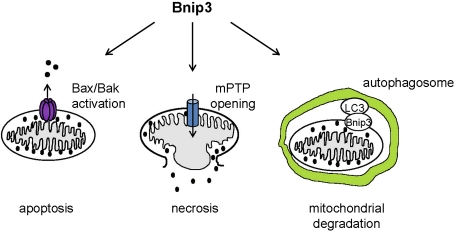
The Bcl-2 adenovirus E1B 19 kDa-interacting protein 3 (Bnip3) is a pro-apoptotic BH3-only protein associated with the pathogenesis of many diseases, including cancer and cardiovascular disease. Studies over the past decade have provided insight into how Bnip3 induces mitochondrial dysfunction and subsequent cell death in cells. More recently, Bnip3 was identified as a potent inducer of autophagy in cells. However, the functional role of Bnip3-mediated autophagy has been difficult to define and remains controversial. New evidence has emerged suggesting that Bnip3 is an important regulator of mitochondrial turnover via autophagy in the myocardium. Also, studies suggest that the induction of Bnip3-dependent mitochondrial autophagy is a separately activated process independent of Bax/Bak and the mitochondrial permeability transition pore (mPTP). This review discusses the current understanding of the functional role that Bnip3 plays in the myocardium. Recent studies suggest that Bnip3 might have a dual function in the myocardium, where it regulates both mitochondrial turnover via autophagy and cell death and that these are two separate processes activated by Bnip3.
Bcl-2腺病毒E1B 19 kDa相互作用蛋白3(Bnip3)是一种仅含BH3结构域的促凋亡蛋白,与包括癌症和心血管疾病在内的多种疾病的发病机制相关。过去十年的研究深入探讨了Bnip3如何诱导细胞内线粒体功能障碍及随后的细胞死亡。最近,Bnip3被确定为细胞中自噬的强效诱导剂。然而,Bnip3介导的自噬的功能作用一直难以界定,仍存在争议。新证据表明,Bnip3是心肌中通过自噬进行线粒体周转的重要调节因子。此外,研究表明,Bnip3依赖性线粒体自噬的诱导是一个独立于Bax/Bak和线粒体通透性转换孔(mPTP)的单独激活过程。本文综述了目前对Bnip3在心肌中功能作用的理解。最近的研究表明,Bnip3在心肌中可能具有双重功能,即通过自噬调节线粒体周转以及细胞死亡,且这是由Bnip3激活的两个独立过程。