Department of Medical Oncology, Waikato District Health Board, Hamilton, New Zealand.
Cancer Cell Int. 2011 Jan 7;11(1):1. doi: 10.1186/1475-2867-11-1.
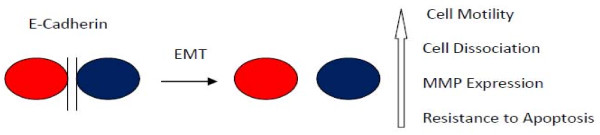
Physiologic wound repair and tissue regeneration are associated with distinct cellular behaviors triggered by tissue damage. Normally quiescent stem cells proliferate to regenerate damaged tissue, while relatively immobile epithelial cells can transform into a motile, tissue invasive phenotype through a partial epithelial-mesenchymal transition. These distinct cellular behaviors may have particular relevance to how cancer cells can be predicted to behave after treatments damaging a tumor.
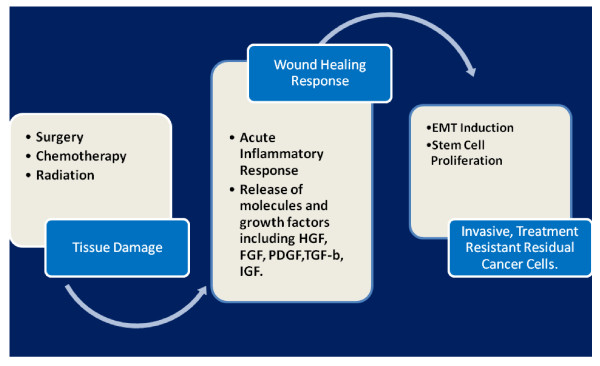
Surgery, chemotherapy, and radiation therapy trigger highly conserved wound healing pathways that: (1) facilitate the phenotypic transformation of surviving cancer cells into a highly mobile, metastatic phenotype through an EMT or epithelial-mesenchymal transition and (2) induce residual cancer stem cell proliferation.
Tissue damage caused by cancer treatments will trigger the release of distinct cytokines with established roles in physiologic wound healing, EMT induction, and stem cell activation. They will be released rapidly after treatment and detectable in the patient's blood. Careful histologic evaluation of cancerous tissue before and after treatment will reveal cellular changes suggestive of EMT induction (down regulation of cytokeratin expression) and cancer stem cell enrichment (stem cell markers upregulated).
Cancer cells surviving treatment will be more capable of metastasis and resistant to conventional therapies than the pre-treatment population of cancer cells. These changes will develop rapidly after treatment and, in distinct contrast to selection pressures fostering such changes, be triggered by highly conserved wound repair signals released after tissue damage. This pattern of tissue (tumor) repair may be amenable to treatment intervention at the time it is upregulated.
生理伤口修复和组织再生与组织损伤引发的独特细胞行为有关。通常处于静止状态的干细胞会增殖以再生受损组织,而相对不动的上皮细胞可以通过部分上皮-间充质转化转变为运动的、组织侵袭性表型。这些不同的细胞行为可能与预测癌症细胞在损伤肿瘤的治疗后如何行为特别相关。
手术、化疗和放射治疗触发高度保守的伤口愈合途径,这些途径:(1)通过 EMT 或上皮-间充质转化促进存活的癌细胞向高度移动、转移性表型的表型转化,以及(2)诱导残留的癌症干细胞增殖。
癌症治疗引起的组织损伤将引发具有生理伤口愈合、EMT 诱导和干细胞激活的明确作用的独特细胞因子的释放。它们将在治疗后迅速释放,并可在患者的血液中检测到。仔细的治疗前后癌组织的组织学评估将揭示提示 EMT 诱导(细胞角蛋白表达下调)和癌症干细胞富集(干细胞标志物上调)的细胞变化。
治疗后存活的癌细胞比治疗前的癌细胞更有能力转移和抵抗常规治疗。这些变化将在治疗后迅速发展,与促进这种变化的选择压力形成鲜明对比的是,它们是由组织损伤后释放的高度保守的伤口修复信号触发的。这种组织(肿瘤)修复模式可能适合在其上调时进行治疗干预。