Department of Surgery and Cancer, Biophysics Section, Imperial College London, London, UK.
Exp Physiol. 2011 Apr;96(4):451-9. doi: 10.1113/expphysiol.2010.055848. Epub 2011 Jan 14.
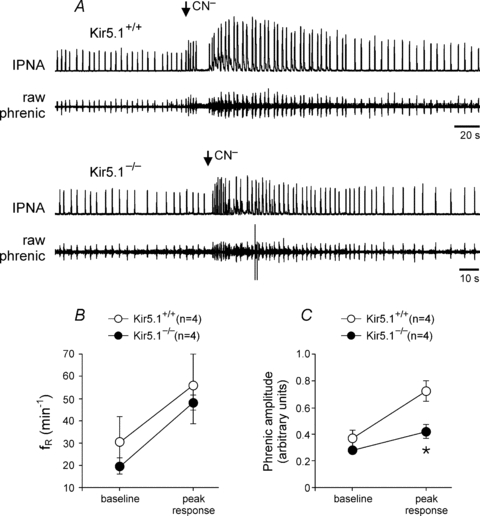
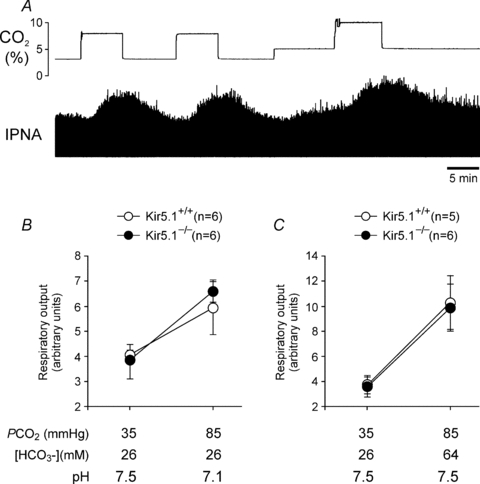
Inward rectifier (Kir) potassium channels contribute to the control of electrical activity in excitable tissues and their activity is modulated by many biochemical factors, including protons. Heteromeric Kir4.1-Kir5.1 channels are highly pH sensitive within the physiological range of pH changes and are strongly expressed by the peripheral chemosensors as well as in the brainstem pH-sensitive areas which mediate respiratory responses to changes in blood and brain levels of P(CO(2))/[H(+)]. In the present study, Kir5.1 knockout mice (Kir5.1(-/-)) were used to determine the role of these channels in the chemosensory control of breathing. We found that Kir5.1(-/-) mice presented with persistent metabolic acidosis and a clear respiratory phenotype. Despite metabolic acidosis, ventilation at rest and in hyperoxic hypercapnia were similar in wild-type and Kir5.1(-/-) mice. Ventilatory responses to hypoxia and normoxic hypercapnia were significantly reduced in Kir5.1(-/-) mice; however, carotid body chemoafferent responses to hypoxia and CO(2) were not affected. In the in situ brainstem-spinal cord preparations with denervated peripheral chemoreceptors, resting phrenic nerve activity and phrenic nerve responses to respiratory acidosis or isohydric hypercapnia were also similar in Kir5.1(-/-) and wild-type mice. In in situ preparations of Kir5.1(-/-) mice with intact peripheral chemoreceptors, application of CN(-) resulted in a significantly reduced phrenic nerve response, suggesting that the relay of peripheral chemosensory information to the CNS is compromised. We suggest that this compensatory modulation of the peripheral chemosensory inputs develops in Kir5.1(-/-) mice in order to counteract the effect of continuing metabolic acidosis on the activity of the peripheral chemoreceptors. These results therefore suggest that despite their intrinsic pH sensitivity, Kir4.1-Kir5.1 channels are dispensable for functional central and peripheral respiratory chemosensitivity.
内向整流 (Kir) 钾通道有助于控制兴奋组织的电活动,其活性可被许多生化因素调节,包括质子。异源四聚体 Kir4.1-Kir5.1 通道在生理 pH 变化范围内对 pH 非常敏感,并且在外周化学感受器以及脑干 pH 敏感区域中强烈表达,这些区域介导呼吸对血液和脑 P(CO(2))/[H(+)])水平变化的反应。在本研究中,使用 Kir5.1 敲除小鼠 (Kir5.1(-/-)) 来确定这些通道在化学感受器控制呼吸中的作用。我们发现,Kir5.1(-/-) 小鼠表现出持续的代谢性酸中毒和明显的呼吸表型。尽管存在代谢性酸中毒,但野生型和 Kir5.1(-/-) 小鼠在休息和高氧高碳酸血症时的通气量相似。Kir5.1(-/-) 小鼠对缺氧和常氧高碳酸血症的通气反应明显降低;然而,颈动脉体化学感受器对缺氧和 CO(2)的反应不受影响。在去神经外周化学感受器的原位脑干-脊髓标本中,休息时膈神经活动和膈神经对呼吸性酸中毒或等氢离子性高碳酸血症的反应在 Kir5.1(-/-) 和野生型小鼠中也相似。在具有完整外周化学感受器的 Kir5.1(-/-) 小鼠的原位标本中,CN(-) 的应用导致膈神经反应明显降低,这表明外周化学感受器信息向中枢神经系统的传递受损。我们认为,这种对周围化学感受器传入的代偿性调节是在 Kir5.1(-/-) 小鼠中发展起来的,以抵消持续代谢性酸中毒对周围化学感受器活性的影响。因此,这些结果表明,尽管 Kir4.1-Kir5.1 通道具有内在的 pH 敏感性,但它们对于中枢和外周呼吸化学敏感性的功能是可有可无的。